 Indietro
Genetics Study Guide: Foundations, Mendelian Inheritance, Sex Linkage, Maternal Inheritance, Linkage & Recombination
Guida di studio - Note intelligenti
 Appunti personalizzati basati sui tuoi materiali, ampliati con definizioni chiave, esempi e contesto.
Chapter One: Introduction to Genetics
Genes and Chromosomes
Genes are fundamental units of heredity, composed of DNA and located on chromosomes. They carry information from one generation to the next and encode proteins that perform essential cellular functions.
Gene: Segment of DNA responsible for a specific trait.
Allele: Different forms of a gene at a single locus.
Chromosome: Linear arrangement of genes and other DNA.
DNA: Deoxyribonucleic acid, structured as a double helix with sugar-phosphate backbone and nitrogenous base pairs (adenine-thymine, guanine-cytosine).
DNA Polymerases: Enzymes that replicate DNA.
Single Nucleotide Polymorphisms (SNPs): Variations at a single nucleotide position in the genome.
Historical Discoveries:
Gregor Mendel: Established principles of inheritance.
William Bateson: Rediscovered Mendel's work.
Thomas H. Morgan: Demonstrated that genes are located on chromosomes.
Model Organisms: Small, easy-to-maintain species with short generation times and large offspring numbers are ideal for genetic studies.
Genetic Tools: Enable gene therapy to correct disorders caused by mutant genes.
Chapter Two: Mendelian Inheritance
Phenotype and Mutation
The phenotype is the observable manifestation of a genotype. Mutations, which arise from wild types, can be harmful, beneficial, or neutral.
Phenotype: Outward expression of a genotype.
Mutation: Change in DNA sequence; source of genetic variation.
Gene Discovery and Analysis
Gene discovery involves isolating mutants, crossing them with wild types, and analyzing inheritance patterns.
Amass mutants affecting the trait.
Cross mutants with wild types and observe phenotype ratios.
Deduce gene function at the molecular level.
Analyze gene interactions.
Forward Genetics: Starts with phenotype, identifies gene. Reverse Genetics: Starts with gene, studies phenotype.
Mendelian Ratios and Generations
First Filial Generation (F1): Offspring of parental cross.
Second Filial Generation (F2): Offspring of F1 cross.
Phenotypic Ratios: 3:1 (monohybrid), 9:3:3:1 (dihybrid), 27:9:9:9:3:3:3:1 (trihybrid).
Lecture Two: Mendelian Laws and Chromosomal Basis
Key Terms
Character: Physical feature (e.g., flower color).
Trait: Specific form of a character (e.g., purple or white).
Dominant: Trait expressed in heterozygotes.
Recessive: Trait masked in heterozygotes.
Homozygous: Two identical alleles.
Heterozygous: Two different alleles.
Mendel’s Particulate Theory and Laws
Mendel proposed that genes behave as discrete particles and do not blend. His two laws are:
Law of Segregation: Each gamete receives one allele from each parent.
Law of Independent Assortment: Alleles of different genes assort independently during gamete formation.
Chromosomal movement during meiosis explains these laws, as chromosomes are separated into gametes.
Pedigree Analysis
Autosomal Dominant: Appears in every generation.
Autosomal Recessive: May skip generations.
Lecture Three: Sex Linkage and Sex Determination
Sex Linkage and Sexual Dimorphism
Sex-linked traits are associated with sex chromosomes (X or Y), often appearing more frequently in one sex. Sexual dimorphism refers to differences between sexes due to selection or chromosomal factors.
X-linked Dominant: Trait appears in both sexes but more frequently in females.
X-linked Recessive: Trait appears more frequently in males.
Reciprocal and Test Crosses
Reciprocal Cross: Swap phenotypes between male and female parents.
Test Cross: Cross with homozygous recessive individual.
Modes of Sex Determination
Chromosomal: XY (mammals), ZW (birds), haploid/diploid (insects).
Environmental: Temperature or chemicals influence sex (e.g., alligators).
TDF (Testes Determining Factor): SRY gene on Y chromosome triggers male development.
Nondisjunction and Aneuploidy
Nondisjunction is the failure of chromosomes to separate properly during meiosis, resulting in aneuploidy (abnormal chromosome number).
Aneuploidy: More or fewer chromosomes than normal.
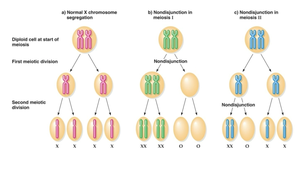
Sex Chromosome Systems
X&Y: Mammals, flies (Y determines male).
W&Z: Birds (W determines female).
Haploid/Diploid: Insects (queen controls fertilization).
Environmental: Fish and reptiles (temperature-dependent).
Lecture Five: Maternal Inheritance and Epigenetics
Maternal Inheritance
Genes inherited exclusively from the mother via mitochondria or chloroplasts.
Mitochondrial Genome: Circular DNA, encodes 13 proteins, 22 tRNAs, 2 rRNAs.
Mutations: Affect energy production and cellular function.
Sperm Centrioles
Sperm centrioles influence cell division post-fertilization.
Epigenetics
Epigenetics involves changes in gene expression not caused by DNA sequence alterations.
Histone Modification: Protein tails are modified, affecting gene expression.
DNA Methylation: Methyl groups added to DNA, usually silencing genes.
X-Inactivation: One X chromosome in females is silenced.
Mosaicism and Calico Patterns
Mosaicism occurs when cells in an organism express different genetic traits, as seen in calico cats where X-inactivation leads to patchy pigment patterns.
Lecture Six: Linkage and Recombination
Linkage
Linkage occurs when genes are located on the same chromosome and are inherited together.
Recombination: Exchange of genetic material between homologous chromosomes.
Test Cross: Used to determine if traits follow Mendelian patterns.
Chi-Squared Test
Used to determine if observed genetic ratios deviate from expected Mendelian ratios.
Formula:
Degrees of freedom: Number of categories minus one.
Genetic Distance
Genetic distance between linked genes is calculated by dividing the number of recombinant offspring by the total number of offspring.
Formula:
Gene Order and Distance
Order and distance between three linked genes can be determined by analyzing recombination frequencies between each pair.
Compare recombination rates to deduce gene order.
Calculate distances using recombinant counts.
Additional Info
Pedigree analysis and memorization of mitosis and meiosis are essential for understanding inheritance patterns.
