 Indietro
Linkage, Recombination, and Eukaryotic Gene Mapping
Guida di studio - Note intelligenti
 Appunti personalizzati basati sui tuoi materiali, ampliati con definizioni chiave, esempi e contesto.
Linkage, Recombination, and Eukaryotic Gene Mapping
Overview of Linkage and Gene Mapping
This chapter explores the principles of genetic linkage, recombination, and the construction of genetic maps in eukaryotes. It covers the distinction between linked and unlinked genes, the mechanisms and consequences of recombination, and the methods used to map gene positions on chromosomes.
Unlinked Genes vs. Linked Genes
Definitions and Key Concepts
Unlinked genes are located on different chromosomes or far apart on the same chromosome, assorting independently during meiosis.
Linked genes are located close together on the same chromosome and tend to be inherited together.
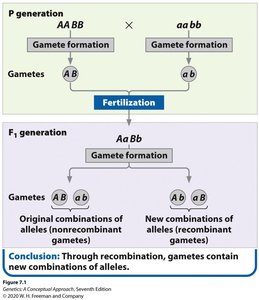
Recombinant gametes contain new combinations of alleles due to crossing over, while nonrecombinant (parental) gametes retain the original allele combinations.
Detecting Gene Linkage
Experimental Approaches
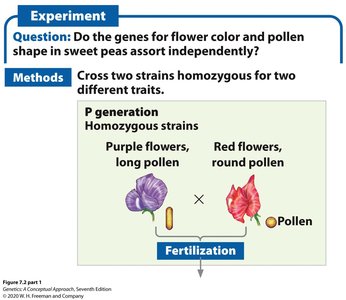
Testcrosses are used to determine if two genes are linked by analyzing the ratios of offspring phenotypes.
If genes assort independently, a 1:1:1:1 ratio of gametes is expected in a testcross.
Deviation from this ratio suggests linkage.
Mechanism of Recombination
Crossing Over During Meiosis
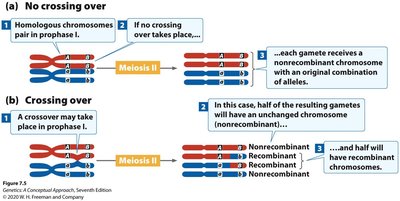
Crossing over occurs during prophase I of meiosis, resulting in the exchange of genetic material between homologous chromosomes.
Without crossing over, only parental combinations are produced; with crossing over, both parental and recombinant gametes are formed.
Recombination Frequency and Genetic Mapping
Calculating Recombination Frequency
Recombination frequency is calculated as:
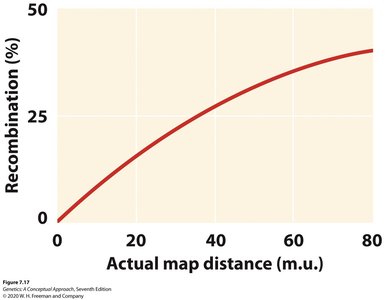
1% recombination = 1 map unit (centimorgan, cM).
The maximum observable recombination frequency is 50% (genes are unlinked at this value).
Coupling (Cis) vs. Repulsion (Trans) Configurations
Gene Arrangements in Heterozygotes
Coupling (cis) configuration: Both dominant or both recessive alleles are on the same chromosome (AB/ab).
Repulsion (trans) configuration: Each chromosome has one dominant and one recessive allele (Ab/aB).
The configuration does not affect the recombination frequency but does affect which combinations are considered parental or recombinant.
Chi-Square Test for Linkage
Statistical Analysis
The chi-square test is used to determine if the observed offspring ratios deviate significantly from the expected 1:1:1:1 ratio (independent assortment).
If the p-value is less than 0.05, the genes are likely linked.
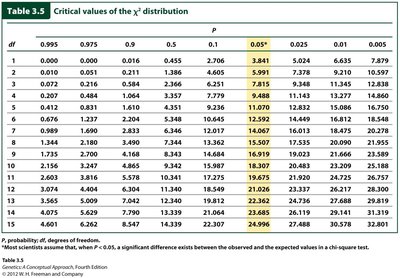
Two-Point and Three-Point Mapping
Constructing Genetic Maps
Two-point mapping: Determines the distance between two genes using recombination frequencies.
Three-point mapping: Involves three genes and allows determination of gene order and more accurate map distances by identifying single and double crossovers.
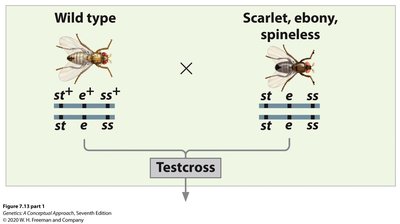
Double Crossovers and Gene Order
Identifying Gene Order
Double crossovers can be detected in three-point testcrosses and are essential for determining the correct order of genes on a chromosome.
Gene order is inferred by comparing the parental and double crossover classes.
Interference and Coefficient of Coincidence
Measuring Crossover Interactions
Coefficient of coincidence (cc):
Interference:
Interference measures the degree to which one crossover event inhibits another in the same region.
Gene Linkage in Humans
Using Pedigrees
Linkage analysis in humans often uses pedigrees to track inheritance of traits and identify linked genes.
Example: Nail-patella syndrome and ABO blood type linkage.
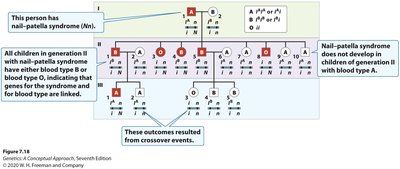
Deletion Mapping
Physical Mapping of Genes
Deletion mapping uses chromosomes with known deletions to localize genes based on the presence or absence of mutant phenotypes in progeny.
Polytene chromosomes in Drosophila are often used for this purpose.
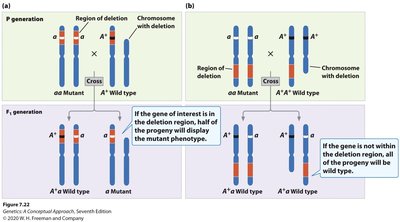
Summary Table: Testcross Results Under Different Linkage Scenarios
Situation | Progeny of Testcross | Expected Proportion |
|---|---|---|
Independent assortment | Aa Bb (nonrecombinant) aa bb (nonrecombinant) Aa bb (recombinant) aa Bb (recombinant) | 25% each |
Complete linkage (coupling) | Aa Bb (nonrecombinant) aa bb (nonrecombinant) | 50% each |
Linkage with some crossing over (coupling) | Aa Bb (nonrecombinant) aa bb (nonrecombinant) Aa bb (recombinant) aa Bb (recombinant) | More than 50% nonrecombinant Less than 50% recombinant |
Key Terms
Linkage group: A set of genes located on the same chromosome and inherited together.
Map unit (centimorgan, cM): A unit of measure for genetic linkage; 1 cM = 1% recombination frequency.
Double crossover: Two separate crossover events between homologous chromosomes in the same region.
Interference: The phenomenon where one crossover event reduces the probability of another nearby crossover.
Applications and Examples
Genetic mapping is fundamental for locating genes associated with diseases and traits.
Understanding linkage and recombination is essential for plant and animal breeding, as well as for human genetic studies.
