 Indietro
Mendelian Genetics: Principles and Applications
Guida di studio - Note intelligenti
 Appunti personalizzati basati sui tuoi materiali, ampliati con definizioni chiave, esempi e contesto.
Chapter 3: Mendelian Genetics
3.1 Mendel Used a Model Experimental Approach to Study Patterns of Inheritance
Mendel’s experiments with pea plants established the foundation of classical genetics. He selected peas as a model organism due to their ease of cultivation, controlled mating possibilities, rapid generation time, and clear, easily distinguishable traits.
Model Organism: Pisum sativum (pea plant) was chosen for its practical advantages in genetic studies.
Experimental Methods: Mendel focused on seven traits, each with two contrasting forms (e.g., tall vs. dwarf, yellow vs. green seeds). He used true-breeding strains and kept detailed quantitative records.
Transmission Genetics: Mendel’s work laid the groundwork for understanding how genes are transmitted from parents to offspring.
Additional info: Mendel’s approach was systematic and quantitative, which was unusual for biological research at the time.
3.2 The Monohybrid Cross Reveals How One Trait Is Transmitted from Generation to Generation
Monohybrid crosses involve parents differing in a single trait. Mendel’s experiments revealed predictable patterns of inheritance, leading to the formulation of key genetic principles.
Monohybrid Cross: Cross between two true-breeding individuals differing in one trait (e.g., tall vs. dwarf).
Generations:
P (Parental) Generation: Original true-breeding parents.
F1 (First Filial) Generation: Offspring of the P generation; all display the dominant trait.
F2 (Second Filial) Generation: Offspring of F1 self-cross; shows a 3:1 ratio of dominant to recessive phenotypes.
Reciprocal Crosses: Crosses performed in both directions (e.g., male tall × female dwarf and vice versa) yield the same results, indicating that inheritance is not sex-dependent for these traits.
Particulate Unit Factors: Mendel proposed that discrete "unit factors" (now called genes) control traits and are passed unchanged from generation to generation.
Mendel’s Three Postulates
Unit Factors in Pairs: Each individual carries two unit factors (alleles) for each trait.
Dominance/Recessiveness: In a pair, one allele may mask the expression of the other (dominant vs. recessive).
Segregation: The two alleles for a trait separate during gamete formation, so each gamete receives only one allele.
Modern Genetic Terminology
Gene: Unit of inheritance.
Allele: Alternative form of a gene.
Genotype: Genetic makeup (e.g., DD, Dd, dd).
Phenotype: Observable trait (e.g., tall, dwarf).
Homozygous: Both alleles are the same (DD or dd).
Heterozygous: Alleles are different (Dd).
Punnett Square
The Punnett square, devised by Reginald C. Punnett, is a tool to visualize all possible combinations of gametes and predict genotypic and phenotypic ratios in offspring.
3.3 Mendel’s Dihybrid Cross Generated a Unique F2 Ratio
Dihybrid crosses involve two pairs of contrasting traits. Mendel’s experiments demonstrated that alleles for different traits segregate independently, leading to new combinations in the offspring.
Dihybrid Cross: Cross between individuals differing in two traits (e.g., seed color and seed shape).
Independent Assortment: Genes for different traits assort independently during gamete formation if they are on different chromosomes (unlinked).
F2 Generation: Results in a phenotypic ratio of 9:3:3:1 (e.g., 9 yellow round : 3 yellow wrinkled : 3 green round : 1 green wrinkled).
Example: In a cross between plants heterozygous for seed color (Yy) and seed shape (Rr):
Possible gametes: YR, Yr, yR, yr (determined by the FOIL method: First, Outside, Inside, Last).
Each F2 zygote receives one of four combinations, producing the 9:3:3:1 ratio.
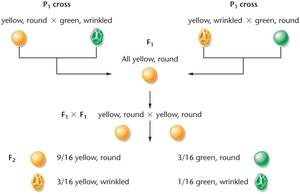
Mendel’s Fourth Postulate: Independent Assortment
Unit factors (genes) for different traits assort independently during gamete formation.
This principle applies to genes located on different chromosomes (unlinked genes).
3.5 Mendel’s Work Was Rediscovered in the Early Twentieth Century
Mendel’s findings were not widely recognized until the early 1900s, when other scientists independently confirmed his results. This led to the development of the chromosomal theory of inheritance.
Discontinuous Variation: Mendel’s results supported the idea that traits are inherited as discrete units, not blended (contrasting with Darwin’s theory of continuous variation).
Chromosomal Theory of Inheritance: Genes are located on chromosomes, and their segregation during meiosis explains Mendel’s principles.
Unit Factors, Genes, and Homologous Chromosomes
Diploid Number (2n): Each somatic cell contains two sets of chromosomes.
Meiosis: Reduces chromosome number by half, producing haploid (n) gametes.
Fertilization: Restores diploid number in the zygote.
Homologous Chromosomes: Pairs of chromosomes with the same size, centromere location, and gene order; one from each parent.
3.6 Independent Assortment Leads to Extensive Genetic Variation
Independent assortment during meiosis results in a vast number of possible genetic combinations in gametes, contributing to genetic diversity.
Chromosome Combinations: The number of possible gametes is , where n is the haploid number.
Example (Humans): possible gamete combinations due to independent assortment alone.
Additional info: This calculation does not include additional variation from crossing over.
3.9 Pedigrees Reveal Patterns of Inheritance of Human Traits
Pedigree analysis is a tool used to study inheritance patterns in humans, where controlled crosses are not possible.
Pedigree: A family tree diagram showing the inheritance of a trait over several generations.
Proband: The individual whose phenotype first brings attention to the family; indicated by an arrow in the pedigree.
Purpose: To determine whether a trait is dominant, recessive, autosomal, or sex-linked.
Representative Recessive and Dominant Human Traits
Trait | Dominant Form | Recessive Form |
|---|---|---|
Widow's peak | Present | Absent |
Free earlobe | Free | Attached |
Albinism | Normal pigmentation | Albinism |
Hitchhiker's thumb | Straight | Hitchhiker's |
Additional info: | Table entries inferred from standard genetics examples. |
