Indietro
Mendelian Genetics: Principles, Experiments, and Applications
Guida di studio - Note intelligenti
 Appunti personalizzati basati sui tuoi materiali, ampliati con definizioni chiave, esempi e contesto.
Mendelian Genetics
The Origin of Genetics
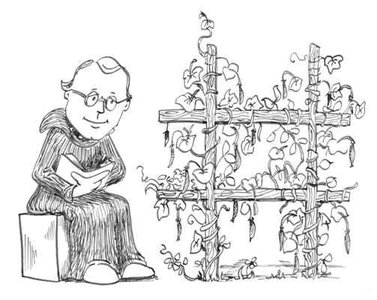
Mendelian genetics is founded on the pioneering work of Gregor Mendel, who systematically studied the inheritance of traits in pea plants. His experiments established the basic principles of heredity, which remain central to modern genetics.
Theories of Inheritance Before Mendel
Prior to Mendel, several theories attempted to explain how traits were passed from parents to offspring:
Pangenesis: Proposed by Hippocrates, this theory suggested that "seeds" from all parts of the body were collected and transmitted to offspring at conception.
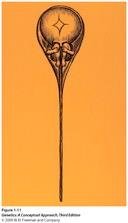
Preformationism: Suggested that a miniature human (homunculus) existed in either the sperm (spermists) or the egg (ovists).
Blending Theory: Stated that hereditary factors were malleable and could blend together generation after generation.
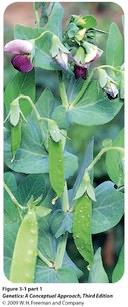
Mendel's Choice of Experimental Organism: The Pea Plant
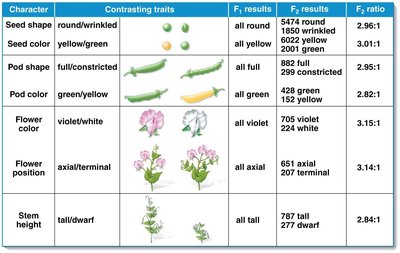
Mendel selected the pea plant (Pisum sativum) for his experiments due to its distinct, easily observable traits and its ability to self- and cross-fertilize. He identified over 20 traits and focused on 7 for detailed study:
Seed shape: round vs. wrinkled
Seed color: yellow vs. green
Flower color: red vs. white
Pod shape: inflated vs. pinched
Pod color: yellow vs. green
Flower position: axial vs. terminal
Stem length: long vs. short
Modern Model Genetic Organisms
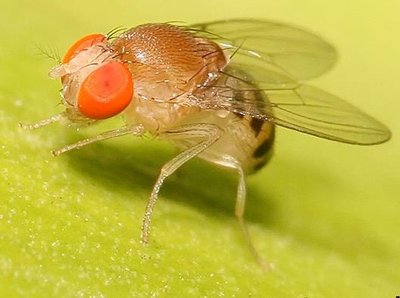
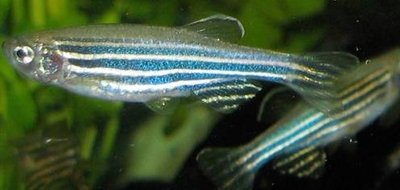
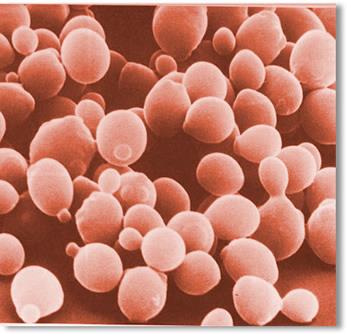
Geneticists now use a variety of model organisms to study inheritance, chosen for their evolutionary position, genome size, ease of genetic manipulation, and ability to monitor development. Examples include:
Bacteria: E. coli
Yeast: Saccharomyces cerevisiae
Worm: C. elegans
Fly: Drosophila melanogaster
Zebra fish: Danio rerio
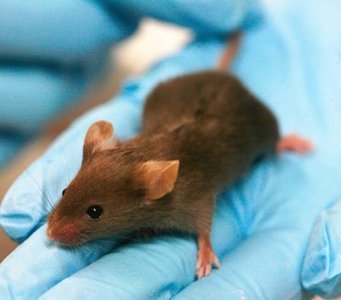
Mouse: Mus musculus
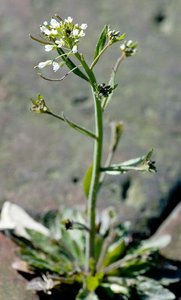
Thale cress: Arabidopsis
Experimental Design: True-Breeding and Hybrid Crosses
Mendel began with true-breeding lines, where self-fertilization produced offspring identical to the parent. He then crossed plants with different traits to create hybrids, using monohybrid (one trait) and dihybrid (two traits) crosses.
Monohybrid Crosses
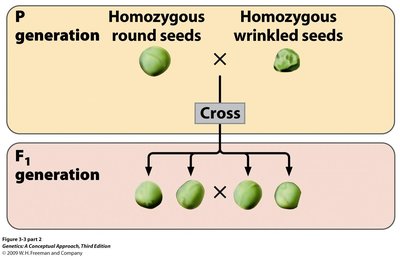
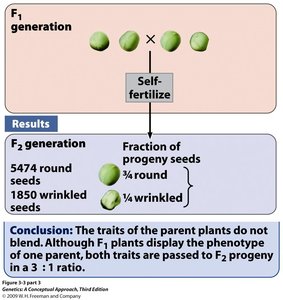
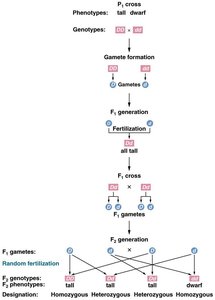
Monohybrid crosses involve a single pair of contrasting traits. The parental (P) generation produces the first filial (F1) generation, which is then self-fertilized to produce the second filial (F2) generation.
Results of Monohybrid Crosses
F1 generation: All plants display one of the two contrasting traits.
F2 generation: Traits reappear in a 3:1 ratio (dominant:recessive).
Reciprocal Crosses
Reciprocal crosses demonstrate that inheritance patterns are not sex-dependent; the results are consistent regardless of which parent provides which trait.
Mendel's Principles and Terminology
Mendel proposed that traits are determined by discrete unit factors (now called genes), which are inherited unchanged from generation to generation. Each individual has two factors for each trait, which may be identical (homozygous) or different (heterozygous).
Dominant allele: Expressed in the phenotype when present.
Recessive allele: Masked in the presence of a dominant allele.
Genotype: The genetic composition of an individual.
Phenotype: The observable traits of an individual.
Punnett Squares
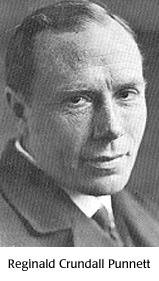
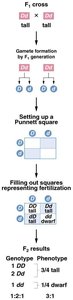
Punnett squares, devised by Reginald C. Punnett, are used to visualize the possible genotypes and phenotypes resulting from genetic crosses.
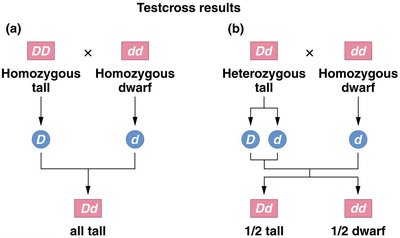
Testcrosses
A testcross is used to determine whether an individual displaying a dominant phenotype is homozygous or heterozygous. This is done by crossing the individual with a homozygous recessive partner.
Dihybrid Crosses and Independent Assortment
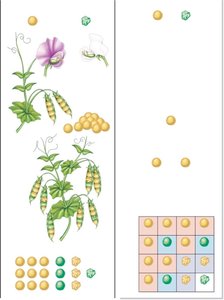
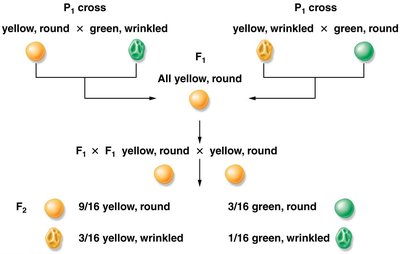
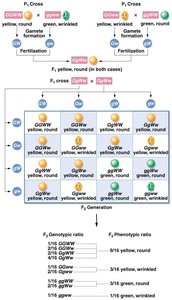
Dihybrid crosses involve two pairs of contrasting traits and demonstrate Mendel's Law of Independent Assortment, which states that genes for different traits segregate independently during gamete formation.
Results of Dihybrid Crosses
F2 generation shows a 9:3:3:1 phenotypic ratio.
Each trait behaves independently, and all possible combinations occur with equal frequency.
Product Law
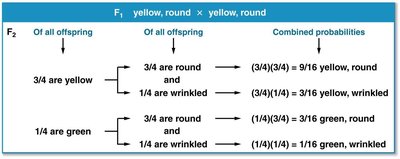
The probability of two independent events occurring simultaneously is the product of their individual probabilities.
Example: Probability of F2 plant having yellow and round seeds:
Probability and Statistics in Genetics
Geneticists use probability calculations to predict the outcomes of crosses. The sum rule and product rule are fundamental for these predictions.
Sum rule: The probability of one of several mutually exclusive events is the sum of their individual probabilities.
Product rule: The probability of two independent events occurring together is the product of their probabilities.
Pedigree Analysis
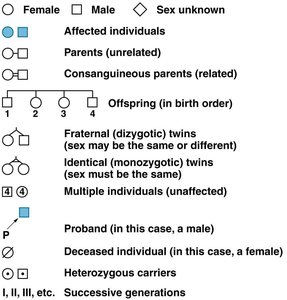
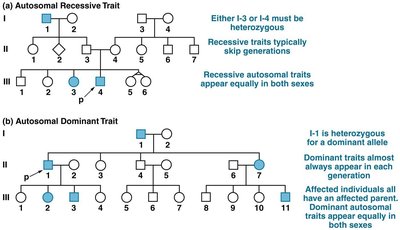
Pedigree analysis is used to infer inheritance patterns in humans, where controlled crosses are not possible. Standard conventions are used to represent family relationships and traits.
Patterns of Inheritance
Recessive pattern: Can skip generations; two affected individuals produce only affected offspring.
Dominant pattern: Does not skip generations; affected individuals have at least one affected parent.
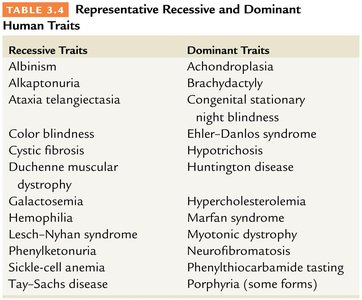
Representative Human Traits
Recessive Traits | Dominant Traits |
|---|---|
Albinism, Color blindness, Cystic fibrosis, Sickle-cell anemia, Tay-Sachs disease, Hemophilia, Galactosemia, Phenylketonuria, Duchenne muscular dystrophy, Lesch-Nyhan syndrome, Ataxia telangiectasia, Alkaptonuria | Achondroplasia, Huntington disease, Marfan syndrome, Neurofibromatosis, Ehlers-Danlos syndrome, Brachydactyly, Hypercholesterolemia, Myotonic dystrophy, Hypotrichosis, Phenylthiocarbamide tasting, Porphyria (some forms), Congenital stationary night blindness |