 Indietro
Mendelian Genetics: Principles, Probability, and Pedigree Analysis
Guida di studio - Note intelligenti
 Appunti personalizzati basati sui tuoi materiali, ampliati con definizioni chiave, esempi e contesto.
Mendelian Genetics: Foundations and Principles
Introduction to Mendelian Genetics
Mendelian genetics is the study of how traits are inherited from one generation to the next, based on the pioneering work of Gregor Mendel. Mendel's experiments with pea plants established the fundamental laws of inheritance, which form the basis of classical genetics.
Transmission genetics focuses on how genes are passed from parents to offspring.
Mendel's work was rediscovered in the 20th century and remains foundational to genetics.
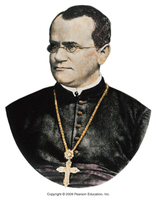
Mendel’s Model Organism: Pea Plants
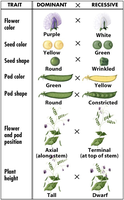
Mendel selected pea plants for his experiments due to their suitability for controlled breeding and clear, observable traits. He studied seven distinct, true-breeding traits, each with two contrasting forms.
Easy to grow and true-breeding strains
Controlled mating: self-fertilization or cross-fertilization
Observable characteristics with two distinct forms
Recorded all experimental data meticulously
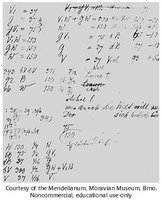
Mendel’s Original Notes
Mendel’s original experimental records demonstrate his systematic approach to studying inheritance. He performed over 2800 crosses between pea plants, carefully documenting the outcomes.
Monohybrid Crosses and Mendel’s Laws
Monohybrid Crosses: Experimental Design
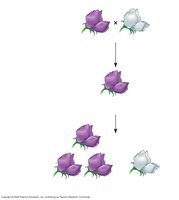
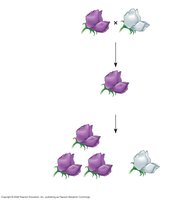
Monohybrid crosses involve a single pair of contrasting traits. Mendel observed the inheritance patterns across three generations: P (parental), F1 (first filial), and F2 (second filial).
True-breeding: Offspring always display the same phenotype as parents.
F1 generation: All offspring display the dominant trait.
F2 generation: Both dominant and recessive traits reappear in a 3:1 ratio.
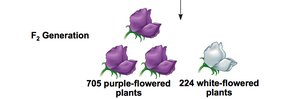
Consistent Patterns Across Traits
Mendel observed the same inheritance pattern for all seven traits, confirming the universality of his findings.
Dominant and recessive traits segregate in predictable ratios.
The "heritable factor" is now known as a gene.
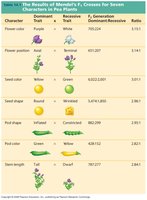
Mendel’s Three Postulates
Mendel formulated three key postulates to explain his results:
Unit factors exist in pairs: Each trait is controlled by two factors (alleles).
Dominance/Recessiveness: One allele may mask the effect of the other.
Segregation: Alleles separate independently during gamete formation.
Law of Dominance
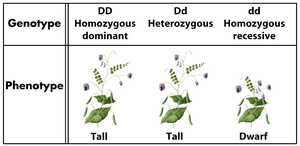
The dominant allele determines the phenotype in heterozygotes, while the recessive allele is masked. This is often due to loss-of-function mutations in the recessive allele.
Functional allele produces the trait (e.g., pigment).
Non-functional allele does not produce the trait.
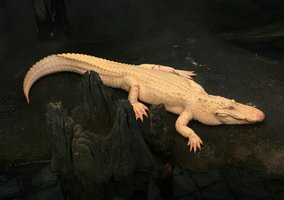
Example: Albinism as an Autosomal Recessive Trait
Albinism is caused by mutations in genes regulating pigment synthesis. It is inherited in an autosomal recessive manner.
Individuals with two recessive alleles lack pigment.
Carriers (heterozygotes) have normal pigmentation.

Punnett Squares and Genotype/Phenotype Ratios
Punnett squares are used to predict the outcome of genetic crosses. In a monohybrid cross, the F2 generation shows a 3:1 phenotype ratio and a 1:2:1 genotype ratio.
Genotypes: Homozygous dominant, heterozygous, homozygous recessive
Phenotypes: Dominant and recessive traits

Test Crosses
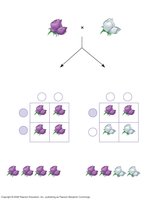
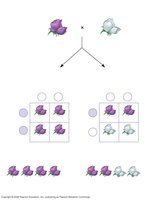
A test cross is used to determine whether an individual with a dominant phenotype is homozygous or heterozygous by crossing it with a homozygous recessive individual.
If all offspring display the dominant trait, the parent is homozygous.
If offspring display both traits, the parent is heterozygous.
Dihybrid and Trihybrid Crosses: Independent Assortment
Mendel’s Fourth Postulate: Independent Assortment
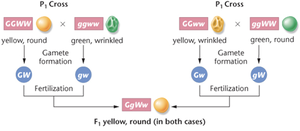
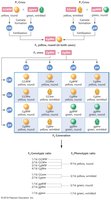
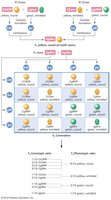
Traits controlled by different genes assort independently during gamete formation, leading to new combinations in offspring.
Law applies to genes on different, nonhomologous chromosomes.
Dihybrid crosses yield a 9:3:3:1 phenotypic ratio in the F2 generation.
Trihybrid Crosses and Branched Diagrams
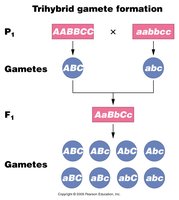
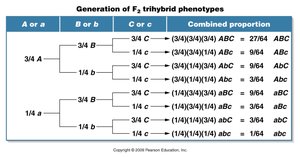
Trihybrid crosses involve three independent traits and demonstrate that Mendel’s principles apply to multiple traits. Branched diagrams efficiently calculate phenotype ratios.
Punnett squares become impractical for more than two traits.
Branched diagrams simplify probability calculations.
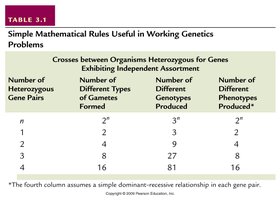
Probability and Statistics in Genetics
Laws of Probability
Genetic ratios are best expressed as probabilities. The product law (multiplication rule) and sum law (addition rule) are used to calculate the likelihood of genetic events.
Product law: Probability of simultaneous events (AND) is the product of their individual probabilities.
Sum law: Probability of mutually exclusive events (OR) is the sum of their individual probabilities.
Binomial Theorem
The binomial theorem is used to determine the probability of a specific combination of outcomes in a series of independent events.
General formula:
Where n = total events, s = number of times outcome a occurs, t = number of times outcome b occurs, a = probability of outcome a, b = probability of outcome b.
Chi-Square Analysis
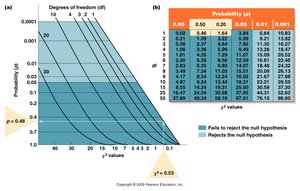
Chi-square analysis tests whether observed genetic data fit expected ratios, evaluating the influence of chance deviation.
Null hypothesis: Data fit a predicted ratio (e.g., 3:1).
Chi-square formula:
Degrees of freedom:
Interpretation: p > 0.05 means deviation is due to chance; p < 0.05 means deviation is significant.
P-value ≤ 0.05 (Low p-value): Reject the null hypothesis
Meaning: Your results are statistically significant. The differences between your observed data and expected data are too large to be explained by random chance alone.
P-value > 0.05 (High p-value): Fail to reject the null hypothesis
Meaning: You do not have enough evidence to claim a significant difference or association. Any variation matches what you might expect from random chance.
Pedigree Analysis: Patterns of Inheritance in Humans
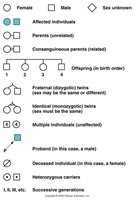
Pedigrees and Symbols
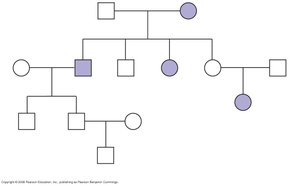
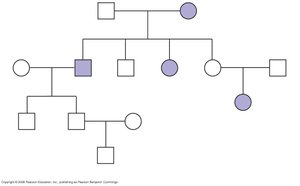
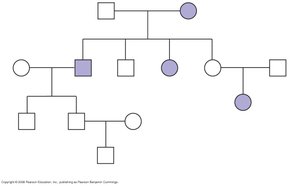
Pedigrees are diagrams that show the inheritance of traits in families. Standard symbols are used to represent individuals and relationships.
Pedigree analysis reveals whether traits are dominant, recessive, autosomal, or sex-linked.
Autosomal Recessive and Dominant Traits
Pedigrees can distinguish between autosomal recessive and dominant inheritance patterns.
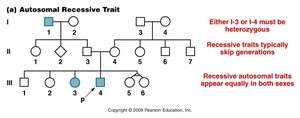
Recessive traits often skip generations and appear equally in both sexes.
Dominant traits appear in every generation and affected individuals have an affected parent.
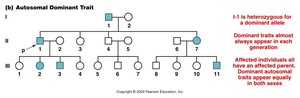
Pedigree Example and Genotype Inference
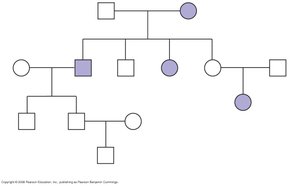
Pedigree analysis allows inference of genotypes for individuals based on observed phenotypes and inheritance patterns.
Normal individuals may be carriers (heterozygotes) for recessive traits.
Some genotypes can be determined with certainty, others remain ambiguous.
Summary
Mendel’s model experimental approach revealed fundamental patterns of inheritance.
Monohybrid, dihybrid, and trihybrid crosses demonstrate the transmission of traits.
Probability and statistical methods are essential for analyzing genetic data.
Pedigree analysis is a powerful tool for studying inheritance in humans.
Additional info: These notes cover the core concepts of Mendelian genetics, probability, and pedigree analysis, suitable for exam preparation in a college genetics course.
