 Indietro
RNA Molecules: Structure, Types, and Functions
Guida di studio - Note intelligenti
 Appunti personalizzati basati sui tuoi materiali, ampliati con definizioni chiave, esempi e contesto.
RNA Molecules
Overview of RNA and Learning Outcomes
RNA (ribonucleic acid) is a versatile molecule essential for gene expression and regulation. This section covers the differences between DNA and RNA, the various types of RNA, and their roles in cellular processes.
Explain the difference between DNA and RNA
Describe features of messenger RNA (mRNA), ribosomal RNA (rRNA), and transfer RNA (tRNA)
Describe the formation and function of microRNA (miRNA), small interfering RNA (siRNA), CRISPR RNA (crRNA), small nuclear RNA (snRNA), small nucleolar RNA (snoRNA), and long non-coding RNA (lncRNA)
DNA vs RNA
Structural and Functional Differences
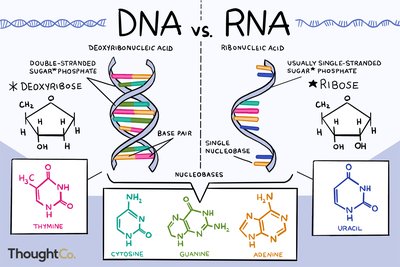
DNA and RNA are nucleic acids with distinct structures and functions in the cell.
DNA (Deoxyribonucleic Acid): Double-stranded, contains deoxyribose sugar, bases are adenine (A), thymine (T), cytosine (C), and guanine (G).
RNA (Ribonucleic Acid): Usually single-stranded, contains ribose sugar, bases are adenine (A), uracil (U), cytosine (C), and guanine (G).
Function: DNA stores genetic information; RNA is involved in gene expression and regulation.
Transcription
RNA Synthesis from DNA
Transcription is the process by which RNA is synthesized from a DNA template. The basic mechanism is similar in prokaryotes and eukaryotes, but eukaryotic transcription involves more proteins. Transcription is mediated by RNA polymerase and does not occur in heterochromatin. Reverse transcription, mediated by reverse transcriptase, occurs in some viruses.
Types of RNA
Major and Minor RNA Molecules
Multiple types of RNA are produced by transcription, each with specialized functions:
Messenger RNA (mRNA): Encodes information for protein synthesis.
Transfer RNA (tRNA): Brings amino acids to the ribosome during translation.
Ribosomal RNA (rRNA): Structural and catalytic component of ribosomes.
Small interfering RNA (siRNA): Involved in RNA interference and gene silencing.
Micro RNA (miRNA): Regulates gene expression post-transcriptionally.
CRISPR RNA (crRNA): Adaptive immune function in prokaryotes.
Small nuclear RNA (snRNA): Involved in pre-mRNA splicing in eukaryotes.
Small nucleolar RNA (snoRNA): Guides chemical modifications of rRNA and tRNA.
Long non-coding RNA (lncRNA): Regulates gene expression and chromatin structure.
Messenger RNA (mRNA)
Structure and Processing
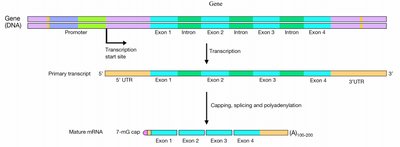
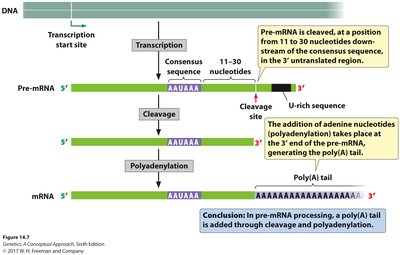
mRNA carries genetic information from DNA to the ribosome for protein synthesis. In eukaryotes, the initial transcript (pre-mRNA) undergoes several modifications to become mature mRNA.
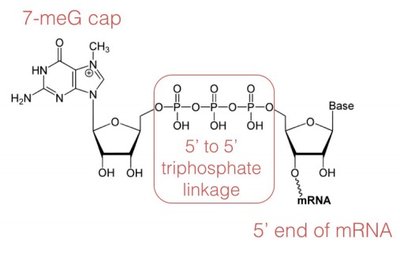
5' Cap: Addition of a 7-methylguanosine cap to the 5' end, which facilitates ribosome binding and protects mRNA from degradation.
3' Poly(A) Tail: Addition of a string of adenine nucleotides to the 3' end, increasing mRNA stability and aiding in export from the nucleus.
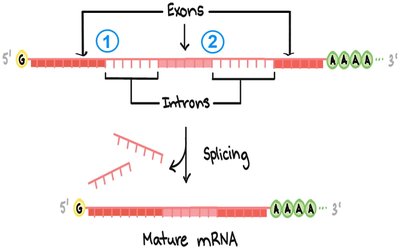
Splicing: Removal of non-coding introns and joining of coding exons.
Alternative Splicing
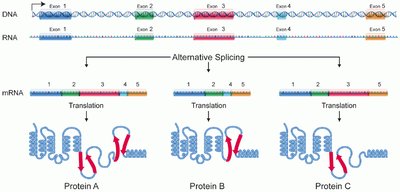
Alternative splicing allows a single pre-mRNA to be processed in different ways, producing multiple mRNA variants and thus different proteins from the same gene.
Significance: Increases protein diversity without increasing the number of genes.
Splicing Mechanism
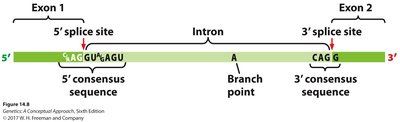
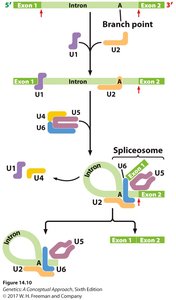
Splicing is mediated by the spliceosome, a complex of snRNAs and proteins (snRNPs). Key sequences involved include the 5' and 3' splice sites and the branch point.
snRNPs: Bind to splice sites and branch point, facilitating intron removal and exon ligation.
Lariat Structure: Formed during splicing as the intron is excised.
Types of Introns
Introns are classified based on their location and splicing mechanism:
Type of Intron | Location | Splicing Mechanism |
|---|---|---|
Group I | Genes of bacteria, bacteriophages, and eukaryotes | Self-splicing |
Group II | Genes of bacteria, archaea, and eukaryotic organelles | Self-splicing |
Nuclear pre-mRNA | Protein-encoding genes in the nucleus of eukaryotes | Spliceosomal |
tRNA | tRNA genes of bacteria, archaea, and eukaryotes | Enzymatic |
Additional info: Minor introns include group III introns, twintrons, and archaeal introns.
Summary of mRNA Processing in Eukaryotes
Modification | Function |
|---|---|
Addition of 5' cap | Facilitates ribosome binding, increases mRNA stability |
3' cleavage and poly(A) tail | Increases stability, facilitates ribosome binding |
RNA splicing | Removes introns, allows for alternative splicing |
RNA editing | Alters nucleotide sequence of mRNA |
Ribosomal RNA (rRNA)
Structure and Function
rRNA forms the core of ribosomes, which are the sites of protein synthesis. Ribosomes are composed of large and small subunits, each containing specific rRNA molecules and proteins.
Prokaryotic Ribosomes: 70S (50S large + 30S small subunit)
Eukaryotic Ribosomes: 80S (60S large + 40S small subunit)
Cell Type | Ribosome Size | Subunits | rRNA Components | Proteins |
|---|---|---|---|---|
Bacterial | 70S | 50S (large), 30S (small) | 23S, 5S, 16S | 31 (large), 21 (small) |
Eukaryote | 80S | 60S (large), 40S (small) | 28S, 5.8S, 5S, 18S | 49 (large), 33 (small) |
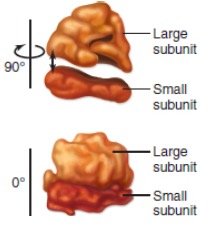
rRNA Processing
Multiple copies of rRNA genes are transcribed to form precursor rRNA, which is processed by snoRNPs (small nucleolar ribonucleoproteins) to yield functional rRNA molecules.
Transfer RNA (tRNA)
Structure and Function
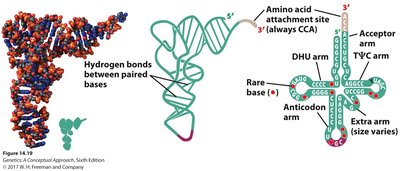
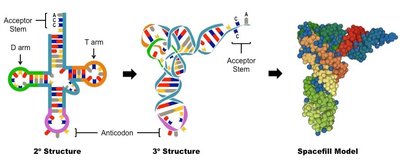
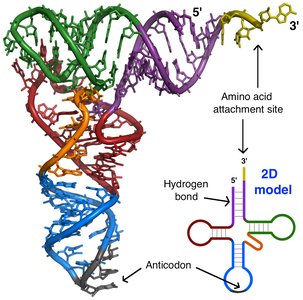
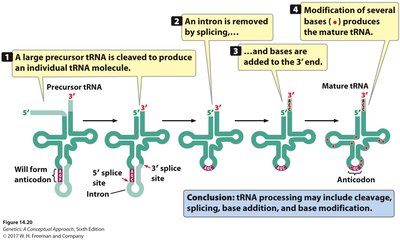
tRNA molecules transport amino acids to the ribosome and recognize codons in mRNA via their anticodon loop. tRNAs have a characteristic cloverleaf secondary structure and an L-shaped tertiary structure.
Key Features: Acceptor stem (3' CCA end), anticodon arm, D arm, TψC arm, and variable arm.
Base Modifications: tRNAs contain unusual bases formed by chemical modification.
tRNA Processing
tRNA is initially transcribed as a precursor and undergoes cleavage, splicing, base addition, and base modification to become mature tRNA.
Small RNA Molecules
Types and Functions
Small RNA molecules (20–30 nucleotides) include siRNA, miRNA, and crRNA. They play roles in gene silencing, translation inhibition, and defense against foreign nucleic acids.
siRNA: Derived from double-stranded RNA, cleaved by Dicer, incorporated into RISC to degrade mRNA.
miRNA: Encoded by the genome, processed from hairpin precursors, incorporated into RISC to inhibit translation or degrade mRNA.
crRNA: Derived from CRISPR arrays in prokaryotes, guides the cleavage of foreign DNA.
RNA Interference (RNAi)
RNAi is a process where small RNAs (siRNA and miRNA) guide the silencing of specific mRNAs, either by degradation or translational repression.
siRNA: Perfect base pairing with target mRNA leads to degradation.
miRNA: Imperfect base pairing leads to translational inhibition or degradation.
Differences between siRNA and miRNA
Feature | siRNA | miRNA |
|---|---|---|
Origin | mRNA, transposon, or virus | RNA transcribed from distinct gene |
Cleavage of | RNA duplex or long hairpins | Short hairpins |
Size | 21–25 nucleotides | 21–25 nucleotides |
Action | Degradation of mRNA, inhibition of transcription, chromatin modification | Degradation of mRNA, inhibition of translation, chromatin modification |
Target | Genes from which they were transcribed | Genes other than those from which they were transcribed |
CRISPR RNA (crRNA)
Origin and Function in Prokaryotes
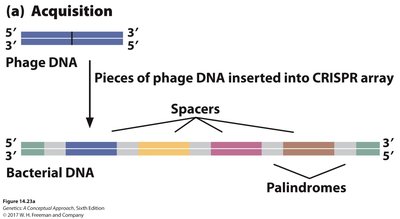
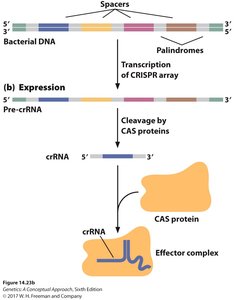
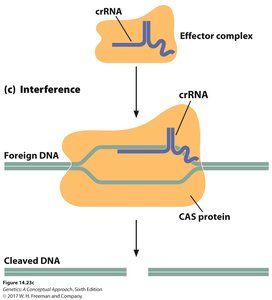
crRNA is produced from CRISPR arrays in prokaryotic genomes and provides adaptive immunity against foreign DNA, such as bacteriophage infection.
Acquisition: Foreign DNA is cleaved and inserted as spacers between palindromic repeats in the CRISPR array.
Expression: CRISPR array is transcribed to pre-crRNA, which is processed by CAS proteins to form mature crRNA.
Interference: crRNA guides the effector complex to recognize and cleave matching foreign DNA.
Small Nuclear RNA (snRNA) and Small Nucleolar RNA (snoRNA)
Functions in Eukaryotic Cells
snRNA: Essential for pre-mRNA splicing as part of the spliceosome.
snoRNA: Involved in the chemical modification and processing of rRNA and tRNA, as well as genome imprinting.
Long Non-coding RNA (lncRNA)
Definition and Roles
Long non-coding RNAs are transcripts longer than 200 nucleotides that do not encode proteins but regulate gene expression by interacting with proteins, modifying chromatin structure, or binding to mRNA.
Prevalence: Only ~1% of the eukaryotic genome encodes proteins, but ~80% is transcribed, producing many lncRNAs.
Functions: Regulation of gene expression, chromatin remodeling, and post-transcriptional control.
Summary
DNA and RNA differ in structure, sugar, and bases.
mRNA, rRNA, and tRNA are the main types of RNA, each with specialized roles in gene expression.
Small RNAs (siRNA, miRNA, crRNA) regulate gene expression and defend against foreign nucleic acids.
snRNA and snoRNA are involved in RNA processing and modification.
lncRNA regulates gene expression at multiple levels.
