 Indietro
Sex Determination and Sex Chromosomes: Mechanisms, Syndromes, and Dosage Compensation
Guida di studio - Note intelligenti
 Appunti personalizzati basati sui tuoi materiali, ampliati con definizioni chiave, esempi e contesto.
Sex Determination and Sex Chromosomes
Introduction to Sex Chromosomes and Sex Determination
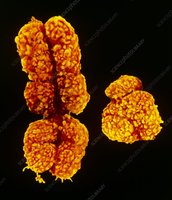
Sex chromosomes are a pair of chromosomes that differ between the sexes and are involved in determining the sex of an organism. In many species, these chromosomes are heteromorphic, meaning they are visibly different in size or shape. Sex determination is governed by specific genes, not by the entire chromosome, and can vary widely among organisms.
Heteromorphic chromosomes: Chromosomes that are dissimilar in morphology, such as the X and Y chromosomes in humans.
Sex chromosomes: Chromosomes that determine the sex of an individual (e.g., X and Y in mammals, Z and W in birds).
Sex determination: The process by which the genetic sex of an individual is established, often by the presence or absence of certain chromosomes or genes.
Modes of Sex Determination
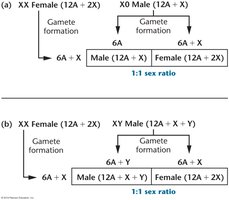
XX/XO Mode
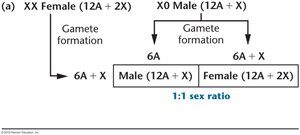
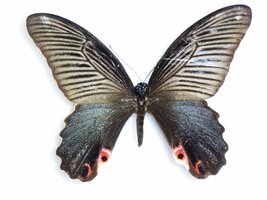
In the XX/XO system, sex is determined by the presence or absence of a second X chromosome. This system is found in some insects such as the butterfly Protenor.
Females have two X chromosomes (XX).
Males have only one X chromosome (XO).
Sex is determined by the random distribution of the X chromosome during gamete formation.
XX/XY Mode
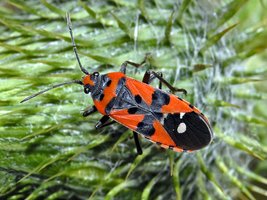
The XX/XY system is common in mammals and some insects, such as the milkweed bug (Lygaeus). Here, females are homogametic (XX) and males are heterogametic (XY).
Female gametes always carry an X chromosome.
Male gametes carry either an X or a Y chromosome.
Fertilization results in XX (female) or XY (male) offspring.
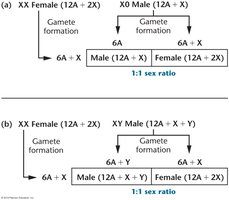
Homogametic and Heterogametic Sex
Homogametic sex produces gametes with like chromosomes (e.g., XX in females), while heterogametic sex produces gametes with unlike chromosomes (e.g., XY in males).
Homogametic sex: Produces gametes with identical sex chromosomes (e.g., XX).
Heterogametic sex: Produces gametes with different sex chromosomes (e.g., XY or ZW).
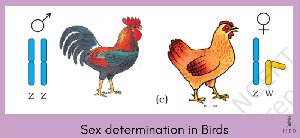
ZZ/ZW Mode
In the ZZ/ZW system, found in birds, some reptiles, and some fish, the female is the heterogametic sex (ZW), and the male is the homogametic sex (ZZ).
Females: ZW (heterogametic)
Males: ZZ (homogametic)
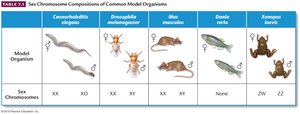
Sex Chromosome Compositions in Model Organisms
Different model organisms use different systems for sex determination, as summarized in the table below:
Model Organism | Sex Chromosomes |
|---|---|
Caenorhabditis elegans | XX/XO |
Drosophila melanogaster | XX/XY |
Mus musculus (mouse) | XX/XY |
Danio rerio (zebrafish) | None |
Xenopus laevis (frog) | ZW/ZZ |
Human Y Chromosome and Maleness
Role of the Y Chromosome
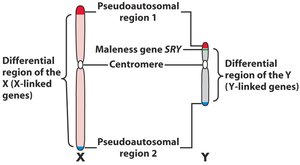
In humans, the presence of the Y chromosome determines maleness. The key gene responsible is SRY (sex-determining region Y), which triggers male development. The X and Y chromosomes only recombine in the pseudoautosomal regions (PARs), which are essential for proper segregation during meiosis.
SRY gene: Encodes the testis-determining factor (TDF), initiating male development.
MSY (Male-specific region of the Y): Nonrecombining region containing genes specific to male development.
PARs: Regions where X and Y chromosomes pair and recombine during meiosis.
Sex Chromosome Nondisjunction Syndromes
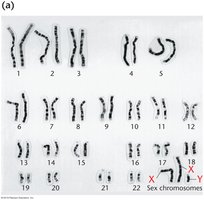
Klinefelter Syndrome (47, XXY)
Klinefelter syndrome results from nondisjunction, leading to an extra X chromosome in males (47, XXY). Individuals are phenotypically male but may have reduced fertility, tall stature, and some feminized traits.
Symptoms: Small testes, low testosterone, reduced muscle mass, enlarged breast tissue, tall stature.
Most individuals show mild symptoms.
Turner Syndrome (45, X)
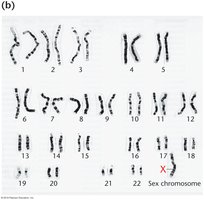
Turner syndrome occurs when a female has only one X chromosome (45, X). Individuals are phenotypically female but may have short stature, underdeveloped ovaries, and other health issues.
Symptoms: Short stature, heart defects, underdeveloped breasts, cognitive impairment.
Symptoms can be subtle and variable.
Other Sex Chromosome Aneuploidies
47, XXX (Triplo-X): Female, may be phenotypically normal or have mild developmental issues.
47, XYY: Male, often tall, may have subnormal intelligence or personality disorders.
Mosaicism
Mosaicism refers to the presence of two or more populations of cells with different genotypes in one individual, often due to nondisjunction during early development. Mosaic Turner syndrome is a common example, where some cells are 45,X and others may have different sex chromosome complements.
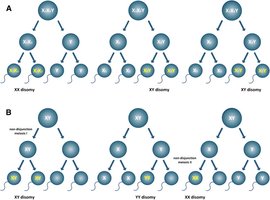
Mechanism of Nondisjunction
Nondisjunction is the failure of chromosomes to separate properly during meiosis, leading to gametes with abnormal numbers of sex chromosomes. This can result in syndromes such as Klinefelter or Turner syndrome.
Dosage Compensation and X-Inactivation
Genetic Dosage Difference
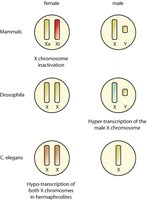
Because females have two X chromosomes and males have one, there is a potential imbalance in the expression of X-linked genes. Dosage compensation mechanisms equalize gene expression between the sexes.
In mammals, dosage compensation is achieved by X-inactivation in females.
Other mechanisms exist in different organisms (e.g., hypertranscription in Drosophila males).
Barr Bodies and the N-1 Rule
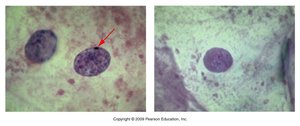
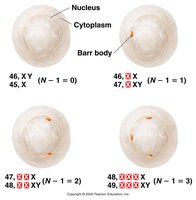
Barr bodies are inactivated X chromosomes visible in the nuclei of female cells. The number of Barr bodies is always one less than the total number of X chromosomes (N-1 rule).
46, XX: 1 Barr body
47, XXX: 2 Barr bodies
45, X: 0 Barr bodies
Lyon Hypothesis and Mosaicism
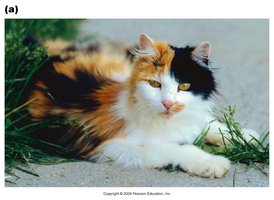
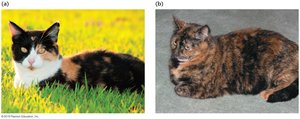
The Lyon hypothesis states that X-inactivation is random in each cell early in embryonic development, leading to mosaicism in females. This is exemplified by calico and tortoiseshell cats, where different patches of fur color result from different X chromosomes being inactivated in different cells.
All descendant cells inherit the same inactive X chromosome as the original cell.
Cloning a calico cat does not reproduce the same fur pattern due to random X-inactivation.

Molecular Mechanism of X-Inactivation
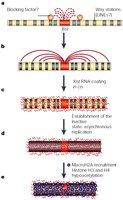
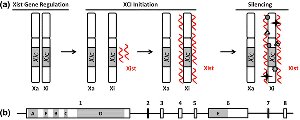
X-inactivation is controlled by the X-inactivation center (Xic) on the X chromosome. The Xist gene within Xic produces a non-coding RNA that coats the X chromosome from which it is transcribed, leading to its inactivation. This process is an example of epigenetic regulation.
Xist RNA acts in cis (on the same chromosome).
Epigenetic modifications such as DNA methylation and histone modification help maintain inactivation.
Sex Determination in Model Organisms
Drosophila melanogaster
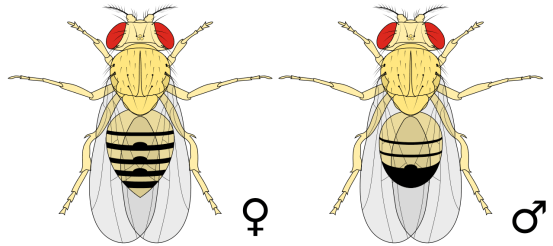
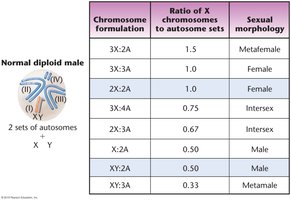
In Drosophila, sex is determined by the ratio of X chromosomes to sets of autosomes (A). The Y chromosome does not determine sex but is required for male fertility.
2X:2A = female
1X:2A = male
Other ratios produce intersex or metafemale individuals.
Dosage Compensation in Drosophila
Unlike mammals, Drosophila males do not inactivate their X chromosome. Instead, X-linked genes in males are transcribed at twice the rate as in females to achieve dosage compensation.
Caenorhabditis elegans
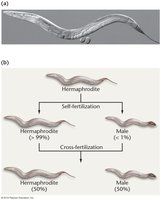
C. elegans has two sexual phenotypes: hermaphrodites (XX) and males (XO). Hermaphrodites can self-fertilize, producing mostly hermaphrodite offspring, with a small percentage of males.
Self-fertilization produces >99% hermaphrodites, <1% males.
Cross-fertilization with males produces 50% males and 50% hermaphrodites.
Temperature-Dependent Sex Determination in Reptiles
In some reptiles, sex is determined by the incubation temperature of eggs during embryonic development. Different temperature ranges can produce males or females, depending on the species.
Summary Table: Modes of Sex Determination
System | Homogametic Sex | Heterogametic Sex | Examples |
|---|---|---|---|
XX/XO | Female (XX) | Male (XO) | Grasshoppers, some insects |
XX/XY | Female (XX) | Male (XY) | Mammals, Drosophila |
ZZ/ZW | Male (ZZ) | Female (ZW) | Birds, some reptiles, fish |
Key Concepts and Applications
Sex determination systems vary among species and can involve different chromosomes or environmental factors.
Nondisjunction during meiosis can lead to syndromes such as Klinefelter and Turner syndrome.
Dosage compensation mechanisms ensure balanced expression of X-linked genes between sexes.
X-inactivation is a classic example of epigenetic regulation and leads to mosaicism in females.
Model organisms such as Drosophila and C. elegans provide insights into the diversity of sex determination mechanisms.
