Ch. 10 - DNA Replication
Klug - Essentials of Genetics 10th Edition
Klug10th EditionEssentials of GeneticsISBN: 9780135588789Non è quello che usi tu?Cambia libro di testo
Capitolo 10, Problema 17

Outline the current model for DNA synthesis.

Guida verificata passo dopo passo
1
Start by explaining that DNA synthesis, also known as DNA replication, is the process by which a cell duplicates its DNA before cell division, ensuring each daughter cell receives an identical copy.
Describe the key enzyme DNA polymerase, which adds nucleotides to the growing DNA strand complementary to the template strand, synthesizing DNA in the 5' to 3' direction.
Explain the role of the replication fork, where the double-stranded DNA is unwound by helicase to create two single-stranded templates for replication.
Discuss the difference between the leading strand, which is synthesized continuously, and the lagging strand, which is synthesized discontinuously in short fragments called Okazaki fragments.
Mention the involvement of other important proteins such as primase (which synthesizes RNA primers to initiate DNA synthesis), ligase (which joins Okazaki fragments), and single-strand binding proteins (which stabilize the unwound DNA).

Risposta video verificata per un problema simile:

Questa soluzione video è stata consigliata dai nostri tutor come utile per risolvere questo problema.
Durata del video:
1m

Concetti chiave

Ecco i concetti essenziali che devi comprendere per rispondere correttamente alla domanda.

DNA Replication Fork

The DNA replication fork is the Y-shaped region where the double helix is unwound to allow synthesis of new strands. It consists of leading and lagging strands, with enzymes working to replicate DNA in opposite directions simultaneously.
Video consigliato:
Percorso guidato
11:59
Steps to DNA Replication

Enzymes Involved in DNA Synthesis

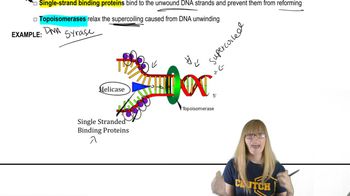
Key enzymes include DNA helicase (unwinds the helix), DNA polymerase (adds nucleotides to the new strand), primase (synthesizes RNA primers), and ligase (joins Okazaki fragments). These enzymes coordinate to ensure accurate and efficient DNA replication.
Video consigliato:
Percorso guidato
02:43
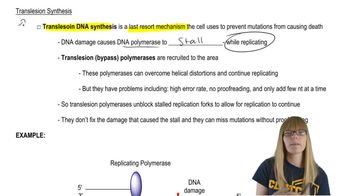
Translesion Synthesis

Leading and Lagging Strand Synthesis

DNA synthesis is continuous on the leading strand, moving toward the replication fork, while the lagging strand is synthesized discontinuously in short Okazaki fragments away from the fork. This difference arises due to DNA polymerase’s 5’ to 3’ synthesis direction.
Video consigliato:
Percorso guidato
02:43
Translesion Synthesis