Indietro
Problema 1a
How was Mendel able to derive postulates concerning the behavior of 'unit factors' during gamete formation when he could not directly observe them?
Problema 1b
How do we know whether an organism expressing a dominant trait is homozygous or heterozygous?
Problema 1c
In analyzing genetic data, how do we know whether deviation from the expected ratio is due to chance rather than to another, independent factor?
Problema 1d
Since experimental crosses are not performed in humans, how do we know how traits are inherited?
Problema 2
Write a short essay that correlates Mendel's four postulates with what is now known about genes, alleles, and homologous chromosomes.
Problema 3
In a cross between a black and a white guinea pig, all members of the F₁ generation are black. The F₂ generation is made up of approximately 3/4 black and 1/4 white guinea pigs. Diagram this cross, showing the genotypes and phenotypes.
Problema 4a
Albinism in humans is inherited as a simple recessive trait. For the following families, determine the genotypes of the parents and offspring. (When two alternative genotypes are possible, list both.)
Two normal parents have five children, four normal and one albino.
Problema 4b
Albinism in humans is inherited as a simple recessive trait. For the following families, determine the genotypes of the parents and offspring. (When two alternative genotypes are possible, list both.)
A normal male and an albino female have six children, all normal.
Problema 5
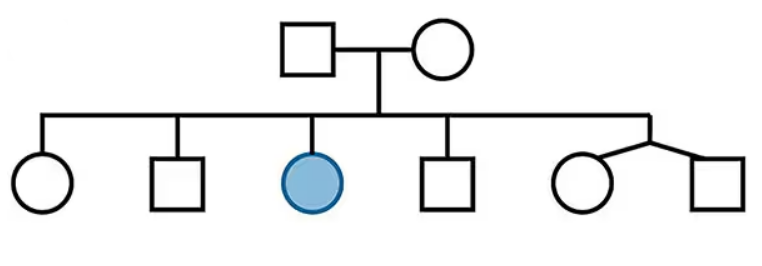
Which of Mendel's postulates are illustrated by the pedigree that you constructed in Problem 3? List and define these postulates.
Problema 6
What advantages were provided by Mendel's choice of the garden pea in his experiments?
Problema 7
Mendel crossed peas having round seeds and yellow cotyledons (seed leaves) with peas having wrinkled seeds and green cotyledons. All the F₁ plants had round seeds with yellow cotyledons. Diagram this cross through the F₂ generation, using both the Punnett square and forked-line, or branch diagram, methods.
Problema 8
Refer to the Now Solve This problem 3.2. Are any of the crosses in this problem testcrosses? If so, which one(s)?
Problema 9
Which of Mendel’s postulates can be demonstrated in the Now Solve This problem 3.2 but not in Problem 3 above? Define this postulate.
Problema 10
Correlate Mendel’s four postulates with what is now known about homologous chromosomes, genes, alleles, and the process of meiosis.
Problema 11
Distinguish between homozygosity and heterozygosity.
Problema 12a
In Drosophila, gray body color is dominant to ebony body color, while long wings are dominant to vestigial wings. Assuming that the P₁ individuals are homozygous, work the following crosses through the F₂ generation, and determine the genotypic and phenotypic ratios for each generation.
gray, long x ebony, vestigial
Problema 12b
In Drosophila, gray body color is dominant to ebony body color, while long wings are dominant to vestigial wings. Assuming that the P₁ individuals are homozygous, work the following crosses through the F₂ generation, and determine the genotypic and phenotypic ratios for each generation.
gray, vestigial x ebony, long
Problema 12c
In Drosophila, gray body color is dominant to ebony body color, while long wings are dominant to vestigial wings. Assuming that the P₁ individuals are homozygous, work the following crosses through the F₂ generation, and determine the genotypic and phenotypic ratios for each generation.
gray, long x gray, vestigial.
Problema 13
How many different types of gametes can be formed by individuals of the following genotypes:
(a) AaBb
(b) AaBB
(c) AaBbCc
(d) AaBBcc
(e) AaBbcc
(f) AaBbCcDdEe
What are the gametes in each case?
Problema 14
Mendel crossed peas having round green seeds with peas having wrinkled yellow seeds. All F₁ plants had seeds that were round and yellow. Predict the results of testcrossing these F₁ plants.
Problema 15
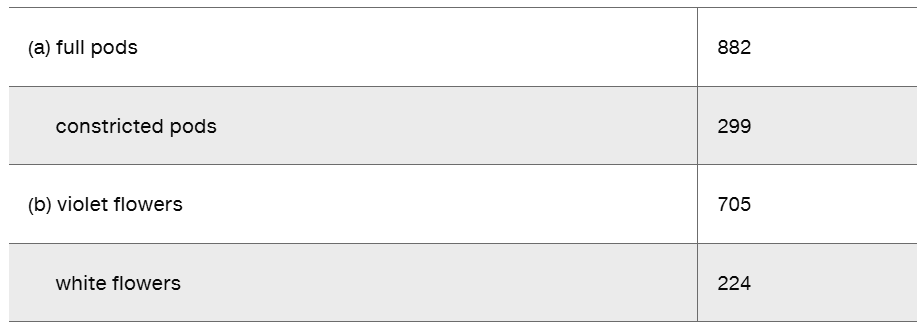
The following are F₂ results of two of Mendel's monohybrid crosses.
For each cross, state a null hypothesis to be tested using x² analysis. Calculate the x² value and determine the p value for both. Interpret the p-values. Can the deviation in each case be attributed to chance or not? Which of the two crosses shows a greater amount of deviation?
Problema 16
In assessing data that fell into two phenotypic classes, a geneticist observed values of 250:150. She decided to perform a ² analysis by using the following two different null hypotheses:
(a) the data fit a 3:1 ratio, and
(b) the data fit a 1:1 ratio.
Calculate the ² values for each hypothesis. What can be concluded about each hypothesis?
Problema 17
The basis for rejecting any null hypothesis is arbitrary. The researcher can set more or less stringent standards by deciding to raise or lower the p value used to reject or not reject the hypothesis. In the case of the chi-square analysis of genetic crosses, would the use of a standard of p = 0.10 be more or less stringent about not rejecting the null hypothesis? Explain.
Problema 18
Consider three independently assorting gene pairs, A/a, B/b, and C/c, where each demonstrates typical dominance (A-, B-, C-) and recessiveness (aa, bb, cc). What is the probability of obtaining an offspring that is AABbCc from parents that are AaBbCC and AABbCc?
Problema 19
What is the probability of obtaining a triply recessive individual from the parents shown in Problem 18.
Problema 20
Of all offspring of the parents in Problem 18, what proportion will express all three dominant traits?
Problema 21
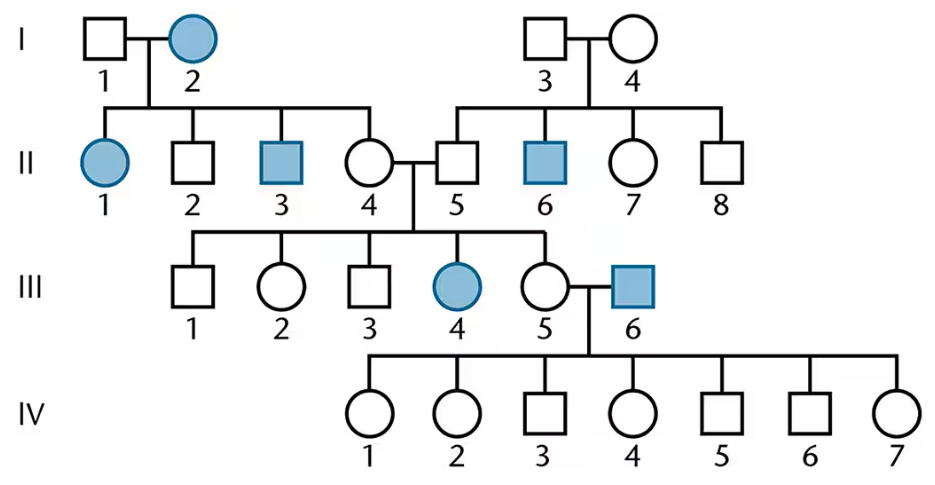
Consider the following pedigree.
Predict the mode of inheritance of the trait of interest and the most probable genotype of each individual. Assume that the alleles A and a control the expression.
Problema 22a
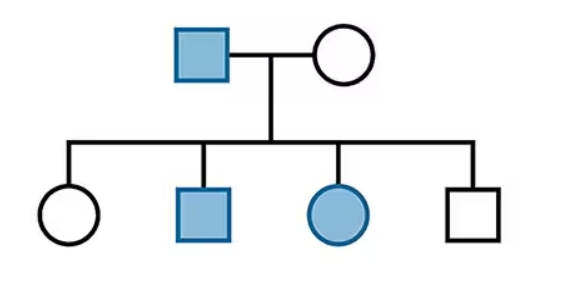
Draw all possible conclusions concerning the mode of inheritance of the trait portrayed in the following limited pedigree.
Problema 22b
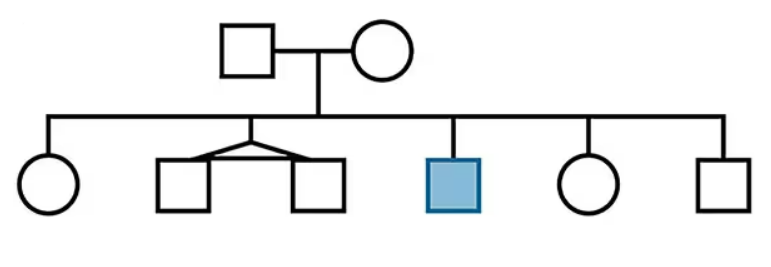
Draw all possible conclusions concerning the mode of inheritance of the trait portrayed in the following limited pedigree.
Problema 22c
Draw all possible conclusions concerning the mode of inheritance of the trait portrayed in the following limited pedigree.