Ch. 11 - Chromosome Structure and DNA Sequence Organization
Klug - Essentials of Genetics 10th Edition
Klug10th EditionEssentials of GeneticsISBN: 9780135588789Non è quello che usi tu?Cambia libro di testo
Capitolo 11, Problema 9

Describe the molecular composition and arrangement of the components in the nucleosome.

Guida verificata passo dopo passo
1
Begin by identifying the core components of a nucleosome, which include DNA and histone proteins.
Explain that the nucleosome consists of approximately 147 base pairs of DNA wrapped around a histone octamer.
Describe the histone octamer as being composed of two copies each of four different histone proteins: H2A, H2B, H3, and H4.
Clarify that the DNA wraps around the histone octamer in about 1.65 left-handed superhelical turns, which helps compact the DNA.
Mention the role of the linker histone H1, which binds to the DNA between nucleosomes and helps stabilize the higher-order chromatin structure.

Risposta video verificata per un problema simile:

Questa soluzione video è stata consigliata dai nostri tutor come utile per risolvere questo problema.
Durata del video:
1m

Concetti chiave

Ecco i concetti essenziali che devi comprendere per rispondere correttamente alla domanda.

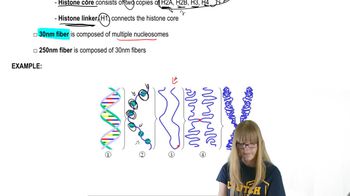
Nucleosome Structure

A nucleosome is the fundamental unit of chromatin, consisting of DNA wrapped around a histone protein core. It compacts DNA and regulates its accessibility, playing a key role in gene expression and DNA packaging.
Video consigliato:
Percorso guidato
07:10
Chromosome Structure

Histone Proteins

Histones are positively charged proteins (H2A, H2B, H3, and H4) that form an octamer core around which DNA wraps. Their interaction with DNA helps neutralize negative charges and facilitates tight DNA packaging.
Video consigliato:

DNA-Histone Interaction

Approximately 147 base pairs of DNA wrap around the histone octamer in about 1.65 turns. This interaction is stabilized by electrostatic forces and hydrogen bonds, enabling efficient DNA compaction while allowing dynamic access for cellular processes.
Video consigliato:
Percorso guidato
07:56
Interacting Genes Overview