

Ch. 11 - Chromosome Structure and DNA Sequence Organization
Klug - Essentials of Genetics 10th Edition
Klug10th EditionEssentials of GeneticsISBN: 9780135588789Non è quello che usi tu?Cambia libro di testo
Capitolo 11, Problema 19

The following is a diagram of the general structure of the bacteriophage chromosome. Speculate on the mechanism by which it forms a closed ring upon infection of the host cell.
Diagram showing a bacteriophage chromosome with double-stranded DNA regions and complementary sequences forming a closed ring.

Guida verificata passo dopo passo
1
Step 1: Identify the key features of the bacteriophage chromosome structure shown in the diagram, focusing on the double-stranded DNA region and the complementary single-stranded ends.
Step 2: Recognize that the complementary sequences at the ends of the linear DNA can base pair with each other, which is essential for forming a closed circular structure.
Step 3: Understand that upon infection, the single-stranded complementary ends can anneal through base pairing, bringing the two ends of the linear chromosome together.
Step 4: Consider the role of host or phage-encoded enzymes, such as DNA ligase, which can covalently join the sugar-phosphate backbones of the annealed ends, sealing the DNA into a closed circular ring.
Step 5: Summarize the mechanism as a process where complementary single-stranded ends hybridize to form a circular intermediate, followed by enzymatic ligation to create a stable closed ring chromosome inside the host cell.

Risposta video verificata per un problema simile:

Questa soluzione video è stata consigliata dai nostri tutor come utile per risolvere questo problema.
Durata del video:
1m

Concetti chiave

Ecco i concetti essenziali che devi comprendere per rispondere correttamente alla domanda.

Bacteriophage Chromosome Structure

Bacteriophage chromosomes often consist of double-stranded DNA with specific sequences that can interact to form unique structures. Understanding the arrangement of complementary sequences and double-stranded regions is essential to grasp how the DNA can circularize or form closed rings upon infection.
Video consigliato:
Percorso guidato
07:10
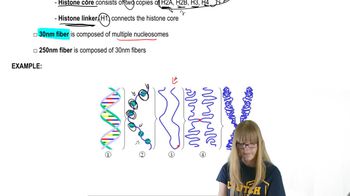
Chromosome Structure

DNA Complementarity and Base Pairing

DNA strands are complementary, meaning bases on one strand pair specifically with bases on the opposite strand (A with T, G with C). This complementarity allows single-stranded regions or sticky ends to anneal, facilitating the formation of circular DNA molecules through base pairing.
Video consigliato:
Percorso guidato
05:05
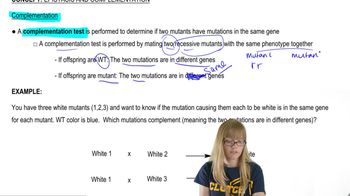
Complementation

Mechanism of DNA Circularization in Phages

Upon infection, linear phage DNA can circularize by annealing complementary single-stranded ends or through enzymatic ligation. This closed ring formation protects the DNA from degradation and is critical for replication and integration within the host.
Video consigliato:
Percorso guidato
04:11
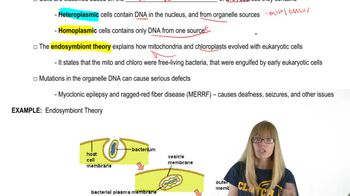
Organelle DNA Characteristics