Ch. 12 - The Genetic Code and Transcription
Klug - Essentials of Genetics 10th Edition
Klug10th EditionEssentials of GeneticsISBN: 9780135588789Non è quello che usi tu?Cambia libro di testo
Capitolo 12, Problema 9

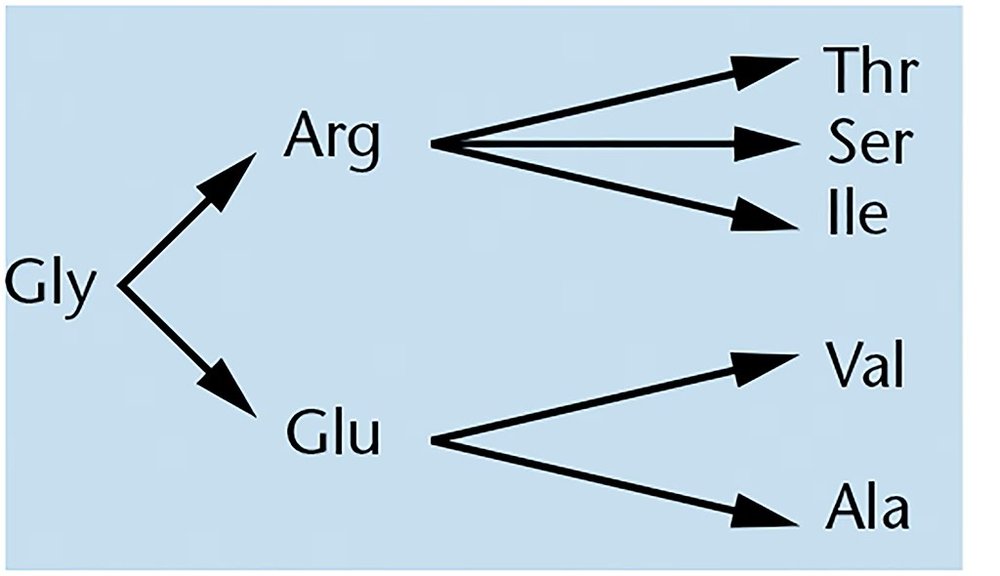
In studies of the amino acid sequence of wild-type and mutant forms of tryptophan synthetase in E. coli, the following changes have been observed:
Diagram showing amino acid changes from Gly to Arg or Glu, then to Thr, Ser, Ile, Val, or Ala via single-nucleotide mutations.
Determine a set of triplet codes in which only a single-nucleotide change produces each amino acid change.

Guida verificata passo dopo passo
1
Step 1: Identify the starting amino acid and its codons. Here, the starting amino acid is Glycine (Gly). Begin by listing all possible codons for Glycine, which are GGU, GGC, GGA, and GGG. These codons differ mainly in the third nucleotide position.
Step 2: Determine codons for the first set of amino acids (Arginine and Glutamic acid) that can be reached from Glycine codons by a single-nucleotide change. For each Gly codon, consider changing one nucleotide at a time to form a codon for Arg or Glu. This involves checking the genetic code table to find codons for Arg and Glu that differ by only one nucleotide from Gly codons.
Step 3: For the second set of amino acids (Thr, Ser, Ile from Arg; Val, Ala from Glu), identify codons that differ by only one nucleotide from the Arg and Glu codons found in Step 2. This means for each Arg and Glu codon, change one nucleotide to get codons for Thr, Ser, Ile, Val, or Ala, respectively.
Step 4: Verify that each amino acid change requires only a single-nucleotide substitution by comparing the codons side-by-side and confirming only one base differs between the original and mutated codons.
Step 5: Compile the set of codons for Gly, Arg, Glu, Thr, Ser, Ile, Val, and Ala that satisfy the single-nucleotide change condition. This set represents the triplet codes where each amino acid change can be produced by a single-nucleotide mutation.

Risposta video verificata per un problema simile:

Questa soluzione video è stata consigliata dai nostri tutor come utile per risolvere questo problema.
Durata del video:
1m

Concetti chiave

Ecco i concetti essenziali che devi comprendere per rispondere correttamente alla domanda.

Genetic Code and Codon Structure

The genetic code consists of triplet codons, each made of three nucleotides, that specify amino acids during protein synthesis. Understanding how single-nucleotide changes (point mutations) in these codons can alter the encoded amino acid is essential for predicting mutation effects. Codon redundancy and specificity influence which amino acid substitutions are possible with minimal nucleotide changes.
Video consigliato:
Percorso guidato
11:43
The Genetic Code

Single-Nucleotide Mutations and Their Effects

Single-nucleotide mutations involve the substitution of one nucleotide in a codon, potentially changing the encoded amino acid. These mutations can be silent, missense, or nonsense, depending on their impact. In this question, identifying codons where a single-nucleotide change leads to specific amino acid substitutions is crucial for mapping mutation pathways.
Video consigliato:
Percorso guidato
03:38
Maternal Effect

Amino Acid Properties and Mutation Pathways

Amino acids differ in chemical properties such as charge, polarity, and size, which affect protein function. The question involves mutations from Glycine (Gly) to Arginine (Arg) or Glutamic acid (Glu), then to other amino acids via single-nucleotide changes. Understanding these relationships helps in selecting codons that allow stepwise single-nucleotide mutations producing the observed amino acid changes.
Video consigliato:
Percorso guidato
09:49
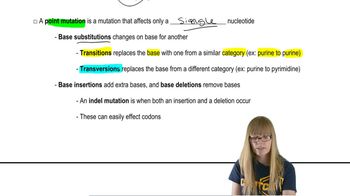
Point Mutations
Pratica correlata
Domanda del libro di testo

Predict the amino acid sequence produced during translation by the following short hypothetical mRNA sequences (note that the second sequence was formed from the first by a deletion of only one nucleotide):

Sequence 1: 5'-AUGCCGGAUUAUAGUUGA-3'

Sequence 2: 5'-AUGCCGGAUUAAGUUGA-3'

What type of mutation gave rise to sequence 2?

803
views
Domanda del libro di testo

In the triplet binding technique, radioactivity remains on the filter when the amino acid corresponding to the codon is labeled. Explain the rationale for this technique.

511
views
Domanda del libro di testo

When the amino acid sequences of insulin isolated from different organisms were determined, differences were noted. For example, alanine was substituted for threonine, serine for glycine, and valine for isoleucine at corresponding positions in the protein. List the single-base changes that could occur in codons of the genetic code to produce these amino acid changes.

467
views
Domanda del libro di testo

Refer to Table 13.1. Can you hypothesize why a synthetic RNA composed of a mixture of poly U poly A would not stimulate incorporation of ¹⁴C-phenylalanine into protein?

672
views
Domanda del libro di testo

In a coding experiment using repeating copolymers, the following data were obtained:

AGG is known to code for arginine. Taking into account the wobble hypothesis, assign each of the four codons produced in the experiment to its correct amino acid.

901
views
Domanda del libro di testo

Why doesn't polynucleotide phosphorylase (Ochoa's enzyme) synthesize RNA in vivo?

848
views