
Ch. 14 - Gene Mutation, DNA Repair, and Transposition
Klug - Essentials of Genetics 10th Edition
Klug10th EditionEssentials of GeneticsISBN: 9780135588789Non è quello che usi tu?Cambia libro di testo
Capitolo 14, Problema 17

What genetic defects result in the disorder xeroderma pigmentosum (XP) in humans? How do these defects create the phenotypes associated with the disorder?

Guida verificata passo dopo passo
1
Understand that xeroderma pigmentosum (XP) is caused by mutations in genes responsible for nucleotide excision repair (NER), a DNA repair pathway that fixes damage caused by ultraviolet (UV) light.
Identify the key genes involved in XP, such as XPA, XPB, XPC, XPD, XPE, XPF, and XPG, which encode proteins that recognize and excise UV-induced DNA lesions like thymine dimers.
Explain that defects in these genes impair the NER pathway, leading to an inability to properly repair UV-induced DNA damage, resulting in accumulation of mutations in skin cells.
Connect the accumulation of unrepaired DNA damage to the clinical phenotypes of XP, including extreme sensitivity to sunlight, freckling, pigmentation abnormalities, and a high predisposition to skin cancers.
Summarize that the genetic defects cause a failure in DNA repair mechanisms, which leads to cellular damage and the characteristic symptoms of XP due to increased mutagenesis and cell death in UV-exposed tissues.

Risposta video verificata per un problema simile:

Questa soluzione video è stata consigliata dai nostri tutor come utile per risolvere questo problema.
Durata del video:
3m

Concetti chiave

Ecco i concetti essenziali che devi comprendere per rispondere correttamente alla domanda.

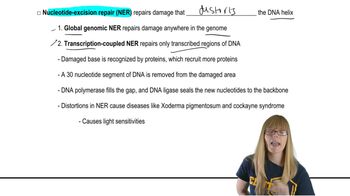
Nucleotide Excision Repair (NER) Pathway

NER is a DNA repair mechanism that removes bulky DNA lesions, such as those caused by UV light-induced thymine dimers. It involves recognition, excision, and resynthesis of damaged DNA segments. Defects in NER genes impair this process, leading to accumulation of DNA damage.
Video consigliato:
Percorso guidato
05:44
Repair Pathways

Genetic Mutations in XP-Related Genes

Xeroderma pigmentosum results from mutations in genes encoding proteins essential for NER, such as XPA, XPB, XPC, and others. These mutations reduce or eliminate repair activity, causing cells to be hypersensitive to UV-induced DNA damage.
Video consigliato:
Percorso guidato
10:48
Mutations and Phenotypes

Phenotypic Consequences of DNA Repair Defects

Failure to repair UV-induced DNA damage leads to mutations, genomic instability, and cell death. Clinically, this manifests as extreme UV sensitivity, skin abnormalities, pigmentation changes, and a high risk of skin cancers characteristic of XP patients.
Video consigliato:
Percorso guidato
05:44
Repair Pathways
Pratica correlata
Domanda del libro di testo

In maize, a Ds or Ac transposon can alter the function of genes at or near the site of transposon insertion. It is possible for these elements to transpose away from their original insertion site, causing a reversion of the mutant phenotype. In some cases, however, even more severe phenotypes appear, due to events at or near the mutant allele. What might be happening to the transposon or the nearby gene to create more severe mutations?

429
views
Domanda del libro di testo

Compare DNA transposons and retrotransposons. What properties do they share?

1263
views
Domanda del libro di testo

Mammography is an accurate screening technique for the early detection of breast cancer in humans. Because this technique uses X rays diagnostically, it has been highly controversial. Can you explain why? What reasons justify the use of X rays for such a medical screening technique?

605
views
Domanda del libro di testo

Describe how the Ames test screens for potential environmental mutagens. Why is it thought that a compound that tests positively in the Ames test may also be carcinogenic?

1022
views
Domanda del libro di testo

It is estimated that about 0.2 percent of human mutations are due to TE insertions, and a much higher degree of mutational damage is known to occur in some other organisms. In what way might a TE insertion contribute positively to evolution?

444
views
Domanda del libro di testo

A significant number of mutations in the HBB gene that cause human β-thalassemia occur within introns or in upstream noncoding sequences. Explain why mutations in these regions often lead to severe disease, although they may not directly alter the coding regions of the gene.

712
views