Ch. 14 - Gene Mutation, DNA Repair, and Transposition
Klug - Essentials of Genetics 10th Edition
Klug10th EditionEssentials of GeneticsISBN: 9780135588789Non è quello che usi tu?Cambia libro di testo
Capitolo 14, Problema 6

Why is a random mutation more likely to be deleterious than beneficial?

Guida verificata passo dopo passo
1
Understand that mutations are changes in the DNA sequence that can affect the function of genes and proteins.
Recognize that most biological systems have evolved to be well-adapted to their environments, so their current genetic makeup is generally optimized for survival and reproduction.
Consider that a random mutation is more likely to disrupt a well-functioning gene or protein rather than improve it, because the existing system is already fine-tuned.
Realize that deleterious mutations often impair protein structure or function, leading to reduced fitness, while beneficial mutations that improve function are rare and require very specific changes.
Conclude that the probability of a mutation being harmful is higher than it being helpful due to the complexity and optimization of biological systems.

Risposta video verificata per un problema simile:

Questa soluzione video è stata consigliata dai nostri tutor come utile per risolvere questo problema.
Durata del video:
1m

Concetti chiave

Ecco i concetti essenziali che devi comprendere per rispondere correttamente alla domanda.

Random Mutation

A random mutation is a spontaneous change in the DNA sequence that occurs without a specific direction or purpose. These mutations can affect genes in various ways, often altering protein function or regulation unpredictably.
Video consigliato:
Percorso guidato
09:49
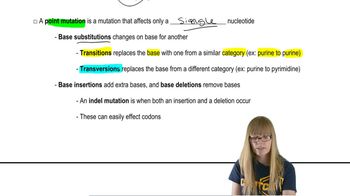
Point Mutations

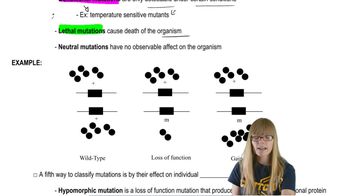
Deleterious vs. Beneficial Mutations

Deleterious mutations negatively impact an organism's fitness by disrupting normal biological functions, while beneficial mutations improve fitness or adaptation. Because biological systems are usually well-optimized, most random changes tend to harm rather than help.
Video consigliato:
Percorso guidato
10:48
Mutations and Phenotypes

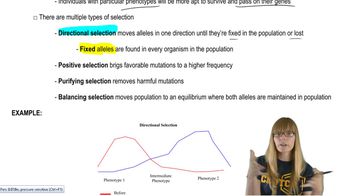
Natural Selection and Mutation Effects

Natural selection acts on mutations by favoring beneficial changes and removing harmful ones over generations. Since beneficial mutations are rare, most random mutations are either neutral or deleterious, making harmful effects more common in the short term.
Video consigliato:
Percorso guidato
05:54
Natural Selection