Ch. 16 - Regulation of Gene Expression in Eukaryotes

Klug10th EditionEssentials of GeneticsISBN: 9780135588789
Non è quello che usi tu?Cambia libro di testoScegli un libro di testo diverso
TOC.tableOfContents
- Ch. 1 - Introduction to Genetics16
- Ch. 2 - Mitosis and Meiosis28
- Ch. 3 - Mendelian Genetics37
- Ch. 4 - Modification of Mendelian Ratios53
- Ch. 5 - Sex Determination and Sex Chromosomes32
- Ch. 6 - Chromosome Mutations: Variation in Number and Arrangement37
- Ch. 7 - Linkage and Chromosome Mapping in Eukaryotes36
- Ch. 8 - Genetic Analysis and Mapping in Bacteria and Bacteriophages24
- Ch. 9 - DNA Structure and Analysis38
- Ch. 10 - DNA Replication29
- Ch. 11 - Chromosome Structure and DNA Sequence Organization22
- Ch. 12 - The Genetic Code and Transcription36
- Ch. 13 - Translation and Proteins27
- Ch. 14 - Gene Mutation, DNA Repair, and Transposition34
- Ch. 15 - Regulation of Gene Expression in Bacteria22
- Ch. 16 - Regulation of Gene Expression in Eukaryotes37
- Ch. 17 - Recombinant DNA Technology27
- Ch. 18 - Genomics, Bioinformatics, and Proteomics30
- Ch. 19 - The Genetics of Cancer21
- Ch. 20 - Quantitative Genetics and Multifactorial Traits37
- Ch. 21 - Population and Evolutionary Genetics45
Klug10th EditionEssentials of GeneticsISBN: 9780135588789Non è quello che usi tu?Cambia libro di testo
Tutti i libri di testo Klug 10th EditionCh. 16 - Regulation of Gene Expression in EukaryotesProblema 23
Klug 10th EditionCh. 16 - Regulation of Gene Expression in EukaryotesProblema 23Capitolo 16, Problema 23
How and why are eukaryotic mRNAs transported and localized to discrete regions of the cell?
 Guida verificata passo dopo passo
1
Understand that eukaryotic mRNAs are transported and localized within the cell to ensure that proteins are synthesized at specific locations where they are needed, which is crucial for cell function and development.
Recognize that mRNA localization involves three main stages: (1) mRNA recognition and binding by specific RNA-binding proteins, (2) transport of the mRNA-protein complex along the cytoskeleton (microtubules or actin filaments), and (3) anchoring or localized translation at the target site.
Learn that RNA-binding proteins recognize localization signals or 'zip codes' within the mRNA sequence, often found in the 3' untranslated region (3' UTR), which direct the mRNA to its destination.
Explore the role of motor proteins such as kinesin, dynein, or myosin that move the mRNA-protein complexes along cytoskeletal tracks to specific cellular regions.
Understand that localized mRNA translation allows for spatial and temporal control of protein synthesis, which is essential for processes like cell polarity, embryonic development, and synaptic function in neurons.
Concetti chiave
Ecco i concetti essenziali che devi comprendere per rispondere correttamente alla domanda.
mRNA Transport Mechanisms in Eukaryotic Cells
Eukaryotic mRNAs are actively transported from the nucleus to specific cytoplasmic locations using motor proteins along the cytoskeleton. This process involves recognition of localization signals within the mRNA and interaction with transport complexes, ensuring precise spatial distribution within the cell.
Video consigliato:
Percorso guidato
 09:16
09:16
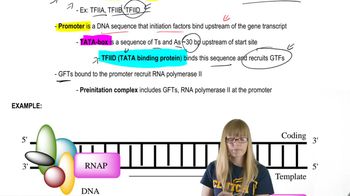
Eukaryotic Transcription
mRNA Localization and Its Functional Importance
Localized mRNA allows for spatially restricted protein synthesis, which is crucial for cell polarity, development, and response to environmental cues. By concentrating proteins at specific sites, cells can efficiently regulate processes like embryogenesis, synaptic function, and cell migration.
Video consigliato:
Percorso guidato
 08:26
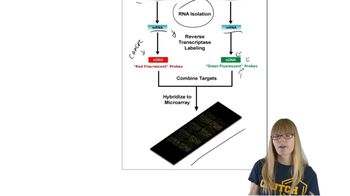
08:26Functional Genomics
Cis-acting Elements and Trans-acting Factors in mRNA Localization
Cis-acting elements are specific sequences or structures within the mRNA that direct its localization, while trans-acting factors are proteins that recognize these elements and mediate transport. Together, they form ribonucleoprotein complexes that guide mRNAs to their target destinations.
Video consigliato:
Percorso guidato
09:16Eukaryotic Transcription
Pratica correlata