Ch. 16 - Regulation of Gene Expression in Eukaryotes

Klug10th EditionEssentials of GeneticsISBN: 9780135588789
Non è quello che usi tu?Cambia libro di testoScegli un libro di testo diverso
TOC.tableOfContents
- Ch. 1 - Introduction to Genetics16
- Ch. 2 - Mitosis and Meiosis28
- Ch. 3 - Mendelian Genetics37
- Ch. 4 - Modification of Mendelian Ratios53
- Ch. 5 - Sex Determination and Sex Chromosomes32
- Ch. 6 - Chromosome Mutations: Variation in Number and Arrangement37
- Ch. 7 - Linkage and Chromosome Mapping in Eukaryotes36
- Ch. 8 - Genetic Analysis and Mapping in Bacteria and Bacteriophages24
- Ch. 9 - DNA Structure and Analysis38
- Ch. 10 - DNA Replication29
- Ch. 11 - Chromosome Structure and DNA Sequence Organization22
- Ch. 12 - The Genetic Code and Transcription36
- Ch. 13 - Translation and Proteins27
- Ch. 14 - Gene Mutation, DNA Repair, and Transposition34
- Ch. 15 - Regulation of Gene Expression in Bacteria22
- Ch. 16 - Regulation of Gene Expression in Eukaryotes37
- Ch. 17 - Recombinant DNA Technology27
- Ch. 18 - Genomics, Bioinformatics, and Proteomics30
- Ch. 19 - The Genetics of Cancer21
- Ch. 20 - Quantitative Genetics and Multifactorial Traits37
- Ch. 21 - Population and Evolutionary Genetics45
Klug10th EditionEssentials of GeneticsISBN: 9780135588789Non è quello che usi tu?Cambia libro di testo
Tutti i libri di testo Klug 10th EditionCh. 16 - Regulation of Gene Expression in EukaryotesProblema 1b
Klug 10th EditionCh. 16 - Regulation of Gene Expression in EukaryotesProblema 1bCapitolo 16, Problema 1b
In this chapter, we focused on the regulation of gene expression in eukaryotes. At the same time, we found many opportunities to consider the methods and reasoning by which much of this information was acquired. From the explanations given in the chapter:
How do we know that DNA methylation is associated with transcriptionally silent genes?
 Guida verificata passo dopo passo
1
Understand that DNA methylation typically involves the addition of a methyl group to cytosine bases in DNA, often at CpG sites, which can affect gene expression by altering chromatin structure or recruiting proteins that repress transcription.
Review experimental evidence where researchers compare the methylation status of DNA regions with the transcriptional activity of the associated genes, often using techniques such as bisulfite sequencing to detect methylation patterns and RNA analysis to measure gene expression levels.
Examine studies where artificially increasing DNA methylation at specific gene promoters leads to decreased transcription, demonstrating a causal relationship between methylation and gene silencing.
Consider experiments involving demethylating agents or mutations in DNA methyltransferase enzymes that result in loss of methylation and subsequent reactivation of previously silent genes, further supporting the association.
Integrate these observations to conclude that the correlation and experimental manipulation of DNA methylation levels provide strong evidence that DNA methylation is associated with transcriptionally silent genes.
Concetti chiave
Ecco i concetti essenziali che devi comprendere per rispondere correttamente alla domanda.
DNA Methylation
DNA methylation involves the addition of a methyl group to cytosine bases in DNA, often at CpG sites. This chemical modification can alter gene expression without changing the DNA sequence, typically leading to gene silencing by affecting chromatin structure and accessibility.
Video consigliato:
Percorso guidato
 01:45
01:45
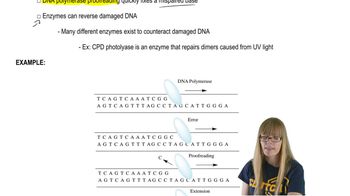
DNA Proofreading
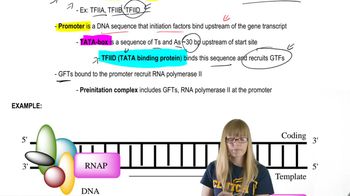
Transcriptional Regulation in Eukaryotes
Transcriptional regulation controls whether a gene is actively transcribed into RNA. In eukaryotes, this process is influenced by multiple factors including DNA methylation, histone modifications, and transcription factors, which together determine if a gene is expressed or silenced.
Video consigliato:
Percorso guidato
 09:16
09:16Eukaryotic Transcription
Experimental Evidence Linking DNA Methylation to Gene Silencing
Researchers use methods like DNA methylation mapping, gene expression analysis, and demethylation treatments to show that methylated genes are often transcriptionally inactive. For example, removing methyl groups can reactivate silenced genes, demonstrating the causal relationship.
Video consigliato:
Percorso guidato
 07:56
07:56Sex-Linked Genes
Pratica correlata