Ch. 18 - Genomics, Bioinformatics, and Proteomics
Klug - Essentials of Genetics 10th Edition
Klug10th EditionEssentials of GeneticsISBN: 9780135588789Non è quello che usi tu?Cambia libro di testo
Capitolo 18, Problema 1b

How do we know if a genomic DNA sequence contains a protein-coding gene?

Guida verificata passo dopo passo
1
Understand that a protein-coding gene in genomic DNA typically contains specific features such as a promoter region, exons, introns, and regulatory sequences that guide transcription and translation.
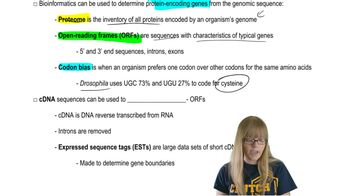
Look for open reading frames (ORFs) within the DNA sequence, which are continuous stretches of codons without stop codons, indicating potential protein-coding regions.
Identify key signals such as start codons (usually ATG) and stop codons (TAA, TAG, TGA) that define the boundaries of the protein-coding region.
Examine the presence of splice sites at exon-intron boundaries, which are conserved sequences indicating where RNA splicing occurs to produce mature mRNA.
Use computational tools or algorithms that analyze sequence features, codon usage bias, and similarity to known genes to predict whether the DNA sequence encodes a protein.

Risposta video verificata per un problema simile:

Questa soluzione video è stata consigliata dai nostri tutor come utile per risolvere questo problema.
Durata del video:
1m

Concetti chiave

Ecco i concetti essenziali che devi comprendere per rispondere correttamente alla domanda.

Open Reading Frames (ORFs)

Open Reading Frames are continuous stretches of codons in DNA that begin with a start codon and end with a stop codon. Identifying ORFs helps predict potential protein-coding regions within a genomic sequence, as these regions can be translated into proteins.
Video consigliato:

Gene Prediction Algorithms

Gene prediction algorithms use computational methods to analyze DNA sequences for features like codon usage, splice sites, and regulatory elements. These tools help distinguish protein-coding genes from non-coding regions by integrating biological signals and statistical models.
Video consigliato:

Comparative Genomics and Homology

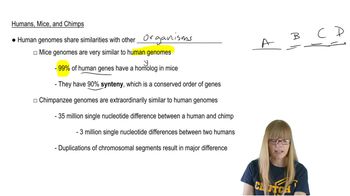
Comparative genomics involves comparing DNA sequences across species to identify conserved regions. Homology to known protein-coding genes in other organisms provides strong evidence that a genomic sequence encodes a protein, as functional genes tend to be conserved through evolution.
Video consigliato:
Percorso guidato
01:49
Humans, Mice, and Chimps