Ch. 2 - Mitosis and Meiosis
Klug - Essentials of Genetics 10th Edition
Klug10th EditionEssentials of GeneticsISBN: 9780135588789Non è quello che usi tu?Cambia libro di testo
Capitolo 2, Problema 27

Consider a diploid cell that contains three pairs of chromosomes designated AA, BB, and CC. Each pair contains a maternal and a paternal member (e.g., Am and Ap). Using these designations, demonstrate your understanding of mitosis and meiosis by drawing chromatid combinations as requested. Be sure to indicate when chromatids are paired as a result of replication and/or synapsis.
Are there any possible combinations present during prophase of meiosis II other than those that you drew in Problem 26? If so, draw them.

Guida verificata passo dopo passo
1
Begin by understanding the chromosome composition: the diploid cell has three pairs of chromosomes (AA, BB, CC), each with a maternal (e.g., A^{m}) and paternal (e.g., A^{p}) homolog.
For mitosis, first illustrate the chromosomes before replication: each chromosome is a single chromatid (A^{m}, A^{p}, B^{m}, B^{p}, C^{m}, C^{p}). Then, show replication where each chromosome duplicates into two sister chromatids joined at the centromere (e.g., A^{m} consists of two identical sister chromatids).
For meiosis, during prophase I, depict homologous chromosomes pairing (synapsis) to form tetrads, where each homologous pair consists of four chromatids (two sister chromatids from each homolog). Indicate this synapsis for each pair (AA, BB, CC).
Recall that after meiosis I, homologous chromosomes separate, and in prophase II, each cell contains chromosomes with sister chromatids but no homologous pairs. Draw the chromatids in prophase II as pairs of sister chromatids (e.g., A^{m} chromatids together), without synapsis.
To answer the question about possible combinations during prophase II beyond those in Problem 26, consider whether any crossing over or recombination events could create new chromatid combinations. If so, illustrate chromatids with recombinant segments paired as sister chromatids, emphasizing that no homologous synapsis occurs at this stage.

Risposta video verificata per un problema simile:

Questa soluzione video è stata consigliata dai nostri tutor come utile per risolvere questo problema.
Durata del video:
2m

Concetti chiave

Ecco i concetti essenziali che devi comprendere per rispondere correttamente alla domanda.

Chromosome Structure and Replication

Chromosomes consist of two sister chromatids joined at a centromere after DNA replication. In a diploid cell with pairs like AA, BB, and CC, each chromosome pair has one maternal and one paternal homolog. Replication occurs during the S phase, resulting in duplicated chromatids that remain attached until separated during cell division.
Video consigliato:
Percorso guidato
07:10
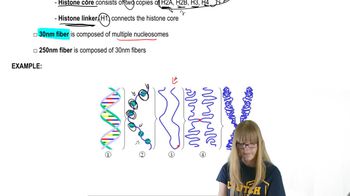
Chromosome Structure

Mitosis vs. Meiosis Chromatid Behavior

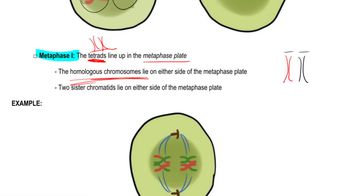
Mitosis involves separation of sister chromatids to produce identical diploid daughter cells, while meiosis includes two divisions: meiosis I separates homologous chromosomes, and meiosis II separates sister chromatids. Synapsis and crossing over occur only in meiosis I, affecting chromatid combinations seen in later stages.
Video consigliato:

Prophase of Meiosis II and Chromatid Combinations

During prophase II, cells have haploid sets of chromosomes, each still composed of sister chromatids. Unlike prophase I, no synapsis occurs here, so chromatid combinations reflect prior recombination events. Understanding whether new combinations arise depends on recognizing that chromatids remain paired only as sisters at this stage.
Video consigliato:
Pratica correlata
Domanda del libro di testo

If one follows 50 primary oocytes in an animal through their various stages of oogenesis, how many secondary oocytes would be formed? How many first polar bodies would be formed? How many ootids would be formed? If one follows 50 primary spermatocytes in an animal through their various stages of spermatogenesis, how many secondary spermatocytes would be formed? How many spermatids would be formed?

724
views
Domanda del libro di testo

Consider a diploid cell that contains three pairs of chromosomes designated AA, BB, and CC. Each pair contains a maternal and a paternal member (e.g., Am and Ap). Using these designations, demonstrate your understanding of mitosis and meiosis by drawing chromatid combinations as requested. Be sure to indicate when chromatids are paired as a result of replication and/or synapsis.

During meiosis I, assuming no crossing over, what chromatid combination(s) will be present at the completion of prophase I? Draw all possible alignments of chromatids as migration begins during early anaphase.

590
views
Domanda del libro di testo

Consider a diploid cell that contains three pairs of chromosomes designated AA, BB, and CC. Each pair contains a maternal and a paternal member (e.g., Am and Ap). Using these designations, demonstrate your understanding of mitosis and meiosis by drawing chromatid combinations as requested. Be sure to indicate when chromatids are paired as a result of replication and/or synapsis.

In mitosis, what chromatid combination(s) will be present during metaphase? What combination(s) will be present at each pole at the completion of anaphase?

554
views
Domanda del libro di testo

Consider a diploid cell that contains three pairs of chromosomes designated AA, BB, and CC. Each pair contains a maternal and a paternal member (e.g., Am and Ap). Using these designations, demonstrate your understanding of mitosis and meiosis by drawing chromatid combinations as requested. Be sure to indicate when chromatids are paired as a result of replication and/or synapsis.

Assume that during meiosis I none of the C chromosomes disjoin at metaphase, but they separate into dyads (instead of monads) during meiosis II. How would this change the alignments that you constructed during the anaphase stages in meiosis I and II? Draw them.

572
views
Domanda del libro di testo

Consider a diploid cell that contains three pairs of chromosomes designated AA, BB, and CC. Each pair contains a maternal and a paternal member (e.g., Am and Ap). Using these designations, demonstrate your understanding of mitosis and meiosis by drawing chromatid combinations as requested. Be sure to indicate when chromatids are paired as a result of replication and/or synapsis.

Draw all possible combinations of chromatids during the early phases of anaphase in meiosis II.

507
views
Domanda del libro di testo

Consider a diploid cell that contains three pairs of chromosomes designated AA, BB, and CC. Each pair contains a maternal and a paternal member (e.g., Am and Ap). Using these designations, demonstrate your understanding of mitosis and meiosis by drawing chromatid combinations as requested. Be sure to indicate when chromatids are paired as a result of replication and/or synapsis.

Assume that each gamete resulting from Problem 29 fuses, in fertilization, with a normal haploid gamete. What combinations will result? What percentage of zygotes will be diploid, containing one paternal and one maternal member of each chromosome pair?

903
views