Ch. 21 - Population and Evolutionary Genetics
Klug - Essentials of Genetics 10th Edition
Klug10th EditionEssentials of GeneticsISBN: 9780135588789Non è quello che usi tu?Cambia libro di testo
Capitolo 21, Problema 11

If the initial allele frequencies are p = 0.5 and q = 0.5 and allele a is a lethal recessive, what will be the frequencies after 1, 5, 10, 25, 100, and 1000 generations?

Guida verificata passo dopo passo
1
Understand the problem context: allele 'a' is a lethal recessive, meaning individuals with genotype 'aa' do not survive to reproduce. The initial allele frequencies are given as \(p = 0.5\) for the dominant allele and \(q = 0.5\) for the recessive lethal allele.
Recall that in a population with a lethal recessive allele, the homozygous recessive genotype frequency (\(q^2\)) will be eliminated each generation because those individuals do not survive. This affects the allele frequencies in subsequent generations.
Use the Hardy-Weinberg principle adjusted for selection against the recessive homozygote. The genotype frequencies before selection are: \(p^2\) (AA), \$2pq$ (Aa), and $q^2$ (aa). Since 'aa' individuals die, only $p^2$ and \$2pq$ contribute to the next generation.
Calculate the new allele frequencies after selection using the formulas: \[ \text{New } p = \frac{p^2 + pq}{1 - q^2} \] \[ \text{New } q = \frac{pq}{1 - q^2} \] where the denominator \(1 - q^2\) is the proportion of surviving individuals.
Iterate this calculation for each generation (1, 5, 10, 25, 100, 1000) by using the updated allele frequencies from the previous generation as the starting values for the next, to observe how \(p\) and \(q\) change over time under selection against the lethal recessive allele.

Risposta video verificata per un problema simile:

Questa soluzione video è stata consigliata dai nostri tutor come utile per risolvere questo problema.
Durata del video:
2m

Concetti chiave

Ecco i concetti essenziali che devi comprendere per rispondere correttamente alla domanda.

Allele Frequencies and Hardy-Weinberg Equilibrium

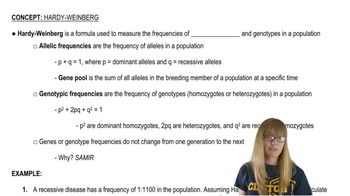
Allele frequencies represent the proportion of different alleles in a population's gene pool. The Hardy-Weinberg principle predicts stable allele frequencies in an ideal population without evolutionary forces. Understanding initial frequencies (p and q) is essential to track changes over generations, especially when selection acts on specific alleles.
Video consigliato:

Lethal Recessive Alleles and Natural Selection

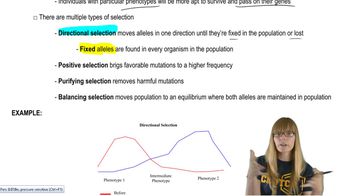
A lethal recessive allele causes death when homozygous (aa), removing those individuals from the population. This selection pressure reduces the frequency of the recessive allele over time, as homozygous recessive individuals do not reproduce. Heterozygotes (Aa) typically survive, allowing the allele to persist at low frequencies.
Video consigliato:
Percorso guidato
05:54
Natural Selection

Genetic Drift and Long-Term Allele Frequency Changes

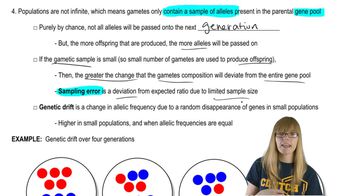
Genetic drift refers to random fluctuations in allele frequencies, especially in small populations, which can affect allele persistence. Over many generations, selection against lethal recessives and drift influence allele frequencies, often leading to a decrease in the lethal allele but rarely complete elimination without mutation or migration.
Video consigliato:
Pratica correlata
Domanda del libro di testo

Consider a population in which the frequency of allele A is p = 0.7 and the frequency of allele a is q = 0.3 and where the alleles are codominant. What will be the allele frequencies after one generation if the following occurs?

wAA = 1, wAa = 0.95, waa = 0.9

681
views
Domanda del libro di testo

One of the first Mendelian traits identified in humans was a dominant condition known as brachydactyly. This gene causes an abnormal shortening of the fingers or toes (or both). At the time, some researchers thought that the dominant trait would spread until 75 percent of the population would be affected (because the phenotypic ratio of dominant to recessive is 3 : 1). Show that the reasoning was incorrect.

588
views
Domanda del libro di testo

Consider a population in which the frequency of allele A is p = 0.7 and the frequency of allele a is q = 0.3 and where the alleles are codominant. What will be the allele frequencies after one generation if the following occurs?

wAA = 1, wAa = 0.99, waa = 0.98

701
views
Domanda del libro di testo

Assume that a recessive autosomal disorder occurs in 1 of 10,000 individuals (0.0001) in the general population and that in this population about 2 percent (0.02) of the individuals are carriers for the disorder. Estimate the probability of this disorder occurring in the offspring of a marriage between first cousins. Compare this probability to the population at large.

620
views
Domanda del libro di testo

Under what circumstances might a lethal dominant allele persist in a population?

520
views
Domanda del libro di testo

Consider a population in which the frequency of allele A is p = 0.7 and the frequency of allele a is q = 0.3 and where the alleles are codominant. What will be the allele frequencies after one generation if the following occurs?

wAA = 0.8, wAa = 1, waa = 0.8

675
views