Ch. 21 - Population and Evolutionary Genetics
Klug - Essentials of Genetics 10th Edition
Klug10th EditionEssentials of GeneticsISBN: 9780135588789Non è quello che usi tu?Cambia libro di testo
Capitolo 21, Problema 1c

How do we know whether the genetic structure of a population is static or dynamic?

Guida verificata passo dopo passo
1
Understand that the genetic structure of a population refers to the distribution of genetic variation within that population, including allele frequencies and genotype frequencies.
Recognize that a static genetic structure means allele frequencies remain constant over generations, while a dynamic structure means allele frequencies change over time.
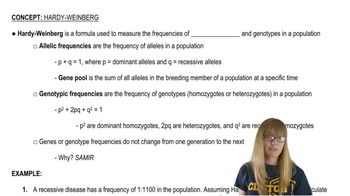
Use the Hardy-Weinberg principle as a baseline model, which predicts that allele and genotype frequencies will remain constant in an ideal population with no evolutionary forces acting (no mutation, migration, selection, genetic drift, or non-random mating).
Collect genetic data from the population at different time points and calculate allele frequencies using the formula \(p = \frac{2N_{AA} + N_{Aa}}{2N}\) and \(q = \frac{2N_{aa} + N_{Aa}}{2N}\), where \(N_{AA}\), \(N_{Aa}\), and \(N_{aa}\) are the numbers of individuals with each genotype, and \(N\) is the total number of individuals.
Compare allele frequencies across generations; if frequencies remain approximately the same and fit Hardy-Weinberg expectations, the structure is static; if frequencies change significantly, the structure is dynamic, indicating evolutionary forces at work.

Risposta video verificata per un problema simile:

Questa soluzione video è stata consigliata dai nostri tutor come utile per risolvere questo problema.
Durata del video:
1m

Concetti chiave

Ecco i concetti essenziali che devi comprendere per rispondere correttamente alla domanda.

Hardy-Weinberg Equilibrium

The Hardy-Weinberg equilibrium describes a theoretical state where allele and genotype frequencies in a population remain constant across generations, assuming no evolutionary forces act on the population. It serves as a baseline to determine if a population's genetic structure is static or changing.
Video consigliato:

Evolutionary Forces

Evolutionary forces such as natural selection, genetic drift, mutation, migration, and non-random mating can alter allele frequencies in a population. Detecting changes in these frequencies over time indicates a dynamic genetic structure.
Video consigliato:

Population Genetics Analysis

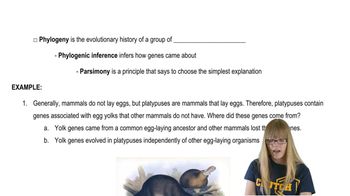
Population genetics uses statistical methods and genetic data to measure allele frequencies and genotype distributions over time. Comparing these data points helps identify whether the genetic structure is stable or evolving.
Video consigliato:
Percorso guidato
02:48
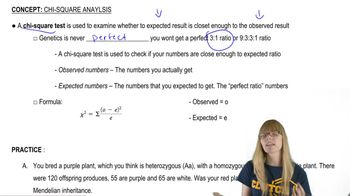
Chi Square Analysis