Ch. 3 - Mendelian Genetics
Klug - Essentials of Genetics 10th Edition
Klug10th EditionEssentials of GeneticsISBN: 9780135588789Non è quello che usi tu?Cambia libro di testo
Capitolo 3, Problema 17

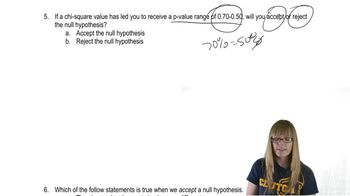
The basis for rejecting any null hypothesis is arbitrary. The researcher can set more or less stringent standards by deciding to raise or lower the p value used to reject or not reject the hypothesis. In the case of the chi-square analysis of genetic crosses, would the use of a standard of p = 0.10 be more or less stringent about not rejecting the null hypothesis? Explain.

Guida verificata passo dopo passo
1
Understand that the p-value in hypothesis testing represents the probability of obtaining results at least as extreme as those observed, assuming the null hypothesis is true.
Recognize that a lower p-value threshold (e.g., 0.05) means you require stronger evidence against the null hypothesis to reject it, making the test more stringent.
Conversely, a higher p-value threshold (e.g., 0.10) means you accept weaker evidence against the null hypothesis to reject it, making the test less stringent.
In the context of chi-square analysis of genetic crosses, using a p-value standard of 0.10 means you are more willing to reject the null hypothesis even if the evidence is not very strong.
Therefore, setting the p-value at 0.10 is less stringent about not rejecting the null hypothesis compared to a lower p-value standard like 0.05.

Risposta video verificata per un problema simile:

Questa soluzione video è stata consigliata dai nostri tutor come utile per risolvere questo problema.
Durata del video:
2m

Concetti chiave

Ecco i concetti essenziali che devi comprendere per rispondere correttamente alla domanda.

Null Hypothesis and Significance Level (p-value)

The null hypothesis is a default assumption that there is no effect or difference. The p-value represents the probability of observing the data if the null hypothesis is true. A significance level (alpha) is set to decide when to reject the null hypothesis, commonly 0.05, meaning results with p-values below this threshold lead to rejection.
Video consigliato:

Stringency of Significance Levels

Stringency refers to how strict the criteria are for rejecting the null hypothesis. A lower p-value threshold (e.g., 0.01) is more stringent, requiring stronger evidence to reject the null. Conversely, a higher p-value threshold (e.g., 0.10) is less stringent, making it easier to reject the null hypothesis.
Video consigliato:

Chi-square Test in Genetic Crosses

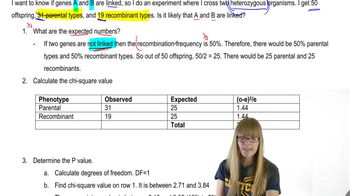
The chi-square test compares observed genetic data to expected ratios under the null hypothesis of no difference. It calculates a p-value to assess if deviations are due to chance. The chosen p-value threshold determines whether the genetic data significantly deviate from expected Mendelian ratios.
Video consigliato:
Percorso guidato
07:33
Chi Square and Linkage