
Ch. 3 - Mendelian Genetics
Klug - Essentials of Genetics 10th Edition
Klug10th EditionEssentials of GeneticsISBN: 9780135588789Non è quello che usi tu?Cambia libro di testo
Capitolo 3, Problema 24b

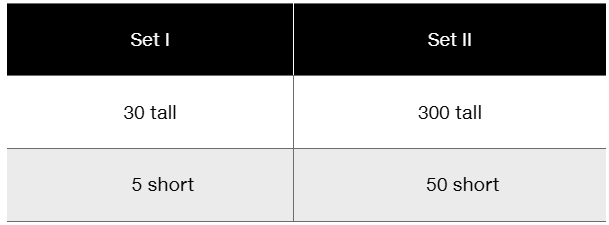
To assess Mendel's law of segregation using tomatoes, a true-breeding tall variety (SS) is crossed with a true-breeding short variety (ss). The heterozygous F₁ tall plants (Ss) were crossed to produce two sets of F₂ data, as follows.
Table comparing two data sets showing 30 tall and 5 short plants versus 300 tall and 50 short plants from a genetic cross.
From the above analysis, what can you conclude about the importance of generating large datasets in experimental conditions?

Guida verificata passo dopo passo
1
Step 1: Understand the genetic cross and expected ratio. The cross involves heterozygous tall plants (Ss) crossed with each other, where 'S' is dominant for tall and 's' is recessive for short. According to Mendel's law of segregation, the expected phenotypic ratio in the F₂ generation is 3 tall : 1 short.
Step 2: Calculate the expected numbers based on the total plants in each set. For Set I, total plants = 30 tall + 5 short = 35 plants. For Set II, total plants = 300 tall + 50 short = 350 plants. Use the expected 3:1 ratio to calculate expected counts: Expected tall = (3/4) × total, Expected short = (1/4) × total.
Step 3: Compare observed data to expected data. For each set, compare the observed number of tall and short plants to the expected numbers calculated in Step 2. This helps assess how closely the data fits Mendel's predicted ratio.
Step 4: Analyze the effect of sample size on data accuracy. Notice that Set II, with a larger sample size, is more likely to show a ratio closer to the expected 3:1 compared to Set I, which has a smaller sample size and more deviation from the expected ratio.
Step 5: Conclude the importance of large datasets. Larger sample sizes reduce the impact of random variation and provide more reliable data that better reflects true genetic ratios, supporting Mendel's law of segregation more convincingly.

Risposta video verificata per un problema simile:

Questa soluzione video è stata consigliata dai nostri tutor come utile per risolvere questo problema.
Durata del video:
1m

Concetti chiave

Ecco i concetti essenziali che devi comprendere per rispondere correttamente alla domanda.

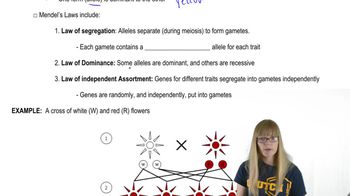
Mendel's Law of Segregation

Mendel's law of segregation states that allele pairs separate during gamete formation, so each gamete carries only one allele for each gene. In a monohybrid cross like Ss x Ss, the expected phenotypic ratio is 3:1, with three tall plants for every short plant, reflecting dominant and recessive traits.
Video consigliato:

Sample Size and Statistical Reliability

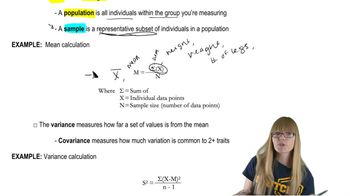
Larger sample sizes provide more reliable and accurate representations of expected genetic ratios by minimizing the effects of random variation. Small datasets may deviate from theoretical ratios due to chance, while larger datasets tend to closely approximate predicted Mendelian ratios.
Video consigliato:
Percorso guidato
11:06
Mathematical Measurements

Phenotypic Ratios in Genetic Crosses

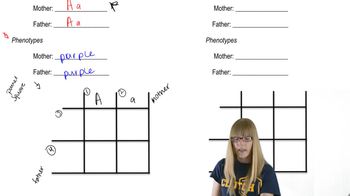
Phenotypic ratios describe the proportion of different observable traits in offspring from genetic crosses. For a heterozygous cross (Ss x Ss), the expected phenotypic ratio is 3 tall : 1 short, which can be confirmed by analyzing the distribution of tall and short plants in the F2 generation.
Video consigliato:
Percorso guidato
10:20
Monohybrid Cross