Ch. 4 - Modification of Mendelian Ratios
Klug - Essentials of Genetics 10th Edition
Klug10th EditionEssentials of GeneticsISBN: 9780135588789Non è quello che usi tu?Cambia libro di testo
Capitolo 4, Problema 18b

A geneticist from an alien planet that prohibits genetic research brought with him to Earth two pure-breeding lines of frogs. One line croaks by uttering 'rib-it rib-it' and has purple eyes. The other line croaks more softly by muttering 'knee-deep knee-deep' and has green eyes. With a newfound freedom of inquiry, the geneticist mated the two types of frogs, producing F₁ frogs that were all utterers and had blue eyes. A large F₂ generation then yielded the following ratios:
27/64 blue-eyed, 'rib-it' utterer
12/64 green-eyed, 'rib-it' utterer
9/64 blue-eyed, 'knee-deep' mutterer
9/64 purple-eyed, 'rib-it' utterer
4/64 green-eyed, 'knee-deep' mutterer
3/64 purple-eyed, 'knee-deep' mutterer
Of these, how many are controlling eye color? How can you tell? How many are controlling croaking?

Guida verificata passo dopo passo
1
Step 1: Identify the traits and their phenotypes. We have two traits: croaking sound ('rib-it' vs. 'knee-deep') and eye color (purple, blue, green). The parental lines are pure-breeding for these traits, so each parent is homozygous for its respective alleles.
Step 2: Analyze the F₁ generation phenotype. All F₁ frogs are 'rib-it' utterers with blue eyes, indicating that 'rib-it' and blue eyes are dominant phenotypes or result from heterozygous combinations.
Step 3: Examine the F₂ phenotypic ratios and total number of phenotypic classes. There are 6 phenotypic classes with specific fractions out of 64, suggesting a dihybrid cross involving two genes, each with multiple alleles or interactions.
Step 4: Determine the number of genes controlling each trait by comparing the observed ratios to expected Mendelian ratios. For example, a 27/64 ratio corresponds to (3/4)^3, which suggests three genes controlling eye color (since 64 = 4^3), while croaking phenotypes fit a simpler ratio, indicating fewer genes.
Step 5: Conclude that eye color is controlled by three genes (polygenic inheritance) because the phenotypic ratios fit a 3-gene model, while croaking is controlled by one gene (monogenic) because the ratios fit a simpler dominant/recessive pattern.

Risposta video verificata per un problema simile:

Questa soluzione video è stata consigliata dai nostri tutor come utile per risolvere questo problema.
Durata del video:
6m

Concetti chiave

Ecco i concetti essenziali che devi comprendere per rispondere correttamente alla domanda.

Dihybrid Cross and Mendelian Ratios

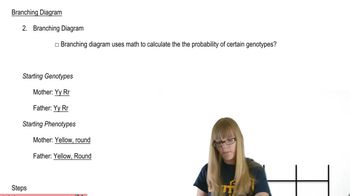
A dihybrid cross involves two genes, each with two alleles, and their independent assortment during gamete formation. The classic Mendelian ratio for two independently assorting genes with complete dominance is 9:3:3:1 in the F2 generation. Deviations or expansions of this ratio can indicate more complex inheritance patterns or multiple alleles.
Video consigliato:

Gene Interaction and Phenotypic Ratios

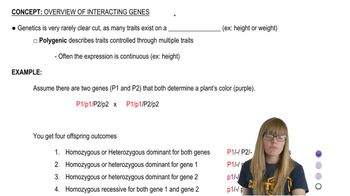
Phenotypic ratios in offspring reveal how many genes control traits and their interaction. When multiple genes influence traits independently, expected ratios follow Mendelian patterns. Complex ratios suggest multiple genes or linked genes, and analyzing the distribution of phenotypes helps determine the number of genes involved.
Video consigliato:
Percorso guidato
07:56
Interacting Genes Overview

Determining Number of Genes from Phenotypic Classes

The number of phenotypic classes in the F2 generation can indicate how many genes control a trait. For example, 4 phenotypic classes suggest two genes (2^2=4), while 8 classes suggest three genes (2^3=8). By counting distinct phenotype combinations and their ratios, one can infer the number of genes controlling each trait.
Video consigliato:
Pratica correlata
Domanda del libro di testo

A geneticist from an alien planet that prohibits genetic research brought with him to Earth two pure-breeding lines of frogs. One line croaks by uttering 'rib-it rib-it' and has purple eyes. The other line croaks more softly by muttering 'knee-deep knee-deep' and has green eyes. With a newfound freedom of inquiry, the geneticist mated the two types of frogs, producing F₁ frogs that were all utterers and had blue eyes. A large F₂ generation then yielded the following ratios:

27/64 blue-eyed, 'rib-it' utterer

12/64 green-eyed, 'rib-it' utterer

9/64 blue-eyed, 'knee-deep' mutterer

9/64 purple-eyed, 'rib-it' utterer

4/64 green-eyed, 'knee-deep' mutterer

3/64 purple-eyed, 'knee-deep' mutterer

Indicate the genotypes of the six F₂ phenotypes.

460
views
Domanda del libro di testo

While vermilion is X-linked in Drosophila and causes the eye color to be bright red, brown is an autosomal recessive mutation that causes the eye to be brown. Flies carrying both mutations lose all pigmentation and are white-eyed. Predict the F₁ and F₂ results of the following crosses:

white females x wild-type males

1886
views
Domanda del libro di testo

A geneticist from an alien planet that prohibits genetic research brought with him to Earth two pure-breeding lines of frogs. One line croaks by uttering 'rib-it rib-it' and has purple eyes. The other line croaks more softly by muttering 'knee-deep knee-deep' and has green eyes. With a newfound freedom of inquiry, the geneticist mated the two types of frogs, producing F₁ frogs that were all utterers and had blue eyes. A large F₂ generation then yielded the following ratios:

27/64 blue-eyed, 'rib-it' utterer

12/64 green-eyed, 'rib-it' utterer

9/64 blue-eyed, 'knee-deep' mutterer

9/64 purple-eyed, 'rib-it' utterer

4/64 green-eyed, 'knee-deep' mutterer

3/64 purple-eyed, 'knee-deep' mutterer

Assign gene symbols for all phenotypes and indicate the genotypes of the P₁ and F₁ frogs.

508
views
Domanda del libro di testo

A geneticist from an alien planet that prohibits genetic research brought with him to Earth two pure-breeding lines of frogs. One line croaks by uttering 'rib-it rib-it' and has purple eyes. The other line croaks more softly by muttering 'knee-deep knee-deep' and has green eyes. With a newfound freedom of inquiry, the geneticist mated the two types of frogs, producing F₁ frogs that were all utterers and had blue eyes. A large F₂ generation then yielded the following ratios:

27/64 blue-eyed, 'rib-it' utterer

12/64 green-eyed, 'rib-it' utterer

9/64 blue-eyed, 'knee-deep' mutterer

9/64 purple-eyed, 'rib-it' utterer

4/64 green-eyed, 'knee-deep' mutterer

3/64 purple-eyed, 'knee-deep' mutterer

How many total gene pairs are involved in the inheritance of both traits? Support your answer.

491
views