
Ch. 4 - Modification of Mendelian Ratios
Klug - Essentials of Genetics 10th Edition
Klug10th EditionEssentials of GeneticsISBN: 9780135588789Non è quello che usi tu?Cambia libro di testo
Capitolo 4, Problema 7

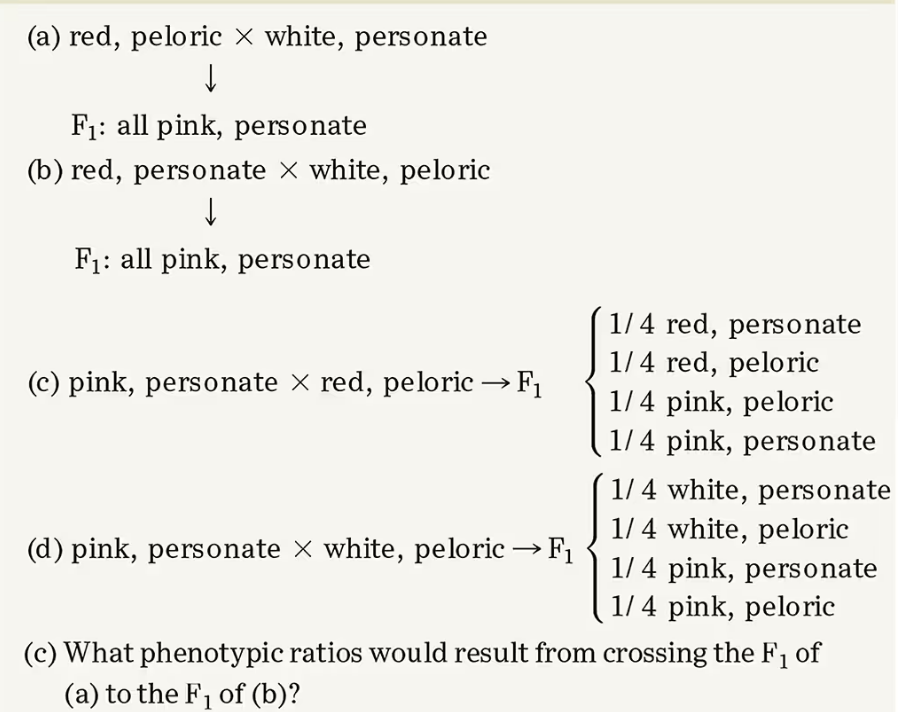
Flower color may be red, white, or pink, and flower shape may be personate or peloric. For the following crosses, determine the P₁ and F₁ genotypes:
Crosses showing flower color and shape combinations with resulting F1 genotypes and phenotypic ratios for given crosses.

Guida verificata passo dopo passo
1
Step 1: Define the alleles and their dominance relationships for both traits. For flower color, red (R) and white (W) show incomplete dominance, resulting in pink (RW) in heterozygotes. For flower shape, personate (P) and peloric (p) are determined by a simple dominant-recessive relationship, where personate (P) is dominant over peloric (p).
Step 2: Assign genotypes to the P₁ parents in crosses (a) and (b) based on the phenotypes and the F₁ results. For example, in (a), since crossing red peloric with white personate yields all pink personate F₁, deduce the genotypes of the parents considering incomplete dominance for color and dominance for shape.
Step 3: Determine the F₁ genotypes for crosses (a) and (b) by combining the alleles from the P₁ parents. Use the rules of inheritance: incomplete dominance for color (heterozygotes are pink) and dominance for shape (presence of P allele results in personate).
Step 4: For part (c), cross the F₁ genotypes from (a) and (b). Set up a Punnett square for both traits separately (color and shape), then combine the results to find the phenotypic ratios. Remember to consider the independent assortment of the two traits.
Step 5: Calculate the phenotypic ratios by multiplying the probabilities of each color genotype with each shape genotype from the Punnett squares. This will give the expected proportions of each phenotype in the offspring.

Risposta video verificata per un problema simile:

Questa soluzione video è stata consigliata dai nostri tutor come utile per risolvere questo problema.
Durata del video:
3m

Concetti chiave

Ecco i concetti essenziali che devi comprendere per rispondere correttamente alla domanda.

Incomplete Dominance

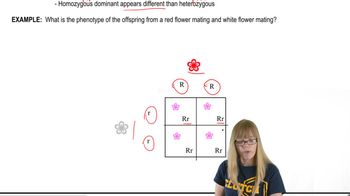
Incomplete dominance occurs when the heterozygous phenotype is intermediate between the two homozygous phenotypes, such as red and white flower colors producing pink flowers. This concept explains why crossing red and white flowers results in all pink offspring in the F1 generation.
Video consigliato:
Percorso guidato
04:37
Variations on Dominance

Independent Assortment

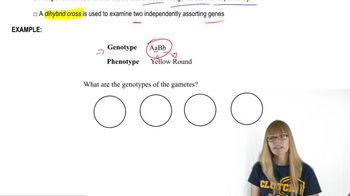
Independent assortment refers to the principle that alleles of different genes segregate independently during gamete formation. This explains the variety of phenotypic combinations (color and shape) seen in the offspring, as flower color and shape genes assort independently.
Video consigliato:
Percorso guidato
04:58
Gamete Genetics and Independent Assortment

Genotype and Phenotype Ratios

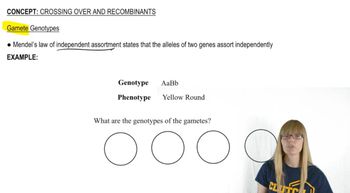
Genotype ratios describe the genetic makeup of offspring, while phenotype ratios describe observable traits. Understanding how to deduce genotypes from phenotypes and predict offspring ratios is essential for solving crosses and interpreting the results shown in the problem.
Video consigliato:
Percorso guidato
07:52
Gamete Genotypes
Pratica correlata
Domanda del libro di testo

With regard to the ABO blood types in humans, determine the genotype of the male parent and female parent shown here:

Male parent: Blood type B; mother type O

Female parent: Blood type A; father type B

Predict the blood types of the offspring that this couple may have and the expected proportion of each.

1325
views
Domanda del libro di testo

In rats, the following genotypes of two independently assorting autosomal genes determine coat color:

A third gene pair on a separate autosome determines whether or not any color will be produced. The CC and Cc genotypes allow color according to the expression of the A and B alleles. However, the cc genotype results in albino rats regardless of the A and B alleles present. Determine the F₁ phenotypic ratio of the following crosses:

AAbbCC×aaBBcc

595
views
Domanda del libro di testo

In foxes, two alleles of a single gene, P and p, may result in lethality (PP), platinum coat (Pp), or silver coat (pp). What ratio is obtained when platinum foxes are interbred? Is the P allele behaving dominantly or recessively in causing (a) lethality; (b) platinum coat color?

993
views
Domanda del libro di testo

Three gene pairs located on separate autosomes determine flower color and shape as well as plant height. The first pair exhibits incomplete dominance, where the color can be red, pink (the heterozygote), or white. The second pair leads to personate (dominant) or peloric (recessive) flower shape, while the third gene pair produces either the dominant tall trait or the recessive dwarf trait. Homozygous plants that are red, personate, and tall are crossed to those that are white, peloric, and dwarf. Determine the F₁ genotype(s) and phenotype(s). If the F₁ plants are interbred, what proportion of the offspring will exhibit the same phenotype as the F₁ plants?

828
views
Domanda del libro di testo

Given the inheritance pattern of coat color in rats described in Problem 17, predict the genotype and phenotype of the parents who produced the following offspring:

9/16 gray: 3/16 yellow: 3/16 black: 1/16 cream

535
views
Domanda del libro di testo

In rats, the following genotypes of two independently assorting autosomal genes determine coat color:

A third gene pair on a separate autosome determines whether or not any color will be produced. The CC and Cc genotypes allow color according to the expression of the A and B alleles. However, the cc genotype results in albino rats regardless of the A and B alleles present. Determine the F₁ phenotypic ratio of the following crosses:

AaBbCc×AaBbcc

474
views