Ch. 4 - Modification of Mendelian Ratios
Klug - Essentials of Genetics 10th Edition
Klug10th EditionEssentials of GeneticsISBN: 9780135588789Non è quello che usi tu?Cambia libro di testo
Capitolo 4, Problema 9c

Given the inheritance pattern of coat color in rats described in Problem 17, predict the genotype and phenotype of the parents who produced the following offspring: 27/64 gray:
16/64 albino: 9/64 yellow: 9/64 black: 3/64 cream

Guida verificata passo dopo passo
1
Step 1: Identify the inheritance pattern described in Problem 17. Since the offspring phenotypic ratios are given as fractions out of 64, this suggests a dihybrid cross involving two genes with multiple alleles affecting coat color in rats. Typically, such ratios come from a cross involving two genes with epistatic interactions or multiple alleles.
Step 2: Assign symbols to the genes involved. For example, let’s say gene A controls pigment production (A = pigment, a = albino) and gene B controls pigment color (B = black, b = yellow). The presence of albino (16/64) suggests recessive homozygosity at the A locus (aa) results in albino phenotype regardless of B locus genotype.
Step 3: Analyze the phenotypic ratios to deduce genotypes. The ratio 27/64 gray, 16/64 albino, 9/64 yellow, 9/64 black, and 3/64 cream suggests a combination of genotypes at both loci. Use the expected Mendelian ratios for dihybrid crosses and epistasis to match these numbers to genotypes.
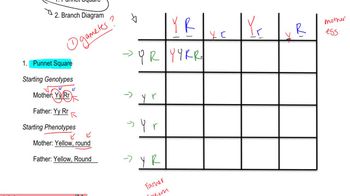
Step 4: Use Punnett squares to model the cross between two heterozygous parents at both loci (e.g., AaBb x AaBb) and calculate the expected phenotypic ratios. Compare these expected ratios to the observed ratios to confirm the parental genotypes.
Step 5: Conclude the most likely genotypes of the parents based on the matching phenotypic ratios and explain the phenotypes of the offspring based on the genotypes at each locus, considering dominance, recessiveness, and epistatic interactions.

Risposta video verificata per un problema simile:

Questa soluzione video è stata consigliata dai nostri tutor come utile per risolvere questo problema.
Durata del video:
1m

Concetti chiave

Ecco i concetti essenziali che devi comprendere per rispondere correttamente alla domanda.

Mendelian Inheritance and Dihybrid Crosses

Mendelian inheritance explains how traits are passed from parents to offspring through dominant and recessive alleles. A dihybrid cross involves two genes, each with two alleles, producing a characteristic phenotypic ratio in offspring. Understanding these ratios helps predict parental genotypes based on observed offspring phenotypes.
Video consigliato:

Epistasis and Coat Color Genetics

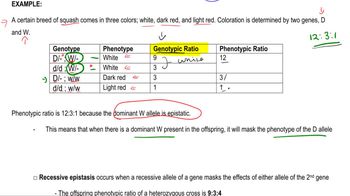
Epistasis occurs when one gene masks or modifies the expression of another gene, affecting phenotypic ratios. In coat color genetics, interactions between multiple loci (e.g., pigment production and pigment distribution genes) can produce complex inheritance patterns, explaining deviations from classic Mendelian ratios.
Video consigliato:
Percorso guidato
13:08
Epistatic Genes

Phenotypic Ratios and Genotypic Prediction

Analyzing offspring phenotypic ratios allows inference of parental genotypes by matching observed ratios to expected Mendelian or epistatic patterns. Calculating probabilities for each phenotype helps identify which allele combinations parents likely carry, enabling prediction of both genotype and phenotype.
Video consigliato:
Percorso guidato
07:52
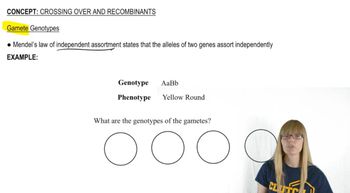
Gamete Genotypes
Pratica correlata
Domanda del libro di testo

Given the inheritance pattern of coat color in rats described in Problem 17, predict the genotype and phenotype of the parents who produced the following offspring:

9/16 gray: 3/16 yellow: 4/16 albino

561
views
Domanda del libro di testo

Given the inheritance pattern of coat color in rats described in Problem 17, predict the genotype and phenotype of the parents who produced the following offspring:

9/16 gray: 3/16 yellow: 3/16 black: 1/16 cream

535
views
Domanda del libro di testo

In humans, the ABO blood type is under the control of autosomal multiple alleles. Color blindness is a recessive X-linked trait. If two parents who are both type A and have normal vision produce a son who is color-blind and is type O, what is the probability that their next child will be a female who has normal vision and is type O?

1181
views
Domanda del libro di testo

In goats, the development of the beard is due to a recessive gene. The following cross involving true-breeding goats was made and carried to the F₂ generation:

Offer an explanation for the inheritance and expression of this trait, diagramming the cross. Propose one or more crosses to test your hypothesis.

740
views
Domanda del libro di testo

In rats, the following genotypes of two independently assorting autosomal genes determine coat color:

A third gene pair on a separate autosome determines whether or not any color will be produced. The CC and Cc genotypes allow color according to the expression of the A and B alleles. However, the cc genotype results in albino rats regardless of the A and B alleles present. Determine the F₁ phenotypic ratio of the following crosses:

AaBbCc×AaBbcc

474
views
Domanda del libro di testo

A husband and wife have normal vision, although both of their fathers are red–green color-blind, an inherited X-linked recessive condition. What is the probability that their first child will be (a) a normal son, (b) a normal daughter, (c) a color-blind son, (d) a color-blind daughter?

865
views
1
rank