Describe the origin of cultivated American cotton.
Ch. 6 - Chromosome Mutations: Variation in Number and Arrangement
Klug10th EditionEssentials of GeneticsISBN: 9780135588789Non è quello che usi tu?Cambia libro di testo
Tutti i libri di testo
Klug 10th Edition
Ch. 6 - Chromosome Mutations: Variation in Number and Arrangement
Problema 9
Klug 10th Edition
Ch. 6 - Chromosome Mutations: Variation in Number and Arrangement
Problema 9Capitolo 6, Problema 9
Predict how the synaptic configurations of homologous pairs of chromosomes might appear when one member is normal and the other member has sustained a deletion or duplication.
Guida verificata passo dopo passo1
Understand that synapsis is the pairing of homologous chromosomes during prophase I of meiosis, where chromosomes align gene by gene to form a synaptonemal complex.
Recognize that when one homologous chromosome has a deletion (a missing segment), the other homologous chromosome will have an unpaired region because there is no corresponding segment to pair with.
Predict that the chromosome with the deletion will cause a loop or bulge to form on the normal chromosome during synapsis, as the normal chromosome's extra segment has no counterpart on the deleted chromosome.
Similarly, if one homolog has a duplication (an extra segment), the duplicated region will loop out on the chromosome with the duplication to allow the rest of the chromosome to align properly with the normal homolog.
Conclude that these loops or bulges are visible under a microscope during meiosis and represent structural adjustments to maintain as much pairing as possible despite the deletion or duplication.

Risposta video verificata per un problema simile:
Questa soluzione video è stata consigliata dai nostri tutor come utile per risolvere questo problema.
Durata del video:
2mConcetti chiave
Ecco i concetti essenziali che devi comprendere per rispondere correttamente alla domanda.
Chromosome Synapsis
Synapsis is the pairing of homologous chromosomes during prophase I of meiosis, allowing for alignment and recombination. Proper synapsis ensures that homologs are closely paired along their lengths, facilitating genetic exchange and accurate segregation.
Video consigliato:
Percorso guidato
Chromosome Structure
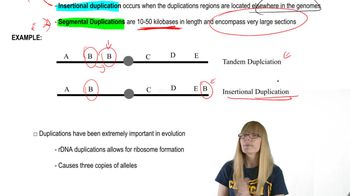
Chromosomal Deletions and Duplications
Deletions involve the loss of a chromosome segment, while duplications involve the repetition of a segment. These structural changes alter the length and gene content of one homolog, potentially disrupting normal pairing during meiosis.
Video consigliato:
Percorso guidato
Duplications
Synaptic Configurations in Structural Heterozygotes
When one homolog has a deletion or duplication, synapsis can form loops or unpaired regions to accommodate length differences. For example, a duplication may cause a loop on the normal chromosome, while a deletion may cause a loop on the altered chromosome, reflecting misalignment.
Video consigliato:
Percorso guidato
Ribosome Structure
Pratica correlata
Domanda del libro di testo
795
views
Domanda del libro di testo
Inversions are said to 'suppress crossing over.' Is this terminology technically correct? If not, restate the description accurately.
682
views
Domanda del libro di testo
Contrast the fertility of an allotetraploid with an autotriploid and an autotetraploid.
810
views
Domanda del libro di testo
Human adult hemoglobin is a tetramer containing two alpha (α) and two beta (β) polypeptide chains. The α gene cluster on chromosome 16 and the β gene cluster on chromosome 11 share amino acid similarities such that 61 of the amino acids of the α-globin polypeptide (141 amino acids long) are shared in identical sequence with the β-globin polypeptide (146 amino acids long). How might one explain the existence of two polypeptides with partially shared function and structure on two different chromosomes?
568
views