Ch. 6 - Chromosome Mutations: Variation in Number and Arrangement
Klug - Essentials of Genetics 10th Edition
Klug10th EditionEssentials of GeneticsISBN: 9780135588789Non è quello che usi tu?Cambia libro di testo
Capitolo 6, Problema 13

The primrose, Primula kewensis, has 36 chromosomes that are similar in appearance to the chromosomes in two related species, P. floribunda (2n=18) and P. verticillata (2n=18). How could P. kewensis arise from these species? How would you describe P. kewensis in genetic terms?

Guida verificata passo dopo passo
1
Step 1: Understand the chromosome numbers of the species involved. Both P. floribunda and P. verticillata have 2n = 18 chromosomes, meaning they are diploid species with 18 chromosomes in their somatic cells. P. kewensis has 2n = 36 chromosomes, which is exactly double the chromosome number of the other two species.
Step 2: Consider the possibility of hybridization between P. floribunda and P. verticillata. When two different species hybridize, their offspring initially have one set of chromosomes from each parent, resulting in a hybrid with n = 9 + n = 9 = 18 chromosomes, which is typically sterile due to problems in chromosome pairing during meiosis.
Step 3: Explore the concept of chromosome doubling (polyploidy). If the sterile hybrid undergoes chromosome doubling, it would have 2n = 36 chromosomes, restoring fertility because each chromosome now has a homologous partner for pairing during meiosis.
Step 4: Define P. kewensis genetically as an allopolyploid. This means it contains two complete sets of chromosomes derived from two different species, making it a fertile hybrid with doubled chromosome number.
Step 5: Summarize that P. kewensis likely arose through hybridization between P. floribunda and P. verticillata followed by chromosome doubling, resulting in an allopolyploid species with 2n = 36 chromosomes.

Risposta video verificata per un problema simile:

Questa soluzione video è stata consigliata dai nostri tutor come utile per risolvere questo problema.
Durata del video:
1m

Concetti chiave

Ecco i concetti essenziali che devi comprendere per rispondere correttamente alla domanda.

Polyploidy

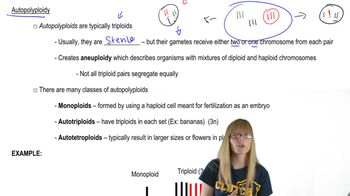
Polyploidy is the condition of having more than two complete sets of chromosomes. It commonly occurs in plants and can result from the hybridization of two species followed by chromosome doubling. This process can create new species with increased chromosome numbers, such as a tetraploid with four sets of chromosomes.
Video consigliato:

Hybridization

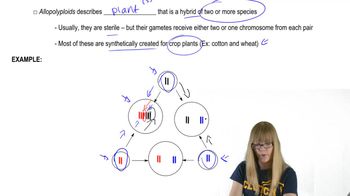
Hybridization is the crossing of two different species or genetically distinct populations to produce offspring. In plants, hybrids can combine traits from both parents, and if chromosome doubling occurs, the hybrid can become fertile and form a new species, as seen in allopolyploidy.
Video consigliato:
Percorso guidato
03:08
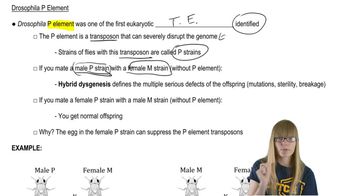
Drosophila P Element

Allopolyploidy

Allopolyploidy is a type of polyploidy where the chromosome sets come from different species. It arises when two species hybridize and the resulting hybrid undergoes chromosome doubling, restoring fertility. This explains how Primula kewensis (2n=36) could arise from two species each with 2n=18 chromosomes.
Video consigliato:
Pratica correlata
Domanda del libro di testo

Drosophila may be monosomic for chromosome 4, yet remain fertile. Contrast the F₁ and F₂ results of the following crosses involving the recessive chromosome 4 trait, bent bristles:

monosomic IV, normal bristles x diploid, bent bristles.

538
views
Domanda del libro di testo

Inversions are said to 'suppress crossing over.' Is this terminology technically correct? If not, restate the description accurately.

682
views
Domanda del libro di testo

Certain varieties of chrysanthemums contain 18, 36, 54, 72, and 90 chromosomes; all are multiples of a basic set of nine chromosomes. How would you describe these varieties genetically? What feature do the karyotypes of each variety share? A variety with 27 chromosomes has been discovered, but it is sterile. Why?

507
views
Domanda del libro di testo

Drosophila may be monosomic for chromosome 4, yet remain fertile. Contrast the F₁ and F₂ results of the following crosses involving the recessive chromosome 4 trait, bent bristles:

monosomic IV, bent bristles x diploid, normal bristles

521
views
Domanda del libro di testo

Human adult hemoglobin is a tetramer containing two alpha (α) and two beta (β) polypeptide chains. The α gene cluster on chromosome 16 and the β gene cluster on chromosome 11 share amino acid similarities such that 61 of the amino acids of the α-globin polypeptide (141 amino acids long) are shared in identical sequence with the β-globin polypeptide (146 amino acids long). How might one explain the existence of two polypeptides with partially shared function and structure on two different chromosomes?

568
views