
Ch. 7 - Linkage and Chromosome Mapping in Eukaryotes
Klug - Essentials of Genetics 10th Edition
Klug10th EditionEssentials of GeneticsISBN: 9780135588789Non è quello che usi tu?Cambia libro di testo
Capitolo 7, Problema 22

Based on our discussion of the potential inaccuracy of mapping, would you revise your answer to Problem 22? If so, how?

Guida verificata passo dopo passo
1
Step 1: Review the original answer to Problem 22 carefully, noting the genetic map distances and recombination frequencies that were calculated or inferred.
Step 2: Understand the concept of mapping inaccuracies, which often arise due to factors like interference, double crossovers, or limitations in detecting recombination events, as discussed in Figure 5.12.
Step 3: Consider how these inaccuracies might affect the original map distances—specifically, whether the distances might be underestimated or overestimated due to undetected double crossovers or interference.
Step 4: Adjust the original calculations by incorporating corrections for interference or by using more accurate mapping functions (such as the Kosambi or Haldane mapping functions) that account for crossover interference.
Step 5: Revise your answer by explaining how the corrected map distances or recombination frequencies differ from the original ones, and describe the biological implications of these adjustments on the genetic map.

Risposta video verificata per un problema simile:

Questa soluzione video è stata consigliata dai nostri tutor come utile per risolvere questo problema.
Durata del video:
1m

Concetti chiave

Ecco i concetti essenziali che devi comprendere per rispondere correttamente alla domanda.

Genetic Mapping and Recombination Frequency

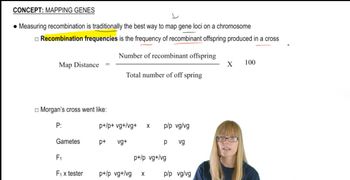
Genetic mapping estimates the relative positions of genes on a chromosome based on recombination frequencies. The frequency of crossover events between genes reflects their physical distance, with closer genes recombining less often. Understanding this helps interpret map distances and their potential inaccuracies.
Video consigliato:

Limitations and Inaccuracies in Genetic Maps

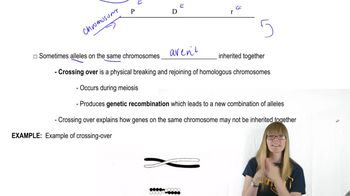
Genetic maps can be inaccurate due to factors like interference, multiple crossovers, and limited sample sizes. These factors can cause underestimation or overestimation of distances between genes, leading to revisions in gene order or distance estimates.
Video consigliato:
Percorso guidato
11:11
Mapping Overview

Interpreting and Revising Genetic Data

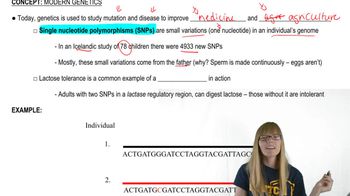
Revising answers based on new data or recognized inaccuracies involves critical analysis of mapping results. This includes reassessing gene order, distances, and considering alternative explanations or additional experiments to improve map accuracy.
Video consigliato:
Percorso guidato
09:03
Modern Genetics