Ch. 7 - Linkage and Chromosome Mapping in Eukaryotes
Klug - Essentials of Genetics 10th Edition
Klug10th EditionEssentials of GeneticsISBN: 9780135588789Non è quello che usi tu?Cambia libro di testo
Capitolo 7, Problema 1d

How do we know that sister chromatids undergo recombination during mitosis?

Guida verificata passo dopo passo
1
Understand the biological context: Sister chromatids are identical copies of a chromosome formed during DNA replication in the S phase of the cell cycle, and mitosis is the process of cell division that ensures each daughter cell receives an identical set of chromosomes.
Recall that recombination typically occurs during meiosis to increase genetic diversity, but evidence shows that sister chromatids can also undergo recombination during mitosis, primarily for DNA repair purposes.
Examine experimental evidence such as the use of molecular markers or DNA sequencing techniques that detect exchange of genetic material between sister chromatids, indicating recombination events.
Consider cytological methods like fluorescence microscopy with labeled chromatids, which can visualize physical exchanges or crossover points between sister chromatids during mitosis.
Review genetic studies where mutations or DNA damage induce recombination between sister chromatids, demonstrating that mitotic recombination is a mechanism for maintaining genome stability rather than generating diversity.

Risposta video verificata per un problema simile:

Questa soluzione video è stata consigliata dai nostri tutor come utile per risolvere questo problema.
Durata del video:
2m

Concetti chiave

Ecco i concetti essenziali che devi comprendere per rispondere correttamente alla domanda.

Sister Chromatids and Their Structure

Sister chromatids are identical copies of a single chromosome connected by a centromere, formed during DNA replication in the S phase. Understanding their structure is essential because recombination involves the exchange of genetic material between these chromatids, which impacts genetic stability during cell division.
Video consigliato:

Mitotic Recombination Mechanism

Mitotic recombination refers to the exchange of genetic information between sister chromatids during mitosis, often as a repair mechanism for DNA damage. Unlike meiotic recombination, it is less frequent but crucial for maintaining genome integrity by correcting replication errors or breaks.
Video consigliato:
Percorso guidato
03:51
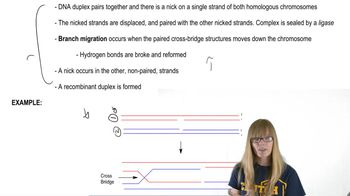
Recombination after Single Strand Breaks

Experimental Evidence for Sister Chromatid Recombination

Evidence for recombination during mitosis comes from genetic and molecular studies, such as marker segregation analysis and DNA repair assays, showing crossover events between sister chromatids. Techniques like fluorescence microscopy and molecular tagging help visualize and confirm these recombination events.
Video consigliato:
Percorso guidato
07:38
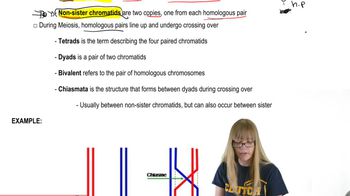
Crossing Over Terminology