Ch. 9 - DNA Structure and Analysis
Klug - Essentials of Genetics 10th Edition
Klug10th EditionEssentials of GeneticsISBN: 9780135588789Non è quello che usi tu?Cambia libro di testo
Capitolo 9, Problema 30a

Newsdate: March 1, 2030. A unique creature has been discovered during exploration of outer space. Recently, its genetic material has been isolated and analyzed. This material is similar in some ways to DNA in its chemical makeup. It contains in abundance the 4-carbon sugar erythrose and a molar equivalent of phosphate groups. In addition, it contains six nitrogenous bases: adenine (A), guanine (G), thymine (T), cytosine (C), hypoxanthine (H), and xanthine (X). These bases exist in the following relative proportions:
A =T = H and C = G = X
X-ray diffraction studies have established a regularity in the molecule and a constant diameter of about 30 Å. Together, these data have suggested a model for the structure of this molecule.
Propose a general model of this molecule. Describe it briefly.

Guida verificata passo dopo passo
1
Step 1: Identify the key components of the molecule based on the problem description. The molecule contains a 4-carbon sugar called erythrose, phosphate groups in molar equivalence, and six nitrogenous bases: adenine (A), guanine (G), thymine (T), cytosine (C), hypoxanthine (H), and xanthine (X).
Step 2: Analyze the base pairing rules implied by the relative proportions: A = T = H and C = G = X. This suggests that bases are grouped into two sets with equal molar amounts, indicating possible base pairing between these groups.
Step 3: Consider the structural implications of the X-ray diffraction data showing a regular structure with a constant diameter of about 30 Å. This suggests a helical or double-stranded structure similar to DNA, but with a larger diameter due to the different sugar and additional bases.
Step 4: Propose that the molecule forms a double helix with strands composed of erythrose-phosphate backbones, where bases from one strand pair specifically with bases from the complementary strand. The base pairing likely involves hydrogen bonding between A, T, and H on one side and C, G, and X on the other, maintaining the constant diameter.
Step 5: Summarize the model by describing the molecule as a double-stranded helical structure with erythrose sugars and phosphate groups forming the backbone, and six nitrogenous bases pairing in a specific manner to stabilize the structure and maintain uniform diameter.

Risposta video verificata per un problema simile:

Questa soluzione video è stata consigliata dai nostri tutor come utile per risolvere questo problema.
Durata del video:
2m

Concetti chiave

Ecco i concetti essenziali che devi comprendere per rispondere correttamente alla domanda.

Nucleic Acid Structure and Components

Nucleic acids are polymers made of sugar-phosphate backbones and nitrogenous bases. DNA typically contains a 5-carbon sugar (deoxyribose), phosphate groups, and four bases (A, T, G, C). Understanding the chemical makeup and base composition is essential to model any nucleic acid-like molecule, including variations in sugar type and additional bases.
Video consigliato:
Percorso guidato
03:49
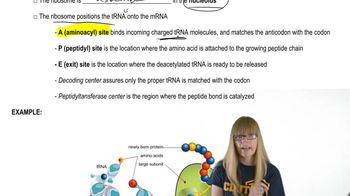
Ribosome Structure

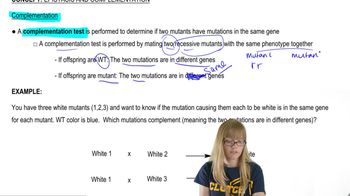
Base Pairing and Complementarity

Base pairing involves hydrogen bonding between complementary nitrogenous bases, which stabilizes the nucleic acid structure. In DNA, A pairs with T and G pairs with C. The question’s base proportions (A=T=H and C=G=X) suggest specific pairing rules that must be considered to propose a stable double-stranded structure.
Video consigliato:
Percorso guidato
05:05
Complementation

X-ray Diffraction and Molecular Geometry

X-ray diffraction reveals the three-dimensional arrangement and dimensions of molecules, such as the helical structure and diameter of nucleic acids. A constant diameter (~30 Å) indicates a regular, possibly double-helical structure, guiding the spatial arrangement of sugar-phosphate backbones and base pairs in the proposed model.
Video consigliato:
Pratica correlata
Domanda del libro di testo

One of the most common spontaneous lesions that occurs in DNA under physiological conditions is the hydrolysis of the amino group of cytosine, converting the cytosine to uracil. What would be the effect on DNA structure of a uracil group replacing cytosine?

674
views
Domanda del libro di testo

A primitive eukaryote was discovered that displayed a unique nucleic acid as its genetic material. Analysis provided the following information:

About 75 percent of the sugars are deoxyribose, while 25 percent are ribose.

Postulate a model for the structure of this molecule that is consistent with the foregoing observations.

406
views
Domanda del libro di testo

Newsdate: March 1, 2030. A unique creature has been discovered during exploration of outer space. Recently, its genetic material has been isolated and analyzed. This material is similar in some ways to DNA in its chemical makeup. It contains in abundance the 4-carbon sugar erythrose and a molar equivalent of phosphate groups. In addition, it contains six nitrogenous bases: adenine (A), guanine (G), thymine (T), cytosine (C), hypoxanthine (H), and xanthine (X). These bases exist in the following relative proportions:

A =T = H and C = G = X

X-ray diffraction studies have established a regularity in the molecule and a constant diameter of about 30 Å. Together, these data have suggested a model for the structure of this molecule.

Given the constant diameter of 30 Å, do you think that either (i) both H and X are purines or both pyrimidines, or (ii) one is a purine and one is a pyrimidine?

596
views
Domanda del libro di testo

During gel electrophoresis, DNA molecules can easily be separated according to size because all DNA molecules have the same charge-to-mass ratio and the same shape (long rod). Would you expect RNA molecules to behave in the same manner as DNA during gel electrophoresis? Why or why not?

822
views
Domanda del libro di testo

In some organisms, cytosine is methylated at carbon 5 of the pyrimidine ring after it is incorporated into DNA. If a 5-methyl cytosine molecule is then hydrolyzed, what base will be generated?

643
views
Domanda del libro di testo

Newsdate: March 1, 2030. A unique creature has been discovered during exploration of outer space. Recently, its genetic material has been isolated and analyzed. This material is similar in some ways to DNA in its chemical makeup. It contains in abundance the 4-carbon sugar erythrose and a molar equivalent of phosphate groups. In addition, it contains six nitrogenous bases: adenine (A), guanine (G), thymine (T), cytosine (C), hypoxanthine (H), and xanthine (X). These bases exist in the following relative proportions:

A =T = H and C = G = X

X-ray diffraction studies have established a regularity in the molecule and a constant diameter of about 30 Å. Together, these data have suggested a model for the structure of this molecule.

What base-pairing properties must exist for H and for X in the model?

532
views