Ch. 9 - DNA Structure and Analysis
Klug - Essentials of Genetics 10th Edition
Klug10th EditionEssentials of GeneticsISBN: 9780135588789Non è quello che usi tu?Cambia libro di testo
Capitolo 9, Problema 24

What is the chemical basis of molecular hybridization?

Guida verificata passo dopo passo
1
Understand that molecular hybridization refers to the process where two complementary strands of nucleic acids (DNA or RNA) form a double-stranded molecule by base pairing.
Recognize that the chemical basis of this process lies in the specific hydrogen bonding between complementary nitrogenous bases: adenine (A) pairs with thymine (T) in DNA or uracil (U) in RNA, and cytosine (C) pairs with guanine (G).
Recall that adenine and thymine/uracil form two hydrogen bonds, while cytosine and guanine form three hydrogen bonds, which stabilize the hybridized structure.
Note that the hybridization process depends on the complementarity and the ability of these bases to form hydrogen bonds, allowing the strands to anneal or re-anneal after denaturation.
Summarize that the chemical basis of molecular hybridization is the formation of specific hydrogen bonds between complementary nucleobases, enabling the pairing and stability of nucleic acid strands.

Risposta video verificata per un problema simile:

Questa soluzione video è stata consigliata dai nostri tutor come utile per risolvere questo problema.
Durata del video:
1m

Concetti chiave

Ecco i concetti essenziali che devi comprendere per rispondere correttamente alla domanda.

Base Pairing Rules

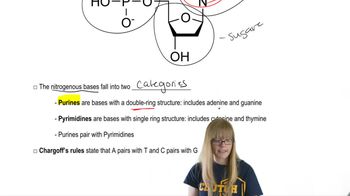
Molecular hybridization relies on the specific pairing between complementary nucleotides: adenine pairs with thymine (or uracil in RNA), and cytosine pairs with guanine. This specificity is due to hydrogen bonding patterns, which enable strands of nucleic acids to recognize and bind to each other accurately.
Video consigliato:
Percorso guidato
03:49
Base Distortions

Hydrogen Bonding

Hydrogen bonds are weak, non-covalent interactions that form between complementary bases in nucleic acids. These bonds stabilize the hybridized double-stranded structure, allowing single strands of DNA or RNA to anneal based on sequence complementarity.
Video consigliato:

Nucleic Acid Structure

The chemical structure of nucleic acids, including the sugar-phosphate backbone and nitrogenous bases, facilitates hybridization. The linear arrangement and polarity of strands allow complementary sequences to align antiparallel and form stable duplexes through base pairing.
Video consigliato:
Percorso guidato
03:49
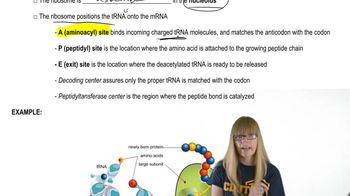
Ribosome Structure