
Ch. 11 - DNA Replication and Recombination
Klug - Concepts of Genetics 12th Edition
Klug12th EditionConcepts of GeneticsISBN: 9780135564776Non è quello che usi tu?Cambia libro di testo
Capitolo 11, Problema 20d

Several temperature-sensitive mutant strains of E. coli display the following characteristics. Predict what enzyme or function is being affected by each mutation.
Synthesis is very slow.

Guida verificata passo dopo passo
1
Step 1: Understand the context of temperature-sensitive mutants in E. coli. These mutants have enzymes or proteins that function normally at a permissive temperature but lose function at a restrictive (higher) temperature, causing observable phenotypic changes such as slow synthesis.
Step 2: Identify what 'synthesis is very slow' refers to. In E. coli, synthesis could mean DNA replication, RNA transcription, or protein translation. Since the problem is general, consider which enzyme or function is critical for the overall synthesis process.
Step 3: Recall that DNA replication requires DNA polymerase, RNA transcription requires RNA polymerase, and protein synthesis requires ribosomes and associated factors. Slow synthesis suggests a bottleneck in one of these key enzymatic activities.
Step 4: Since the problem states 'synthesis is very slow' without specifying which type, the most likely affected enzyme is DNA polymerase if the mutation affects DNA replication, or RNA polymerase if it affects transcription. Consider which enzyme's impairment would broadly slow down synthesis.
Step 5: Conclude that the mutation likely affects an enzyme essential for nucleic acid synthesis, such as DNA polymerase or RNA polymerase, causing the observed slow synthesis phenotype at the restrictive temperature.

Risposta video verificata per un problema simile:

Questa soluzione video è stata consigliata dai nostri tutor come utile per risolvere questo problema.
Durata del video:
2m

Concetti chiave

Ecco i concetti essenziali che devi comprendere per rispondere correttamente alla domanda.

Temperature-Sensitive Mutations

Temperature-sensitive mutations cause proteins to function normally at a permissive temperature but lose activity at a restrictive, usually higher, temperature. This allows researchers to study essential genes by observing phenotypic changes when the temperature shifts, revealing the role of the mutated enzyme or function.
Video consigliato:
Percorso guidato
10:48
Mutations and Phenotypes

Enzymes Involved in DNA Replication and Synthesis

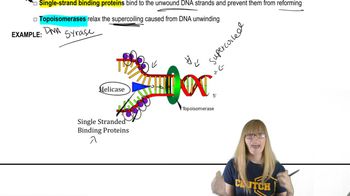
DNA synthesis in E. coli requires enzymes like DNA polymerase, helicase, primase, and ligase. Mutations affecting these enzymes can slow or halt DNA replication, leading to slow synthesis. Identifying which enzyme is impaired helps explain the observed phenotype.
Video consigliato:
Percorso guidato
11:59
Steps to DNA Replication

Phenotypic Effects of Mutations on Cellular Processes

Mutations in genes encoding enzymes involved in critical processes like DNA replication manifest as observable phenotypes, such as slow synthesis. Understanding how mutations alter enzyme function helps predict which step in the pathway is affected and the resulting cellular consequences.
Video consigliato:
Percorso guidato
10:48
Mutations and Phenotypes