Ch. 11 - DNA Replication and Recombination
Klug - Concepts of Genetics 12th Edition
Klug12th EditionConcepts of GeneticsISBN: 9780135564776Non è quello che usi tu?Cambia libro di testo
Capitolo 11, Problema 19

Suppose that E. coli synthesizes DNA at a rate of 100,000 nucleotides per minute and takes 40 minutes to replicate its chromosome.
(a) How many base pairs are present in the entire E. coli chromosome?
(b) What is the physical length of the chromosome in its helical configuration—that is, what is the circumference of the chromosome if it were opened into a circle?

Guida verificata passo dopo passo
1
Step 1: To determine the total number of base pairs in the E. coli chromosome, calculate the total number of nucleotides synthesized during replication. Multiply the synthesis rate (100,000 nucleotides per minute) by the replication time (40 minutes). This gives the total number of nucleotides synthesized during replication.
Step 2: Since DNA is double-stranded, the total number of nucleotides corresponds to the total number of base pairs. Therefore, the result from Step 1 directly represents the total number of base pairs in the E. coli chromosome.
Step 3: To calculate the physical length of the chromosome in its helical configuration, use the fact that the helical structure of DNA has approximately 10 base pairs per turn, and each turn of the helix spans 3.4 nanometers (nm). Multiply the total number of base pairs (from Step 2) by the length per base pair (0.34 nm, derived from 3.4 nm per 10 base pairs).
Step 4: To find the circumference of the chromosome if it were opened into a circle, note that the physical length calculated in Step 3 represents the total length of the chromosome. This length is equivalent to the circumference of the circular chromosome.
Step 5: Ensure all units are consistent throughout the calculations (e.g., converting nanometers to micrometers if needed) and verify the assumptions about DNA structure (e.g., 10 base pairs per turn and 3.4 nm per turn) are applied correctly.

Risposta video verificata per un problema simile:

Questa soluzione video è stata consigliata dai nostri tutor come utile per risolvere questo problema.
Durata del video:
1m

Concetti chiave

Ecco i concetti essenziali che devi comprendere per rispondere correttamente alla domanda.

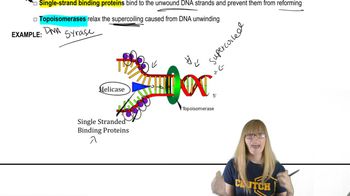
DNA Replication Rate

The DNA replication rate refers to the speed at which DNA polymerase synthesizes new DNA strands. In this case, E. coli synthesizes DNA at a rate of 100,000 nucleotides per minute. Understanding this rate is crucial for calculating the total number of nucleotides replicated over a given time period, which directly relates to the size of the chromosome.
Video consigliato:
Percorso guidato
11:59
Steps to DNA Replication

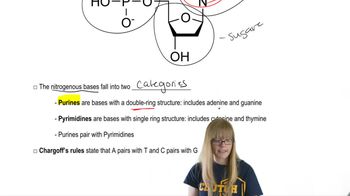
Base Pairs in DNA

Base pairs are the building blocks of the DNA double helix, consisting of pairs of nucleotides (adenine-thymine and guanine-cytosine) that bond together. The total number of base pairs in a chromosome can be determined by multiplying the number of nucleotides by 2, as each nucleotide on one strand pairs with a complementary nucleotide on the opposite strand.
Video consigliato:

Physical Length of DNA

The physical length of DNA refers to the actual distance that the DNA molecule would occupy if it were stretched out. The circumference of a circular DNA molecule can be calculated using the number of base pairs and the average length of a base pair in its helical configuration, which is approximately 0.34 nanometers. This concept is essential for understanding the spatial organization of DNA within a cell.
Video consigliato:
Percorso guidato
01:45
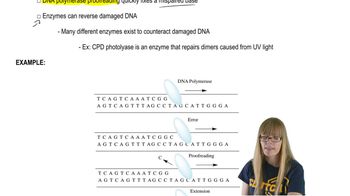
DNA Proofreading