Ch. 11 - DNA Replication and Recombination
Klug - Concepts of Genetics 12th Edition
Klug12th EditionConcepts of GeneticsISBN: 9780135564776Non è quello che usi tu?Cambia libro di testo
Capitolo 11, Problema 18

Why is DNA synthesis expected to be more complex in eukaryotes than in bacteria? How is DNA synthesis similar in the two types of organisms?

Guida verificata passo dopo passo
1
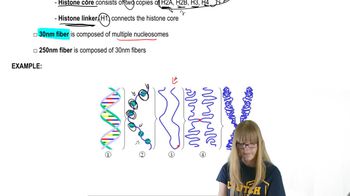
Step 1: Understand the structural differences between eukaryotic and bacterial genomes. Eukaryotic DNA is organized into multiple linear chromosomes with complex packaging involving histones, while bacterial DNA is typically a single circular chromosome without histones.
Step 2: Recognize that the complexity in eukaryotic DNA synthesis arises from the need to replicate multiple origins of replication on each linear chromosome, manage chromatin structure, and deal with the ends of linear chromosomes (telomeres).
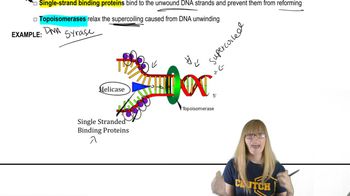
Step 3: Identify the key proteins and enzymes involved in DNA synthesis in both organisms, such as DNA polymerases, helicases, primases, and ligases, noting that while the specific enzymes may differ, their general functions are conserved.
Step 4: Compare the mechanisms of replication fork progression, including leading and lagging strand synthesis, Okazaki fragment formation, and the role of RNA primers, which are fundamentally similar in both eukaryotes and bacteria.
Step 5: Summarize that despite the increased complexity in eukaryotes due to chromatin structure and multiple origins, the core biochemical processes and enzymatic activities of DNA synthesis are conserved between eukaryotes and bacteria.

Risposta video verificata per un problema simile:

Questa soluzione video è stata consigliata dai nostri tutor come utile per risolvere questo problema.
Durata del video:
2m

Concetti chiave

Ecco i concetti essenziali che devi comprendere per rispondere correttamente alla domanda.

Eukaryotic vs. Prokaryotic Genome Structure

Eukaryotic genomes are larger, linear, and organized into multiple chromosomes with complex packaging involving histones, whereas bacterial genomes are typically smaller, circular, and less structured. This complexity in eukaryotes requires more intricate mechanisms for replication.
Video consigliato:
Percorso guidato
07:10
Chromosome Structure

DNA Replication Machinery and Origins of Replication

Eukaryotes have multiple origins of replication on each chromosome to efficiently replicate large genomes, while bacteria usually have a single origin. Both use similar enzymes like DNA polymerases, helicases, and primases, reflecting conserved core replication machinery.
Video consigliato:
Percorso guidato
11:59
Steps to DNA Replication

Replication Process Similarities

Despite differences, DNA synthesis in both eukaryotes and bacteria is semi-conservative, involves leading and lagging strand synthesis, and requires RNA primers. The fundamental steps of unwinding DNA, primer synthesis, elongation, and proofreading are conserved.
Video consigliato:
Percorso guidato
08:39
mRNA Processing