Ch. 13 - The Genetic Code and Transcription
Klug - Concepts of Genetics 12th Edition
Klug12th EditionConcepts of GeneticsISBN: 9780135564776Non è quello che usi tu?Cambia libro di testo
Capitolo 13, Problema 21

Messenger RNA molecules are very difficult to isolate in bacteria because they are rather quickly degraded in the cell. Can you suggest a reason why this occurs? Eukaryotic mRNAs are more stable and exist longer in the cell than do bacterial mRNAs. Is this an advantage or a disadvantage for a pancreatic cell making large quantities of insulin?

Guida verificata passo dopo passo
1
Understand that bacterial mRNAs are quickly degraded because bacteria lack certain protective features found in eukaryotic mRNAs, such as a 5' cap and a poly-A tail, which help stabilize the mRNA molecule.
Recognize that the rapid degradation of bacterial mRNA allows bacteria to quickly adjust protein synthesis in response to environmental changes, which is beneficial for their survival.
Note that eukaryotic mRNAs, including those in pancreatic cells, have a 5' cap and a poly-A tail that protect the mRNA from degradation, resulting in greater stability and longer lifespan within the cell.
Consider that for a pancreatic cell producing large quantities of insulin, having stable mRNA is an advantage because it allows sustained and efficient production of insulin without the need for constant new transcription.
Conclude that the increased stability of eukaryotic mRNA supports the high demand for insulin production by ensuring that the mRNA remains available for translation over a longer period, enhancing protein synthesis efficiency.

Risposta video verificata per un problema simile:

Questa soluzione video è stata consigliata dai nostri tutor come utile per risolvere questo problema.
Durata del video:
2m

Concetti chiave

Ecco i concetti essenziali che devi comprendere per rispondere correttamente alla domanda.

mRNA Stability and Degradation

mRNA stability refers to how long an mRNA molecule persists before being degraded. In bacteria, mRNAs are rapidly degraded to allow quick adaptation to environmental changes, resulting in short half-lives. This rapid turnover makes bacterial mRNAs difficult to isolate. In contrast, eukaryotic mRNAs are generally more stable due to protective features like the 5' cap and poly-A tail.
Video consigliato:
Percorso guidato
08:39
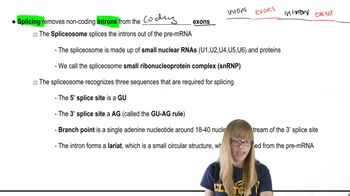
mRNA Processing

Differences Between Prokaryotic and Eukaryotic mRNA

Prokaryotic mRNAs lack a 5' cap and poly-A tail, making them more susceptible to degradation by ribonucleases. Eukaryotic mRNAs have these modifications, which protect them from rapid degradation and allow longer existence in the cytoplasm. These structural differences influence mRNA lifespan and gene expression regulation in the two domains.
Video consigliato:
Percorso guidato
10:14
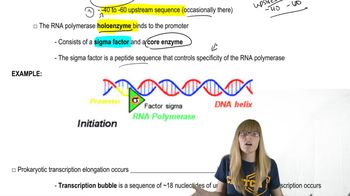
Prokaryotic Transcription

mRNA Stability and Protein Production in Specialized Cells

In specialized cells like pancreatic cells producing insulin, longer mRNA stability is advantageous because it allows sustained protein synthesis without constant transcription. Stable mRNAs enable efficient production of large protein quantities, reducing energy expenditure. Conversely, rapid mRNA turnover would require continuous transcription, which is less efficient for high-demand proteins.
Video consigliato: