Ch. 14 - Translation and Proteins
Klug - Concepts of Genetics 12th Edition
Klug12th EditionConcepts of GeneticsISBN: 9780135564776Non è quello che usi tu?Cambia libro di testo
Capitolo 14, Problema 18

Why is an alteration of electrophoretic mobility interpreted as a change in the primary structure of the protein under study?

Guida verificata passo dopo passo
1
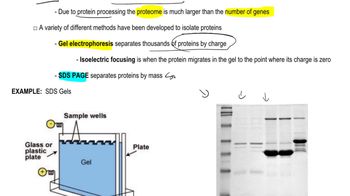
Understand that electrophoretic mobility refers to the movement of proteins in an electric field, which is influenced by the protein's size, shape, and charge.
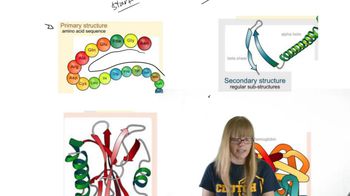
Recognize that the primary structure of a protein is its sequence of amino acids, which determines its overall charge and shape.
Consider that any alteration in the primary structure, such as a mutation or modification, can change the protein's charge or shape.
Realize that changes in charge or shape can affect how the protein moves through the gel during electrophoresis, altering its mobility.
Conclude that observing a change in electrophoretic mobility suggests a change in the primary structure, as it indicates a modification in the protein's charge or shape.

Risposta video verificata per un problema simile:

Questa soluzione video è stata consigliata dai nostri tutor come utile per risolvere questo problema.
Durata del video:
1m

Concetti chiave

Ecco i concetti essenziali che devi comprendere per rispondere correttamente alla domanda.

Electrophoretic Mobility

Electrophoretic mobility refers to the rate at which charged particles, such as proteins, move through a gel or solution under the influence of an electric field. This movement is influenced by the size, shape, and charge of the molecules. Changes in electrophoretic mobility can indicate alterations in the protein's structure, as these factors directly affect how the protein interacts with the medium.
Video consigliato:

Primary Structure of Proteins

The primary structure of a protein is its unique sequence of amino acids, which determines its overall shape and function. Any alteration in this sequence, such as substitutions, deletions, or insertions, can lead to changes in the protein's properties, including its charge and size, which are critical for its behavior during electrophoresis.
Video consigliato:

Protein Conformation and Function

Protein conformation refers to the three-dimensional shape of a protein, which is crucial for its biological function. Changes in the primary structure can lead to alterations in conformation, affecting how the protein interacts with other molecules. This can result in a change in electrophoretic mobility, as the altered shape may affect how the protein migrates through a gel.
Video consigliato:
Pratica correlata
Domanda del libro di testo

The synthesis of flower pigments is known to be dependent on enzymatically controlled biosynthetic pathways. For the crosses shown here, postulate the role of mutant genes and their products in producing the observed phenotypes:

P₁: white × pink

F₁: all purple

F₂: 9/16 purple: 3/16 pink: 4/16 white

432
views
Domanda del libro di testo

The study of biochemical mutants in organisms such as Neurospora has demonstrated that some pathways are branched. The data shown in the following table illustrate the branched nature of the pathway resulting in the synthesis of thiamine:

Why don't the data support a linear pathway? Can you postulate a pathway for the synthesis of thiamine in Neurospora?

706
views
Domanda del libro di testo

Contrast the contributions of Pauling and Ingram to our understanding of the genetic basis for sickle-cell anemia.

498
views
Domanda del libro di testo

Using sickle-cell anemia as an example, describe what is meant by a molecular or genetic disease. What are the similarities and dissimilarities between this type of a disorder and a disease caused by an invading microorganism?

748
views
Domanda del libro di testo

Explain why the one-gene:one-enzyme concept is not considered totally accurate today.

1122
views
Domanda del libro di testo
Hemoglobins from two individuals are compared by electrophoresis and by fingerprinting. Electrophoresis reveals no difference in migration, but fingerprinting shows an amino acid difference. How is this possible?
545
views