Ch. 15 - Gene Mutation, DNA Repair, and Transposition
Klug - Concepts of Genetics 12th Edition
Klug12th EditionConcepts of GeneticsISBN: 9780135564776Non è quello che usi tu?Cambia libro di testo
Capitolo 15, Problema 20

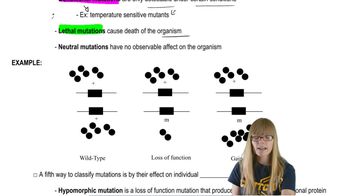
Speculate on how improved living conditions and medical care in the developed nations might affect human mutation rates, both neutral and deleterious.

Guida verificata passo dopo passo
1
span>Step 1: Understand the concept of mutation rates. Mutation rates refer to the frequency at which changes in the genetic material occur. These can be neutral, having no effect on fitness, or deleterious, negatively affecting an organism's survival or reproduction.
span>Step 2: Consider the impact of improved living conditions. Improved living conditions, such as better nutrition and reduced exposure to environmental mutagens, might reduce the occurrence of mutations by minimizing stress and damage to DNA.
span>Step 3: Evaluate the role of medical care. Advanced medical care can lead to the survival of individuals with deleterious mutations, potentially allowing these mutations to persist in the population. However, it can also reduce the impact of these mutations on overall fitness.
span>Step 4: Analyze the effect on neutral mutations. Neutral mutations are less likely to be affected by improved living conditions and medical care, as they do not impact an individual's fitness directly. Their rate might remain relatively constant.
span>Step 5: Consider the long-term evolutionary implications. Over time, the accumulation of neutral mutations and the persistence of some deleterious mutations due to medical interventions could influence genetic diversity and evolution in human populations.

Risposta video verificata per un problema simile:

Questa soluzione video è stata consigliata dai nostri tutor come utile per risolvere questo problema.
Durata del video:
2m

Concetti chiave

Ecco i concetti essenziali che devi comprendere per rispondere correttamente alla domanda.

Mutation Rates

Mutation rates refer to the frequency at which changes occur in the DNA sequence of an organism. These changes can be spontaneous or induced by environmental factors. Understanding mutation rates is crucial for assessing how genetic diversity and evolution are influenced by external conditions, such as improved living standards and healthcare.
Video consigliato:
Percorso guidato
10:48
Mutations and Phenotypes

Natural Selection

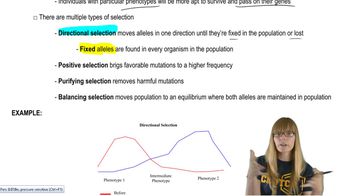
Natural selection is the process by which certain traits become more or less common in a population due to their impact on survival and reproduction. In developed nations with better living conditions, deleterious mutations may have less impact on survival, potentially allowing them to persist in the gene pool, while neutral mutations may also accumulate without significant consequences.
Video consigliato:
Percorso guidato
05:54
Natural Selection

Genetic Drift

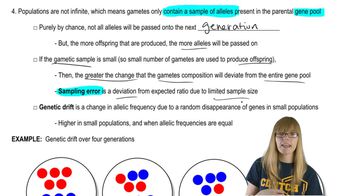
Genetic drift is the random fluctuation of allele frequencies in a population, which can lead to significant changes over time, especially in small populations. In developed nations, where population sizes are often larger and more stable, the effects of genetic drift may be minimized, allowing for a more consistent mutation rate and potentially altering the balance between neutral and deleterious mutations.
Video consigliato:
Pratica correlata
Domanda del libro di testo

In maize, a Ds or Ac transposon can alter the function of genes at or near the site of transposon insertion. It is possible for these elements to transpose away from their original insertion site, causing a reversion of the mutant phenotype. In some cases, however, even more severe phenotypes appear, due to events at or near the mutant allele. What might be happening to the transposon or the nearby gene to create more severe mutations?

429
views
Domanda del libro di testo

Compare DNA transposons and retrotransposons. What properties do they share?

1263
views
Domanda del libro di testo

Describe how the Ames test screens for potential environmental mutagens. Why is it thought that a compound that tests positively in the Ames test may also be carcinogenic?

1022
views
Domanda del libro di testo

It is estimated that about 0.2 percent of human mutations are due to TE insertions, and a much higher degree of mutational damage is known to occur in some other organisms. In what way might a TE insertion contribute positively to evolution?

444
views
Domanda del libro di testo

In a bacterial culture in which all cells are unable to synthesize leucine (leu⁻), a potent mutagen is added, and the cells are allowed to undergo one round of replication. At that point, samples are taken, a series of dilutions are made, and the cells are plated on either minimal medium or minimal medium containing leucine. The first culture condition (minimal medium) allows the growth of only leu⁺ cells, while the second culture condition (minimal medium with leucine added) allows growth of all cells. The results of the experiment are as follows:

What is the rate of mutation at the locus associated with leucine biosynthesis?

705
views
Domanda del libro di testo

What genetic defects result in the disorder xeroderma pigmentosum (XP) in humans? How do these defects create the phenotypes associated with the disorder?

597
views