Ch. 15 - Gene Mutation, DNA Repair, and Transposition
Klug - Concepts of Genetics 12th Edition
Klug12th EditionConcepts of GeneticsISBN: 9780135564776Non è quello che usi tu?Cambia libro di testo
Capitolo 15, Problema 17

Describe how the Ames test screens for potential environmental mutagens. Why is it thought that a compound that tests positively in the Ames test may also be carcinogenic?

Guida verificata passo dopo passo
1
Explain that the Ames test is a biological assay used to assess the mutagenic potential of chemical compounds by observing their ability to cause mutations in the DNA of certain strains of bacteria, typically Salmonella typhimurium, which carry mutations making them unable to synthesize the amino acid histidine.
Describe how the test involves exposing these bacteria to the chemical compound in question and then plating them on a medium lacking histidine; only bacteria that undergo a reverse mutation restoring the ability to produce histidine will grow into colonies.
Clarify that an increased number of colonies compared to a control indicates that the compound induces mutations, suggesting it is a mutagen.
Discuss the connection between mutagenicity and carcinogenicity by explaining that mutations in DNA can lead to uncontrolled cell growth and cancer, so compounds that cause mutations in the Ames test are suspected to have carcinogenic potential.
Mention that while the Ames test is a useful initial screen, further testing in mammalian systems is necessary to confirm carcinogenicity because not all mutagens are carcinogens and vice versa.

Risposta video verificata per un problema simile:

Questa soluzione video è stata consigliata dai nostri tutor come utile per risolvere questo problema.
Durata del video:
1m

Concetti chiave

Ecco i concetti essenziali che devi comprendere per rispondere correttamente alla domanda.

Ames Test Methodology

The Ames test is a biological assay that uses specially engineered strains of bacteria to detect chemical substances that cause mutations. These bacteria are unable to grow on a medium lacking a specific nutrient unless a mutation reverses this defect. By exposing the bacteria to a test compound, the test identifies mutagens based on the number of colonies that regain growth ability, indicating induced mutations.
Video consigliato:
Percorso guidato
04:29
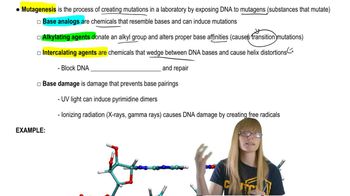
Induced Mutations

Mutagens and Carcinogens Relationship

Mutagens are agents that cause changes in DNA sequences, which can disrupt normal cellular functions. Many carcinogens are mutagens because DNA mutations can lead to uncontrolled cell growth and cancer. Therefore, a positive Ames test suggests that a compound can cause genetic mutations, implying a potential to initiate carcinogenesis.
Video consigliato:
Percorso guidato
08:16
Phylogenetic Trees

Metabolic Activation in Ames Test

Some compounds are not directly mutagenic but become mutagenic after metabolic conversion in the body. The Ames test often includes a liver extract (S9 mix) to simulate this metabolic activation, allowing detection of pro-mutagens. This feature enhances the test’s relevance to real-world exposure and carcinogenic risk assessment.
Video consigliato:
Percorso guidato
04:29
Induced Mutations