Ch. 18 - Post-transcriptional Regulation in Eukaryotes
Klug - Concepts of Genetics 12th Edition
Klug12th EditionConcepts of GeneticsISBN: 9780135564776Non è quello che usi tu?Cambia libro di testo
Capitolo 18, Problema 21

How may the covalent modification of a protein with a phosphate group alter its function?

Guida verificata passo dopo passo
1
Understand that covalent modification refers to the addition or removal of a chemical group to a protein, which can change the protein's properties and activity.
Recognize that phosphorylation is the addition of a phosphate group (PO₄³⁻) to specific amino acid residues, commonly serine, threonine, or tyrosine, in the protein.
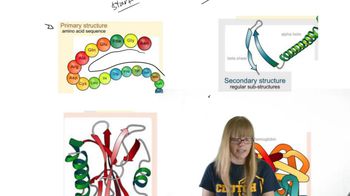
Consider how the addition of a negatively charged phosphate group can induce a conformational change in the protein's three-dimensional structure, potentially altering its shape and function.
Analyze how this conformational change can affect the protein's activity by either activating or inhibiting its enzymatic function, altering its interaction with other molecules, or changing its cellular localization.
Summarize that phosphorylation acts as a regulatory mechanism, allowing cells to control protein function dynamically in response to various signals.

Risposta video verificata per un problema simile:

Questa soluzione video è stata consigliata dai nostri tutor come utile per risolvere questo problema.
Durata del video:
2m

Concetti chiave

Ecco i concetti essenziali che devi comprendere per rispondere correttamente alla domanda.

Protein Phosphorylation

Protein phosphorylation is the covalent addition of a phosphate group, usually to serine, threonine, or tyrosine residues. This modification is catalyzed by enzymes called kinases and can change the protein's activity, interactions, or localization.
Video consigliato:

Conformational Change

The addition of a phosphate group can induce a conformational change in the protein's structure. This structural alteration can activate or inhibit the protein's function by exposing or hiding active sites or interaction domains.
Video consigliato:
Percorso guidato
03:03
New Alleles and Migration

Regulation of Protein Function

Phosphorylation acts as a regulatory mechanism, controlling processes like enzyme activity, signal transduction, and protein-protein interactions. It is reversible, allowing dynamic control through phosphatases that remove phosphate groups.
Video consigliato:
Pratica correlata
Domanda del libro di testo

Incorrectly spliced RNAs often lead to human pathologies. Scientists have examined cancer cells for splice-specific changes and found that many of the changes disrupt tumor-suppressor gene function [Xu and Lee (2003). Nucl. Acids Res. 31:5635–5643]. In general, what would be the effects of splicing changes on these RNAs and the function of tumor-suppressor gene function? How might loss of splicing specificity be associated with cancer?

485
views
Domanda del libro di testo

What role do ubiquitin ligases play in the regulation of gene expression?

552
views
Domanda del libro di testo

How and why are eukaryotic mRNAs transported and localized to discrete regions of the cell?

463
views
Domanda del libro di testo

We discussed several specific cis-elements in mRNAs that regulate splicing, stability, decay, localization, and translation. However, it is likely that many other uncharacterized cis-elements exist. One way in which they may be characterized is through the use of a reporter gene such as the gene encoding the green fluorescent protein (GFP) from jellyfish. GFP emits green fluorescence when excited by blue light. Explain how one might be able to devise an assay to test for the effect of various cis-elements on posttranscriptional gene regulation using cells that transcribe a GFP mRNA with genetically inserted cis-elements.

474
views
Domanda del libro di testo

How is it possible that a given mRNA in a cell is found throughout the cytoplasm but the protein that it encodes is only found in a few specific regions?

437
views
Domanda del libro di testo

How are mRNAs stored within the cell in a translationally inactive state, and how can their translation be stimulated?

556
views