Ch. 20 - Recombinant DNA Technology
Klug - Concepts of Genetics 12th Edition
Klug12th EditionConcepts of GeneticsISBN: 9780135564776Non è quello che usi tu?Cambia libro di testo
Capitolo 20, Problema 1b

What steps make PCR a chain reaction that can produce millions of copies of a specific DNA molecule in a matter of hours without using host cells?

Guida verificata passo dopo passo
1
Understand that PCR (Polymerase Chain Reaction) is a method that amplifies a specific DNA segment exponentially by repeatedly cycling through three main steps: denaturation, annealing, and extension.
Step 1: Denaturation - Heat the reaction mixture to around 94-98°C to separate the double-stranded DNA into single strands, providing single-stranded templates for replication.
Step 2: Annealing - Cool the mixture to 50-65°C to allow short DNA primers, which are complementary to the target sequence, to bind (anneal) to their specific sites on the single-stranded DNA templates.
Step 3: Extension - Raise the temperature to about 72°C, the optimal temperature for the DNA polymerase enzyme, which synthesizes new DNA strands by adding nucleotides to the primers, creating new double-stranded DNA molecules.
Repeat these three steps for 20-40 cycles; because each new DNA strand can serve as a template in the next cycle, the amount of target DNA doubles each cycle, resulting in an exponential increase and producing millions of copies in a few hours without the need for host cells.

Risposta video verificata per un problema simile:

Questa soluzione video è stata consigliata dai nostri tutor come utile per risolvere questo problema.
Durata del video:
2m

Concetti chiave

Ecco i concetti essenziali che devi comprendere per rispondere correttamente alla domanda.

Polymerase Chain Reaction (PCR) Process

PCR is a laboratory technique used to amplify specific DNA sequences exponentially. It involves repeated cycles of denaturation, annealing, and extension, which separate DNA strands, allow primers to bind, and synthesize new DNA strands, respectively. This cyclical process enables rapid multiplication of the target DNA.
Video consigliato:
Percorso guidato
08:39
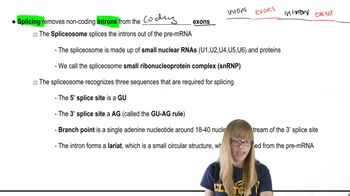
mRNA Processing

Role of DNA Primers

DNA primers are short, single-stranded sequences that are complementary to the target DNA region. They provide a starting point for DNA polymerase to begin synthesis. Primers ensure specificity by binding only to the desired DNA segment, enabling selective amplification during PCR.
Video consigliato:
Percorso guidato
11:59
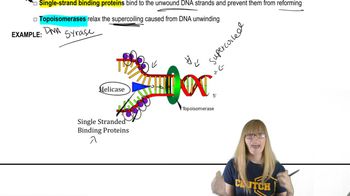
Steps to DNA Replication

Thermostable DNA Polymerase

Thermostable DNA polymerases, like Taq polymerase, can withstand the high temperatures used during PCR denaturation steps. Their heat resistance allows them to remain active throughout the cycles, synthesizing new DNA strands without being denatured, which is essential for the continuous chain reaction.
Video consigliato:
Percorso guidato
01:45
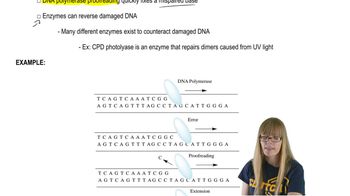
DNA Proofreading