Ch. 25 - Quantitative Genetics and Multifactorial Traits
Klug - Concepts of Genetics 12th Edition
Klug12th EditionConcepts of GeneticsISBN: 9780135564776Non è quello che usi tu?Cambia libro di testo
Capitolo 25, Problema 14b

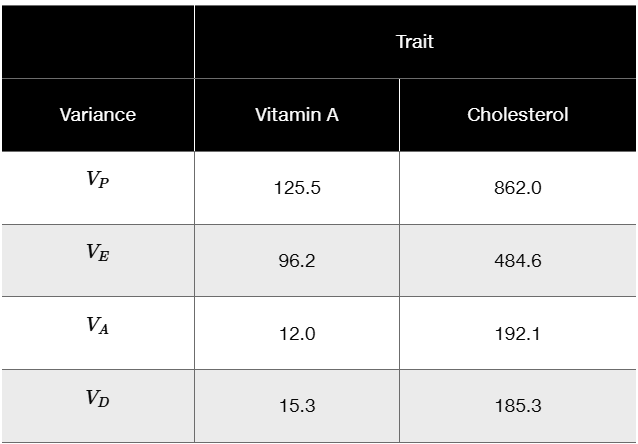
A hypothetical study investigated the vitamin A content and the cholesterol content of eggs from a large population of chickens. The following variances (V) were calculated.
Table showing variances for vitamin A and cholesterol in eggs, comparing phenotypic, environmental, additive, and dominance variances.
Which trait, if either, is likely to respond to selection?

Guida verificata passo dopo passo
1
Step 1: Understand the variances given in the table. \(V_P\) is the phenotypic variance, which is the total observed variance in the trait. \(V_E\) is the environmental variance, representing variation due to environmental factors. \(V_A\) is the additive genetic variance, which is the portion of genetic variance that contributes to resemblance between parents and offspring. \(V_D\) is the dominance genetic variance, which arises from interactions between alleles at the same locus.
Step 2: Recall that the response to selection depends primarily on the additive genetic variance (\(V_A\)) because only additive effects are reliably passed from parents to offspring and thus contribute to heritability.
Step 3: Calculate the narrow-sense heritability (\(h^2\)) for each trait using the formula: \[h^2 = \frac{V_A}{V_P}\] This ratio tells us the proportion of phenotypic variance that is due to additive genetic variance.
Step 4: Compare the \(h^2\) values for Vitamin A and Cholesterol. The trait with the higher \(h^2\) is more likely to respond to selection because it has a greater proportion of additive genetic variance relative to total phenotypic variance.
Step 5: Conclude which trait is likely to respond to selection based on the calculated heritabilities, keeping in mind that traits with low additive genetic variance or low heritability will respond less effectively to selection.

Risposta video verificata per un problema simile:

Questa soluzione video è stata consigliata dai nostri tutor come utile per risolvere questo problema.
Durata del video:
1m

Concetti chiave

Ecco i concetti essenziali che devi comprendere per rispondere correttamente alla domanda.

Phenotypic Variance (V_P)

Phenotypic variance represents the total observed variation in a trait within a population. It includes genetic variance (both additive and dominance) and environmental variance. Understanding V_P is essential to partition the sources of variation affecting the trait.
Video consigliato:
Percorso guidato
08:34
Analyzing Trait Variance

Additive Genetic Variance (V_A)

Additive genetic variance is the portion of genetic variance attributed to the additive effects of alleles. It is crucial for predicting response to selection because only additive effects are reliably passed from parents to offspring, influencing trait heritability.
Video consigliato:
Percorso guidato
13:40
Traits and Variance

Heritability and Response to Selection

Heritability in the narrow sense is the ratio of additive genetic variance to phenotypic variance (h² = V_A / V_P). Traits with higher heritability are more likely to respond to selection because additive genetic effects drive evolutionary change.
Video consigliato:
Percorso guidato
04:15
Artificial Selection
Pratica correlata
Domanda del libro di testo

In an assessment of learning in Drosophila, flies were trained to avoid certain olfactory cues. In one population, a mean of 8.5 trials was required. A subgroup of this parental population that was trained most quickly (mean=6.0) was interbred, and their progeny were examined. These flies demonstrated a mean training value of 7.5. Calculate realized heritability for olfactory learning in Drosophila.

438
views
Domanda del libro di testo

The mean and variance of plant height of two highly inbred strains (P₁ and P₂) and their progeny (F₁ and F₂) are shown here.


  Strain  Mean (cm)  Variance 

   P₁     34.2        4.2

   P₂     55.3        3.8

   F₁     44.2        5.6

   F₂     46.3       10.3


Calculate the broad-sense heritability (H²) of plant height in this species.

814
views
Domanda del libro di testo

Suppose you want to develop a population of Drosophila that would rapidly learn to avoid certain substances the flies could detect by smell. Based on the heritability estimate you obtained in Problem 16, do you think it would be worth doing this by artificial selection? Why or why not?

468
views
Domanda del libro di testo

In a herd of dairy cows the narrow-sense heritability for milk protein content is 0.76, and for milk butterfat it is 0.82. The correlation coefficient between milk protein content and butterfat is 0.91. If the farmer selects for cows producing more butterfat in their milk, what will be the most likely effect on milk protein content in the next generation?

545
views
Domanda del libro di testo

The following variances were calculated for two traits in a herd of hogs.

Which of the two traits will respond best to selection by a breeder? Why?

559
views
Domanda del libro di testo

A hypothetical study investigated the vitamin A content and the cholesterol content of eggs from a large population of chickens. The following variances (V) were calculated.

Calculate the narrow-sense heritability (h²) for both traits.

475
views