Ch. 25 - Quantitative Genetics and Multifactorial Traits
Klug - Concepts of Genetics 12th Edition
Klug12th EditionConcepts of GeneticsISBN: 9780135564776Non è quello che usi tu?Cambia libro di testo
Capitolo 25, Problema 19

In a population of 100 inbred, genotypically identical rice plants, variance for grain yield is 4.67. What is the heritability for yield? Would you advise a rice breeder to improve yield in this strain of rice plants by selection?

Guida verificata passo dopo passo
1
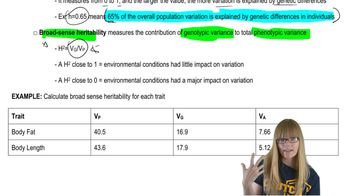
Understand the concept of heritability in the broad sense, which is the proportion of the total phenotypic variance that is due to genetic variance. It is given by the formula: \(H^2 = \frac{V_G}{V_P}\), where \(V_G\) is the genetic variance and \(V_P\) is the total phenotypic variance.
Note that the population consists of inbred, genotypically identical rice plants. Since all plants are genetically identical, the genetic variance \(V_G\) is effectively zero because there is no genetic variation among individuals.
Recognize that the observed variance in grain yield (4.67) must therefore be due to environmental variance \(V_E\), since \(V_P = V_G + V_E\) and \(V_G = 0\) in this case.
Calculate heritability using the formula \(H^2 = \frac{V_G}{V_P}\). Since \(V_G = 0\), heritability \(H^2\) will be zero, indicating no genetic contribution to the observed variance in yield.
Interpret the result: with zero heritability, selection for improved yield in this strain will not be effective because the variation in yield is not due to genetic differences. Advise the breeder accordingly.

Risposta video verificata per un problema simile:

Questa soluzione video è stata consigliata dai nostri tutor come utile per risolvere questo problema.
Durata del video:
1m

Concetti chiave

Ecco i concetti essenziali che devi comprendere per rispondere correttamente alla domanda.

Heritability in the Broad Sense

Heritability in the broad sense (H²) measures the proportion of total phenotypic variance in a trait that is due to genetic variance. It is calculated as the ratio of genetic variance to total phenotypic variance. In inbred, genotypically identical populations, genetic variance is minimal or zero, affecting heritability estimates.
Video consigliato:
Percorso guidato
07:04
Calculating Heritability

Phenotypic Variance and Genetic Variance

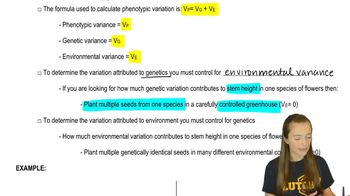
Phenotypic variance (Vp) is the total variation observed in a trait, arising from both genetic (Vg) and environmental (Ve) factors. In genetically identical populations, Vg is near zero, so Vp mainly reflects environmental variance. Understanding these components is essential to interpret heritability and predict response to selection.
Video consigliato:
Percorso guidato
08:34
Analyzing Trait Variance

Selection and Breeding Implications

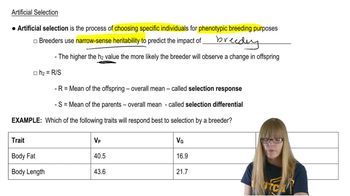
Selection effectiveness depends on heritability; high heritability means genetic factors strongly influence the trait, so selection can improve it. In populations with low or zero genetic variance, selection is unlikely to yield improvement, as observed variation is mostly environmental and not heritable.
Video consigliato:
Percorso guidato
04:15
Artificial Selection
Pratica correlata
Domanda del libro di testo

In an assessment of learning in Drosophila, flies were trained to avoid certain olfactory cues. In one population, a mean of 8.5 trials was required. A subgroup of this parental population that was trained most quickly (mean=6.0) was interbred, and their progeny were examined. These flies demonstrated a mean training value of 7.5. Calculate realized heritability for olfactory learning in Drosophila.

438
views
Domanda del libro di testo

A 3-inch plant was crossed with a 15-inch plant, and all F₁ plants were 9 inches. The F₂ plants exhibited a 'normal distribution,' with heights of 3, 4, 5, 6, 7, 8, 9, 10, 11, 12, 13, 14, and 15 inches.

What ratio will constitute the 'normal distribution' in the F₂?

376
views
Domanda del libro di testo

Suppose you want to develop a population of Drosophila that would rapidly learn to avoid certain substances the flies could detect by smell. Based on the heritability estimate you obtained in Problem 16, do you think it would be worth doing this by artificial selection? Why or why not?

468
views
Domanda del libro di testo

Many traits of economic or medical significance are determined by quantitative trait loci (QTLs) in which many genes, usually scattered throughout the genome, contribute to expression.

What general procedures are used to identify such loci?

426
views
Domanda del libro di testo

In a population of tomato plants, mean fruit weight is 60 g and h² is 0.3. Predict the mean weight of the progeny if tomato plants whose fruit averaged 80 g were selected from the original population and interbred.

426
views
Domanda del libro di testo

Many traits of economic or medical significance are determined by quantitative trait loci (QTLs) in which many genes, usually scattered throughout the genome, contribute to expression.

What is meant by the term cosegregate in the context of QTL mapping? Why are markers such as RFLPs, SNPs, and microsatellites often used in QTL mapping?

454
views