Ch. 26 - Population and Evolutionary Genetics
Klug - Concepts of Genetics 12th Edition
Klug12th EditionConcepts of GeneticsISBN: 9780135564776Non è quello che usi tu?Cambia libro di testo
Capitolo 26, Problema 3a

Price et al. [(1999). J. Bacteriol. 181:2358–2362] conducted a genetic study of the toxin transport protein (PA) of Bacillus anthracis, the bacterium that causes anthrax in humans. Within the 2294-nucleotide gene in 26 strains they identified five point mutations—two missense and three synonyms—among different isolates. Necropsy samples from an anthrax outbreak in 1979 revealed a novel missense mutation and five unique nucleotide changes among ten victims. The authors concluded that these data indicate little or no horizontal transfer between different B. anthracis strains.
Which types of nucleotide changes (missense or synonyms) cause amino acid changes?

Guida verificata passo dopo passo
1
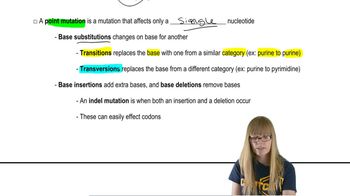
Understand the definitions: A missense mutation is a nucleotide change that results in a different amino acid being incorporated into the protein sequence, potentially altering the protein's function.
Recognize that a synonymous mutation (also called a silent mutation) is a nucleotide change that does not alter the amino acid sequence due to the redundancy of the genetic code.
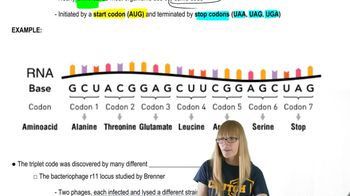
Recall that the genetic code is degenerate, meaning multiple codons can code for the same amino acid, which is why some nucleotide changes do not affect the protein sequence.
Therefore, identify that missense mutations cause amino acid changes because they alter the codon to specify a different amino acid.
Conclude that synonymous mutations do not cause amino acid changes since the altered codon still codes for the same amino acid.

Risposta video verificata per un problema simile:

Questa soluzione video è stata consigliata dai nostri tutor come utile per risolvere questo problema.
Durata del video:
4m

Concetti chiave

Ecco i concetti essenziali che devi comprendere per rispondere correttamente alla domanda.

Missense Mutations

Missense mutations are nucleotide changes in a gene that result in the substitution of one amino acid for another in the protein product. This can affect the protein's structure and function, potentially altering the organism's phenotype. They are important in studying genetic variation and disease.
Video consigliato:
Percorso guidato
09:49
Point Mutations

Synonymous (Silent) Mutations

Synonymous mutations are nucleotide changes that do not alter the amino acid sequence of the protein due to the redundancy of the genetic code. Although they do not change the protein directly, they can sometimes affect gene expression or mRNA stability.
Video consigliato:
Percorso guidato
09:49
Point Mutations

Genetic Code and Protein Translation

The genetic code translates nucleotide triplets (codons) into amino acids during protein synthesis. Because multiple codons can code for the same amino acid, some nucleotide changes do not affect the protein sequence (synonymous), while others do (missense). Understanding this code is essential to interpreting mutation effects.
Video consigliato:
Percorso guidato
11:43
The Genetic Code
Pratica correlata
Domanda del libro di testo

Price et al. [(1999). J. Bacteriol. 181:2358–2362] conducted a genetic study of the toxin transport protein (PA) of Bacillus anthracis, the bacterium that causes anthrax in humans. Within the 2294-nucleotide gene in 26 strains they identified five point mutations—two missense and three synonyms—among different isolates. Necropsy samples from an anthrax outbreak in 1979 revealed a novel missense mutation and five unique nucleotide changes among ten victims. The authors concluded that these data indicate little or no horizontal transfer between different B. anthracis strains.

On what basis did the authors conclude that evidence of horizontal transfer is absent from their data?

468
views
Domanda del libro di testo

How do we know when populations have diverged to the point that they form two different species?

596
views
Domanda del libro di testo

Price et al. [(1999). J. Bacteriol. 181:2358–2362] conducted a genetic study of the toxin transport protein (PA) of Bacillus anthracis, the bacterium that causes anthrax in humans. Within the 2294-nucleotide gene in 26 strains they identified five point mutations—two missense and three synonyms—among different isolates. Necropsy samples from an anthrax outbreak in 1979 revealed a novel missense mutation and five unique nucleotide changes among ten victims. The authors concluded that these data indicate little or no horizontal transfer between different B. anthracis strains.

What is meant by 'horizontal transfer'?

452
views
Domanda del libro di testo

The genetic difference between two Drosophila species, D. heteroneura and D. silvestris, as measured by nucleotide diversity, is about 1.8 percent. The difference between chimpanzees (Pan troglodytes) and humans (H. sapiens) is about the same, yet the latter species is classified in a different genera. In your opinion, is this valid? Explain why.

583
views
Domanda del libro di testo

Write a short essay describing the roles of mutation, migration, and selection in bringing about speciation.

544
views
Domanda del libro di testo

How do we know the age of the last common ancestor shared by two species?

431
views