 Indietro
Alkenes, Alkynes, and Isomers: Structure, Nomenclature, and Geometric Isomerism
Guida di studio - Note intelligenti
 Appunti personalizzati basati sui tuoi materiali, ampliati con definizioni chiave, esempi e contesto.
Alkenes and Alkynes
Introduction to Alkenes and Alkynes
Alkenes and alkynes are two important families of hydrocarbons characterized by the presence of double and triple bonds, respectively. These compounds are classified as unsaturated hydrocarbons because they contain fewer hydrogen atoms than alkanes with the same number of carbon atoms. Their chemical reactivity is largely due to these multiple bonds, which can participate in addition reactions, such as hydrogenation, to form alkanes.
Alkenes: Contain at least one carbon-carbon double bond (C=C).
Alkynes: Contain at least one carbon-carbon triple bond (C≡C).
Both can react with hydrogen gas to become saturated hydrocarbons (alkanes).
Identifying Alkenes
Alkenes are recognized by the presence of one or more carbon-carbon double bonds. The simplest alkene is ethene (C2H4), also known as ethylene. In ethene, each carbon atom in the double bond is bonded to two hydrogen atoms and exhibits a trigonal planar geometry with bond angles of 120°.
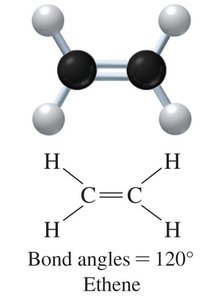
General formula for alkenes: CnH2n
Bond angles: 120° around the double-bonded carbons (sp2 hybridization).
Ethene (Ethylene) in Nature
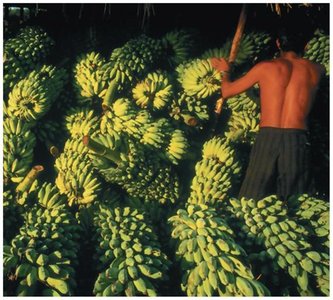
Ethene (ethylene) is not only a fundamental molecule in organic chemistry but also plays a significant biological role as a plant hormone. It is responsible for the ripening of fruits such as bananas and accelerates the breakdown of cellulose in plants, causing flowers to wilt and fall.
Identifying Alkynes
Alkynes are hydrocarbons that contain one or more carbon-carbon triple bonds. The simplest alkyne is ethyne (C2H2), also known as acetylene. In ethyne, each carbon atom in the triple bond is bonded to one hydrogen atom and has a linear geometry with bond angles of 180°.
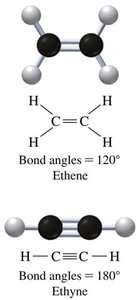
General formula for alkynes: CnH2n-2
Bond angles: 180° around the triple-bonded carbons (sp hybridization).
Comparison of Alkanes, Alkenes, and Alkynes
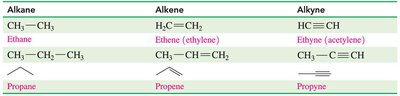
The following table summarizes the structural formulas and examples of alkanes, alkenes, and alkynes, highlighting the differences in bonding and hydrogen content.
Alkane | Alkene | Alkyne |
|---|---|---|
CH3–CH3 Ethane | H2C=CH2 Ethene (ethylene) | HC≡CH Ethyne (acetylene) |
CH3–CH2–CH3 Propane | CH2=CH–CH3 Propene | CH≡C–CH3 Propyne |
Nomenclature of Alkenes and Alkynes
IUPAC Naming Rules
The IUPAC system provides a systematic way to name alkenes and alkynes, similar to alkanes but with modifications to indicate the presence and position of double or triple bonds.
Step 1: Identify and name the longest carbon chain containing the double or triple bond.
Step 2: Number the chain from the end nearest the multiple bond.
Step 3: Name and locate each substituent as a prefix, listing them alphabetically. Use hyphens between numbers and names, and prefixes (di-, tri-, tetra-) for multiple identical substituents.
Alkene names: Replace the "-ane" ending of the corresponding alkane with "-ene".
Alkyne names: Replace the "-ane" ending with "-yne".
Example: CH2=CH–CH3 is named propene.
Naming Cycloalkenes
Cycloalkenes are cyclic hydrocarbons containing a double bond within the ring. The double bond is always assigned to be between carbon 1 and carbon 2, and the ring is numbered to give the lowest possible numbers to substituents.
Numbers for the double bond are not required in the name.
Example: 3-methylcyclopentene (double bond is understood to be between C1 and C2).
Cis–Trans (Geometric) Isomerism in Alkenes
Definition and Explanation
Alkenes can exhibit cis–trans isomerism (geometric isomerism) when each carbon of the double bond has two different groups attached. The restricted rotation around the double bond leads to two distinct arrangements:
Cis isomer: Similar groups are on the same side of the double bond.
Trans isomer: Similar groups are on opposite sides of the double bond.
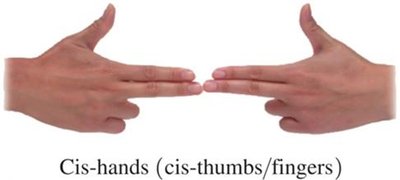
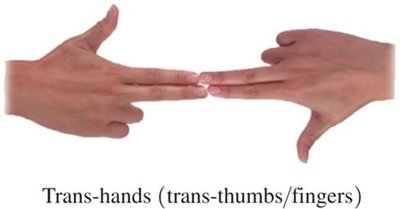
These isomers have different physical and chemical properties, such as boiling points and reactivity.
Cis–Trans Isomers of Butene
2-Butene is a classic example of a molecule that exhibits cis–trans isomerism. In cis-2-butene, the two methyl groups are on the same side of the double bond, while in trans-2-butene, they are on opposite sides.
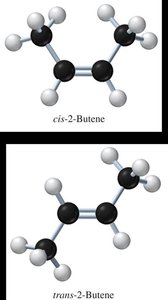
Naming Cis–Trans Isomers
The prefixes cis and trans are placed before the alkene name to indicate the specific geometric isomer. For example:
cis-1,2-dibromoethene: Both bromine atoms are on the same side of the double bond.
trans-1,2-dibromoethene: Bromine atoms are on opposite sides of the double bond.
Summary Table: Key Differences Between Alkanes, Alkenes, and Alkynes
Type | Bond Type | General Formula | Example |
|---|---|---|---|
Alkane | Single (C–C) | CnH2n+2 | Ethane (C2H6) |
Alkene | Double (C=C) | CnH2n | Ethene (C2H4) |
Alkyne | Triple (C≡C) | CnH2n-2 | Ethyne (C2H2) |
Key Equations
General formula for alkanes:
General formula for alkenes:
General formula for alkynes:
Additional info: The content above is based on Timberlake, K. (2018). Chemistry: Introduction to general, organic and biological chemistry (13th ed.). Pearson Education.
