 Indietro
Aqueous Equilibria: Buffers, Titrations, and Solubility (GOB Chemistry Study Notes)
Guida di studio - Note intelligenti
 Appunti personalizzati basati sui tuoi materiali, ampliati con definizioni chiave, esempi e contesto.
Additional Aspects of Aqueous Equilibria
Introduction
This chapter explores advanced concepts in aqueous equilibria, focusing on the common-ion effect, buffer solutions, acid-base titrations, solubility equilibria, and the factors affecting solubility. These topics are essential for understanding chemical reactions in solution, especially in biological and environmental contexts.
The Common-Ion Effect
Definition and Principle
Common-Ion Effect: The suppression of the ionization of a weak electrolyte when a strong electrolyte containing a common ion is added to the solution.
When a solution contains two substances that share a common ion, the equilibrium shifts to reduce the ionization of the weak electrolyte (Le Chatelier’s Principle).
Example: Adding sodium acetate (CH3COONa) to acetic acid (CH3COOH) increases the concentration of acetate ions (CH3COO−), shifting the equilibrium to the left and decreasing [H+].
Key Equation:
Result: The solution becomes less acidic (higher pH).
Buffer Solutions
Composition and Action
Buffer Solution: A solution that resists changes in pH when small amounts of acid or base are added.
Composed of a weak acid and its conjugate base, or a weak base and its conjugate acid.
Buffers are crucial in biological systems (e.g., blood pH) and industrial processes.
How Buffers Work
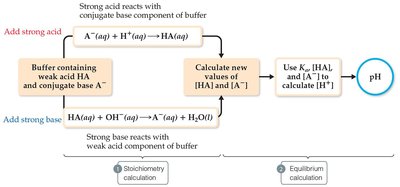
When a strong acid is added, the conjugate base neutralizes the added H+.
When a strong base is added, the weak acid neutralizes the added OH−.
The pH remains nearly constant as long as the buffer components are present in sufficient amounts.
Example: Acetate buffer (CH3COOH/CH3COO−)
Buffer Preparation
Mix a weak acid with a salt of its conjugate base, or a weak base with a salt of its conjugate acid.
Alternatively, partially neutralize a weak acid with a strong base (or vice versa).
Buffer Capacity and pH Range
Buffer Capacity: The amount of acid or base a buffer can neutralize before the pH changes significantly.
Effective Buffer Range: Typically within ±1 pH unit of the buffer’s pKa.
Buffer capacity increases with the concentration of buffer components.
Calculating Buffer pH: Henderson-Hasselbalch Equation
The pH of a buffer can be calculated using the Henderson-Hasselbalch equation:
If [base] = [acid], then pH = pKa.
If [base] > [acid], then pH > pKa.
If [base] < [acid], then pH < pKa.
Addition of Strong Acids and Bases to Buffers
When a strong acid or base is added, first perform a stoichiometric calculation to determine the new concentrations of buffer components.
Then, use the Henderson-Hasselbalch equation to find the new pH.
Acid-Base Titrations
Principles and Setup
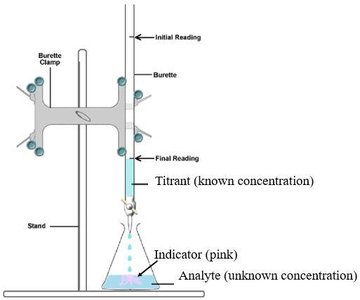
Titration: A quantitative technique to determine the concentration of an unknown acid or base by neutralization with a standard solution.
Equivalence Point: The point at which moles of acid equal moles of base.
Endpoint: The point at which the indicator changes color, ideally close to the equivalence point.
Indicators
Indicators are weak acids or bases that change color at a specific pH range.
The color change occurs when [HIn] = [In−], i.e., pH = pKa of the indicator.
Choose an indicator whose color change interval brackets the equivalence point pH.
Titration Curves
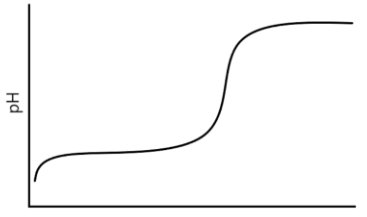
Strong Acid–Strong Base: pH rises slowly, then rapidly near equivalence (pH = 7 at equivalence).
Weak Acid–Strong Base: Initial pH is higher, buffer region present, pH at equivalence > 7.
Polyprotic Acids: Multiple equivalence points, each corresponding to the loss of a proton.
Solubility Equilibria
The Solubility-Product Constant (Ksp)
Ksp: The equilibrium constant for the dissolution of a sparingly soluble salt.
For a salt AB:
For a salt with formula AxBy:
Solubility vs. Solubility Product
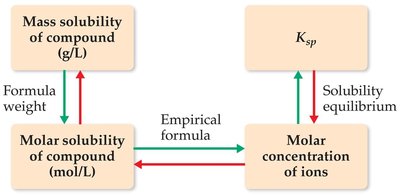
Solubility: The amount of solute that dissolves to form a saturated solution (g/L or mol/L).
Ksp: Depends on the equilibrium concentrations of the ions.
Solubility and Ksp are related but not identical; Ksp is used for calculations involving ionic equilibria.
Predicting Precipitation: The Ion Product (Q)
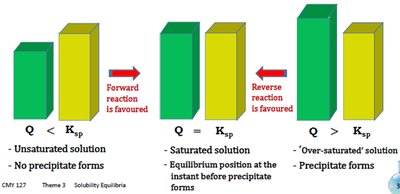
Ion Product (Q): Calculated like Ksp but with initial concentrations.
If Q < Ksp: No precipitate forms (unsaturated solution).
If Q = Ksp: Solution is saturated (at equilibrium).
If Q > Ksp: Precipitate forms (supersaturated solution).
Factors Affecting Solubility
Common-Ion Effect
The presence of a common ion decreases the solubility of a salt due to Le Chatelier’s Principle.
Example: Adding NaF to a solution of CaF2 decreases the solubility of CaF2.
Effect of pH
Salts containing basic anions are more soluble in acidic solutions.
Buffers can control pH and thus influence solubility equilibria.
Precipitation and Separation of Ions
Selective Precipitation
Ions can be separated from mixtures by adding reagents that selectively precipitate the least soluble salts first.
Comparing Ksp values allows prediction of the order of precipitation.
Qualitative Analysis for Metallic Elements
Application of Solubility Rules
Differences in solubility are used to identify and separate metal ions in solution.
This is a foundational technique in qualitative inorganic analysis.
Summary Table: Key Concepts in Aqueous Equilibria
Concept | Definition | Key Equation |
|---|---|---|
Common-Ion Effect | Suppression of ionization by a common ion | |
Buffer Solution | Resists pH change | |
Titration | Determines unknown concentration | |
Ksp | Solubility product constant | |
Ion Product (Q) | Predicts precipitation | Compare Q to Ksp |
