 Indietro
Atoms and Elements: Structure, Properties, and Periodic Trends
Guida di studio - Note intelligenti
 Appunti personalizzati basati sui tuoi materiali, ampliati con definizioni chiave, esempi e contesto.
Atoms and Elements
Introduction to Elements
Elements are the fundamental substances from which all matter is constructed. They cannot be broken down into simpler substances by chemical means. Each element is represented by a unique chemical symbol, often derived from its English or Latin name.
Element: A pure substance consisting of only one type of atom.
Chemical Symbol: One- or two-letter abbreviation for an element (e.g., Al for aluminum).
Example: Sulfur is an element with the symbol S.
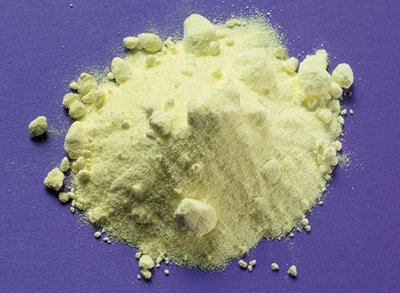
Sources of Element Names
Element names originate from various sources, including planets, mythological figures, minerals, colors, geographic locations, and famous people.
Uranium: Named after the planet Uranus.
Titanium: Named after Titans in mythology.
Chlorine: From Greek 'chloros' meaning greenish yellow.
Gold: Symbol Au from Latin 'aurum'.
Chemical Symbols and Their Usage
Chemical symbols are standardized abbreviations. If two letters are used, only the first is capitalized.
Co: Cobalt
CO: Carbon and oxygen (compound)
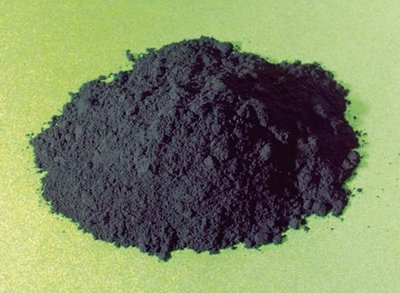
Common Elements and Their Symbols
Name | Symbol |
|---|---|
Aluminum | Al |
Carbon | C |
Iron | Fe |
Gold | Au |
Silver | Ag |
Potassium | K |
Sodium | Na |
Magnesium | Mg |
Zinc | Zn |
Health and Toxicity: Mercury
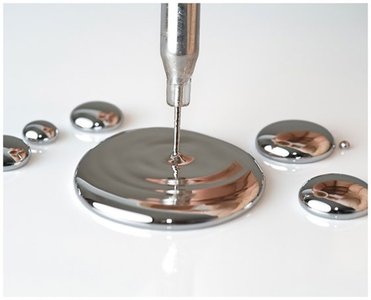
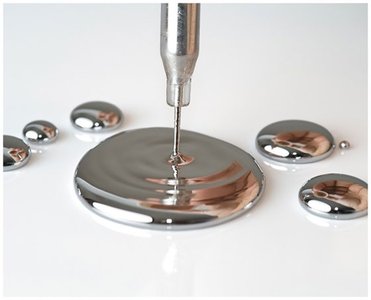
Mercury (Hg) is a liquid metal at room temperature. It is toxic and can enter the body via inhalation, skin contact, or ingestion. Mercury disrupts proteins and cell function, causing damage to the brain and kidneys.
Testing: Blood, urine, and hair samples are used to detect mercury exposure.
The Periodic Table
Structure and Organization
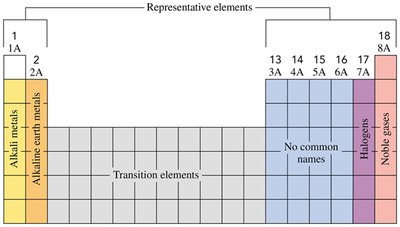
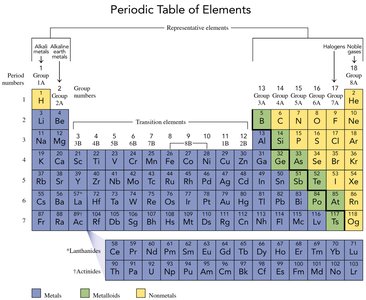
The periodic table arranges 118 elements by increasing atomic number and groups elements with similar properties.
Groups: Vertical columns (1–18 or 1A–8A for representative elements).
Periods: Horizontal rows (1–7).
Group Names and Representative Elements
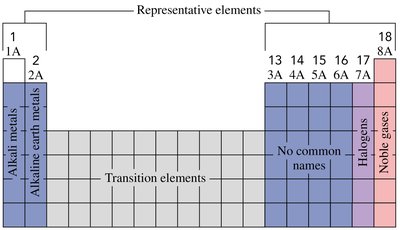
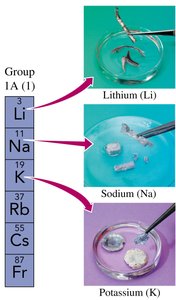
Group 1A (1): Alkali metals (Li, Na, K, Rb, Cs, Fr)
Group 2A (2): Alkaline earth metals (Be, Mg, Ca, Sr, Ba, Ra)
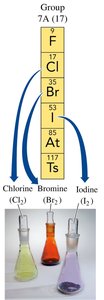
Group 7A (17): Halogens (F, Cl, Br, I, At, Ts)
Group 8A (18): Noble gases (He, Ne, Ar, Kr, Xe, Rn, Og)
Alkali Metals and Halogens
Alkali Metals: Highly reactive, soft metals (Li, Na, K).
Halogens: Reactive nonmetals (Cl2, Br2, I2).
Classification: Metals, Nonmetals, Metalloids
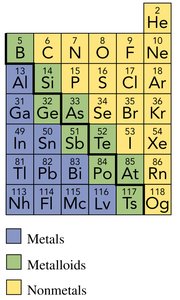
The periodic table is divided by a zigzag line:
Metals: Left of the line; shiny, ductile, malleable, good conductors.
Nonmetals: Right of the line; dull, brittle, poor conductors.
Metalloids: Along the line; properties intermediate between metals and nonmetals.
Comparison Table: Metal, Metalloid, Nonmetal
Property | Metal (Ag) | Metalloid (Sb) | Nonmetal (S) |
|---|---|---|---|
Appearance | Shiny | Blue-gray, shiny | Dull, yellow |
Ductility | Extremely ductile | Brittle | Brittle |
Malleability | Can be hammered | Shatters | Shatters |
Conductivity | Good | Poor | Poor |
Density (g/mL) | 10.5 | 6.7 | 2.1 |
Melting Point (°C) | 962 | 630 | 113 |
Elements Essential to Health
Major Elements and Macrominerals
Four elements (O, C, H, N) make up 96% of body mass. Macrominerals (Ca, P, K, Cl, S, Na, Mg) are vital for bones, teeth, heart, blood vessels, muscle contraction, nerve impulses, and metabolism. 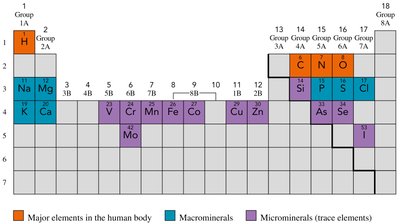
Microminerals (Trace Elements)
Trace elements (Fe, Si, Zn, Cu, Mn, I, Mo, As, Cr, Co, Se, V) are present in small amounts and are essential for various biological functions.
Iron (Fe): Component of hemoglobin.
Iodine (I): Required for thyroid function.
Zinc (Zn): Needed for DNA synthesis and immune function.
The Atom
Atomic Structure and Subatomic Particles
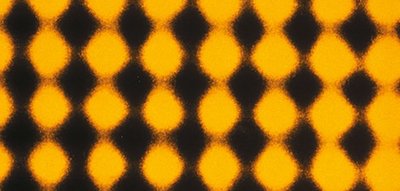
Atoms are the smallest units of elements, retaining their properties. They consist of a nucleus (protons and neutrons) and electrons in surrounding space.
Proton: Positive charge, mass ≈ 1 amu, in nucleus.
Neutron: No charge, mass ≈ 1 amu, in nucleus.
Electron: Negative charge, mass ≈ 0.00055 amu, outside nucleus.
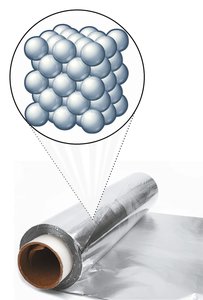
Dalton’s Atomic Theory
John Dalton proposed that all matter is made of atoms, atoms of each element are identical, compounds are formed by combinations of atoms, and chemical reactions rearrange atoms. 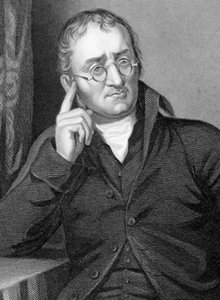
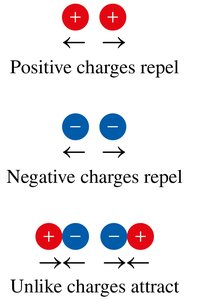
Electrical Charges in Atoms
Like charges repel; unlike charges attract.
J. J. Thomson’s Cathode Ray Experiment
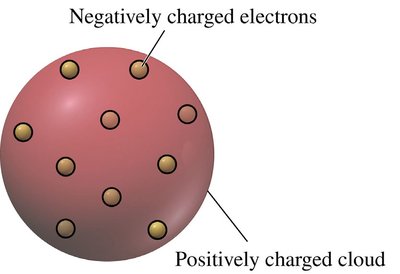
Thomson discovered electrons and proposed the "plum-pudding" model, where electrons are embedded in a positively charged cloud. 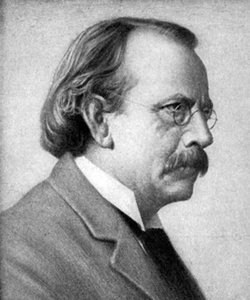
Rutherford’s Gold Foil Experiment
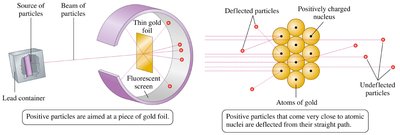
Rutherford showed that atoms have a small, dense, positively charged nucleus surrounded by electrons. 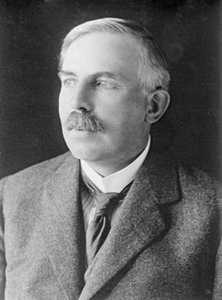
Subatomic Particle Table
Particle | Symbol | Charge | Mass (amu) | Location |
|---|---|---|---|---|
Proton | p or p+ | +1 | 1.007 | Nucleus |
Neutron | n or n0 | 0 | 1.008 | Nucleus |
Electron | e- | -1 | 0.00055 | Outside nucleus |
Atomic Number and Mass Number
Atomic Number
The atomic number is the number of protons in an atom and defines the element. It is shown above the element symbol in the periodic table.
Mass Number
The mass number is the sum of protons and neutrons in the nucleus. It applies to individual atoms, not the average atomic mass.
Number of neutrons = mass number - atomic number
Composition Table for Elements
Element | Symbol | Atomic Number | Mass Number | Protons | Neutrons | Electrons |
|---|---|---|---|---|---|---|
Hydrogen | H | 1 | 1 | 1 | 0 | 1 |
Nitrogen | N | 7 | 14 | 7 | 7 | 7 |
Oxygen | O | 8 | 16 | 8 | 8 | 8 |
Chlorine | Cl | 17 | 37 | 17 | 20 | 17 |
Iron | Fe | 26 | 58 | 26 | 32 | 26 |
Gold | Au | 79 | 197 | 79 | 118 | 79 |
Isotopes and Atomic Mass
Isotopes
Isotopes are atoms of the same element with different mass numbers due to varying numbers of neutrons.
Example: Carbon has three isotopes: C-12, C-13, C-14.
Atomic Symbol
The atomic symbol shows the mass number (upper left) and atomic number (lower left) for a specific isotope.
Atomic Mass
Atomic mass is the weighted average of all naturally occurring isotopes of an element, listed below the symbol in the periodic table.
Isotopes of Magnesium
Atomic Symbol | Name | Protons | Electrons | Mass Number | Neutrons | Mass (amu) | % Abundance |
|---|---|---|---|---|---|---|---|
2412Mg | Mg-24 | 12 | 12 | 24 | 12 | 23.99 | 78.70 |
2512Mg | Mg-25 | 12 | 12 | 25 | 13 | 24.99 | 10.13 |
2612Mg | Mg-26 | 12 | 12 | 26 | 14 | 25.98 | 11.17 |
Electron Energy Levels
Electromagnetic Radiation and Atomic Spectrum
Electromagnetic radiation includes radio waves, microwaves, visible light, and X-rays. The atomic spectrum is unique for each element and results from electron energy changes.
Electron Energy Levels
Electrons occupy specific energy levels (quantized), denoted by principal quantum numbers (n = 1, 2, 3...). Energy increases with distance from the nucleus.
Electron Arrangements for the First 20 Elements
Element | Atomic Number | Energy Level 1 | Energy Level 2 | Energy Level 3 | Energy Level 4 |
|---|---|---|---|---|---|
Hydrogen | 1 | 1 | |||
Helium | 2 | 2 | |||
Lithium | 3 | 2 | 1 | ||
Carbon | 6 | 2 | 4 | ||
Sodium | 11 | 2 | 8 | 1 | |
Potassium | 19 | 2 | 8 | 8 | 1 |
Trends in Periodic Properties
Periodic Properties
Periodic properties such as atomic size, ionization energy, and metallic character change predictably across periods and groups.
Summary Table: Periodic Trends
Property | Top to Bottom (Group) | Left to Right (Period) |
|---|---|---|
Valence Electrons | Same | Increases |
Atomic Size | Increases | Decreases |
Ionization Energy | Decreases | Increases |
Metallic Character | Increases | Decreases |
Lewis Symbols
Lewis symbols represent valence electrons as dots around the element symbol.
