 Indietro
CHE 101 – Practice Test 1 Study Guidance
Guida di studio - Note intelligenti
 Appunti personalizzati basati sui tuoi materiali, ampliati con definizioni chiave, esempi e contesto.
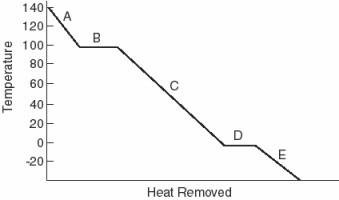
Q16–20. Identify the physical state(s) corresponding to labeled regions on the cooling curve of water shown below.
Background
Topic: States of Matter and Phase Changes
This set of questions tests your understanding of the cooling curve of water, which shows how temperature changes as heat is removed from water. Each region (A–E) represents a different phase or phase change (solid, liquid, gas, or a combination during a transition).
Key Terms and Concepts:
Cooling Curve: A graph showing temperature versus heat removed as a substance cools and changes state.
Phase Change: Flat regions on the curve where temperature remains constant as the substance changes state (e.g., melting, freezing, boiling, condensation).
Solid, Liquid, Gas: The three main physical states of matter.
Step-by-Step Guidance
Examine the cooling curve and note the temperature ranges for each region (A–E). The sloped regions represent temperature changes within a single phase, while the flat regions represent phase changes.
Recall the typical phase change temperatures for water: 0°C (freezing/melting point) and 100°C (boiling/condensation point).
Identify which regions are sloped (temperature changing) and which are flat (phase change occurring). For example, a flat region at 0°C indicates freezing/melting, and at 100°C indicates boiling/condensation.
Assign the physical state(s) to each region based on whether the temperature is changing (single phase) or constant (phase change, so two phases coexist).
For each region, match it to the correct state(s): solid, liquid, gas, or a combination (liquid/solid or liquid/gas).
Try solving on your own before revealing the answer!
Final Answers:
16. Region A: E. liquid and gas (condensation/boiling at 100°C)
17. Region B: F. gas (cooling steam above 100°C)
18. Region C: A. liquid (cooling liquid water between 100°C and 0°C)
19. Region D: D. liquid and solid (freezing/melting at 0°C)
20. Region E: C. solid (cooling ice below 0°C)
Each region corresponds to a different phase or phase change as water cools from steam to ice. The flat regions (A and D) represent phase changes where two states coexist, while the sloped regions (B, C, E) represent single phases.
