 Indietro
Chemical Equilibrium: Principles, Calculations, and Applications
Guida di studio - Note intelligenti
 Appunti personalizzati basati sui tuoi materiali, ampliati con definizioni chiave, esempi e contesto.
Chemical Equilibrium
The Concept of Equilibrium
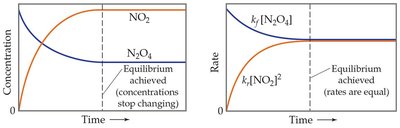
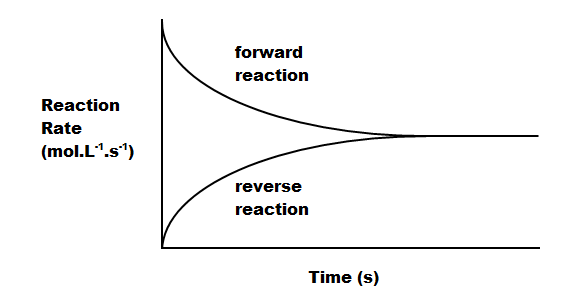
Chemical equilibrium is a fundamental concept in chemistry describing the state in which the rates of the forward and reverse reactions are equal, resulting in constant concentrations of reactants and products. This dynamic state is characteristic of reversible reactions, which are indicated by the double arrow (⇌).
Dynamic Equilibrium: Both forward and reverse reactions continue to occur, but there is no net change in the concentrations of reactants and products.
Reversible Reactions: In theory, all reactions are reversible, but some reverse reactions are so slow they are considered irreversible.
Constant Concentrations: At equilibrium, the amount of each substance remains unchanged over time.
Closed System: Equilibrium can only be established in a closed system where neither reactants nor products can escape.
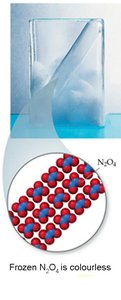
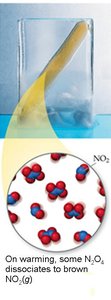
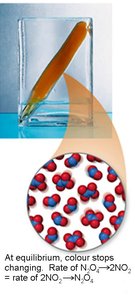
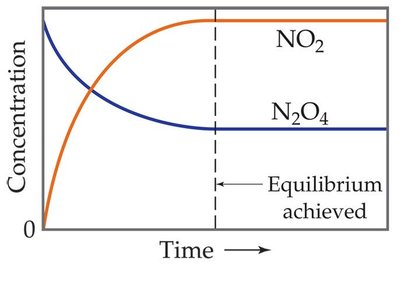
Dynamic Equilibrium
At equilibrium, the system is dynamic: products are formed at the same rate as reactants are consumed, and vice versa. The ratio of the concentrations of products to reactants remains constant.
Rate Equality: The rate of the forward reaction equals the rate of the reverse reaction.
Constant Ratio: The ratio of concentrations of products to reactants is constant at equilibrium.
The Equilibrium Constant
Defining the Equilibrium Constant (Kc)
The equilibrium constant, Kc, quantifies the ratio of the concentrations of products to reactants at equilibrium, each raised to the power of their stoichiometric coefficients.
General Expression: For a reaction aA + bB ⇌ cC + dD, the equilibrium constant is:
Unitless: Kc is typically unitless because concentrations are compared relative to a standard state.
Magnitude: If K > 1, products are favored; if K < 1, reactants are favored; if K ≈ 1, appreciable amounts of both are present.
Temperature Dependence: K changes with temperature.
Equilibrium Constants in Terms of Pressure (Kp)
For gaseous reactions, equilibrium can also be expressed in terms of partial pressures:
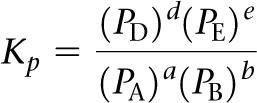
Relationship to Kc: and are related by the equation:
where is the change in moles of gas (moles of gaseous products minus moles of gaseous reactants), R is the gas constant, and T is temperature in Kelvin.
Writing Equilibrium Expressions
To write an equilibrium expression, use the balanced chemical equation and raise each concentration or pressure to the power of its coefficient.
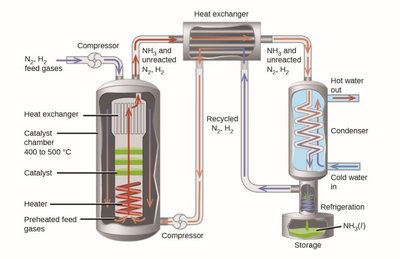
Example: For 3H2(g) + N2(g) ⇌ 2NH3(g):
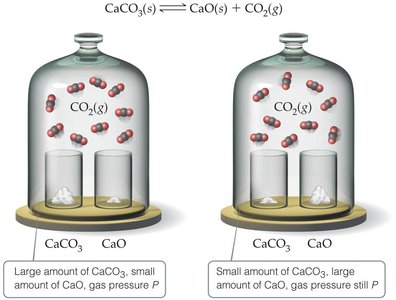
Heterogeneous Equilibria: Pure solids and liquids are omitted from the equilibrium expression; their activity is considered to be 1.
Calculating Equilibrium Constants
Steps for Calculation
To determine the equilibrium constant from experimental data:
Tabulate all known initial and equilibrium concentrations.
Calculate the change in concentration for each species.
Use stoichiometry to relate changes among all reactants and products.
Calculate equilibrium concentrations.
Substitute equilibrium concentrations into the equilibrium expression to solve for Kc.
Reaction Quotient (Q) and Predicting Direction
Reaction Quotient (Q)
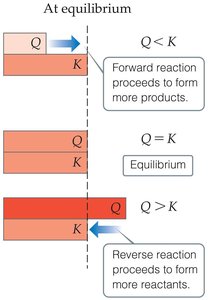
The reaction quotient, Q, is calculated using the same expression as K, but with current (not necessarily equilibrium) concentrations. Comparing Q to K predicts the direction the reaction will proceed to reach equilibrium.
If Q < K: The reaction proceeds forward (toward products).
If Q = K: The system is at equilibrium.
If Q > K: The reaction proceeds in reverse (toward reactants).
Le Châtelier’s Principle
Principle and Applications
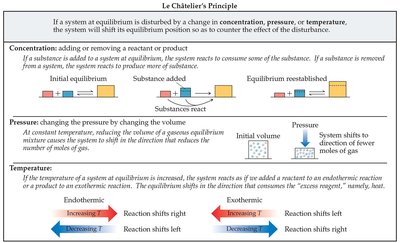
Le Châtelier’s Principle states that if a system at equilibrium is disturbed by a change in concentration, pressure, or temperature, the system will shift its equilibrium position to counteract the disturbance and re-establish equilibrium.
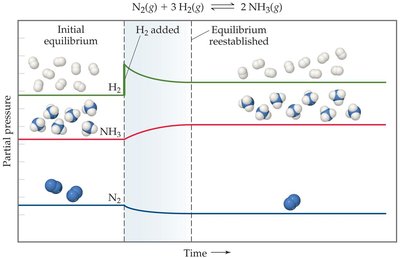
Change in Concentration: Adding a reactant or product shifts equilibrium to consume the added substance; removing shifts to produce more.
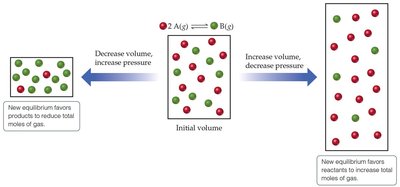
Change in Pressure/Volume: For gaseous equilibria, increasing pressure (decreasing volume) shifts equilibrium toward the side with fewer moles of gas, and vice versa.
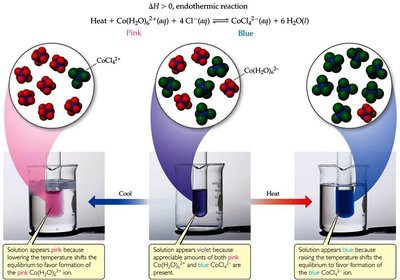
Change in Temperature: For exothermic reactions, increasing temperature shifts equilibrium toward reactants; for endothermic, toward products.
Catalysts: Catalysts speed up the attainment of equilibrium but do not affect the equilibrium position or composition.
Summary of Key Learning Outcomes
Explain the concept of chemical equilibrium and dynamic equilibrium.
Write and interpret equilibrium constant expressions for homogeneous and heterogeneous systems.
Calculate equilibrium constants and equilibrium concentrations from experimental data.
Apply Le Châtelier’s Principle to predict the effects of changes in concentration, pressure, temperature, and catalysts on equilibrium systems.
