 Indietro
Chemical Kinetics: Factors Affecting Reaction Rates and Mechanisms
Guida di studio - Note intelligenti
 Appunti personalizzati basati sui tuoi materiali, ampliati con definizioni chiave, esempi e contesto.
Chemical Kinetics
Introduction to Kinetics
Chemical kinetics is the study of the speed at which chemical reactions occur and the mechanisms by which they proceed. Understanding kinetics allows chemists to control reaction rates and optimize conditions for desired outcomes.
Kinetics provides insight into reaction mechanisms and molecular-level interactions.
Four main factors affect reaction rates: physical state, concentration, temperature, and catalysts.
Goal: To understand chemical reactions at the molecular level.
Factors Affecting Reaction Rates
Physical State of Reactants
The physical state of reactants influences how easily molecules can interact. Reactions occur faster when reactants are in the same phase and well mixed.
Homogeneous mixtures allow molecules to collide more frequently, increasing reaction rate.
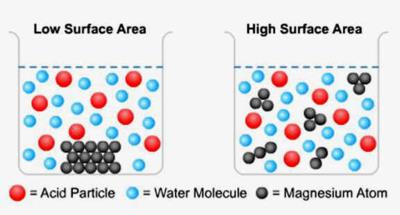
Surface area is crucial: powders react faster than solids due to greater exposure.
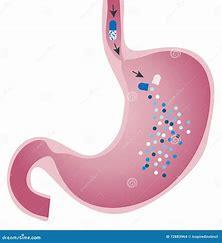
Example: Powdered medicine dissolves and enters the bloodstream faster than tablets.
Concentration of Reactants
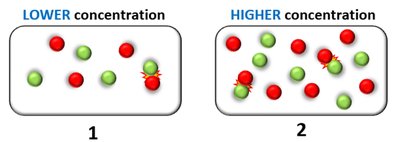
Increasing the concentration of reactants raises the frequency of molecular collisions, thus increasing the reaction rate.
Higher concentration means more reactant molecules per unit volume, leading to more collisions.
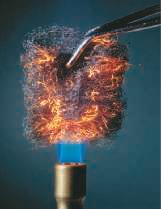
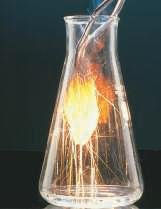
Example: Steel wool burns more vigorously in pure oxygen than in air due to higher O2 concentration.
Temperature
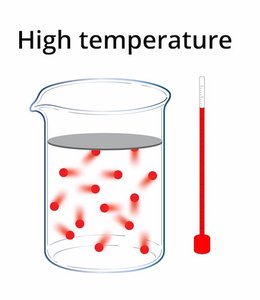
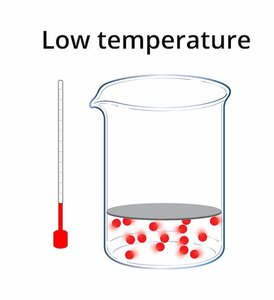
Temperature affects the kinetic energy of molecules. Higher temperatures increase both the frequency and energy of collisions, leading to faster reactions.
At higher temperatures, molecules move faster and collide more energetically.
Example: Food spoils faster at room temperature than in a refrigerator.
Catalysts
Catalysts speed up reactions by providing an alternative pathway with lower activation energy. They are not consumed in the reaction and play crucial roles in biological and industrial processes.
Catalysts change the reaction mechanism, increasing rate without being consumed.
Example: ATP synthase is an enzyme catalyst in cells.
Reaction Rates
Measuring Reaction Rates
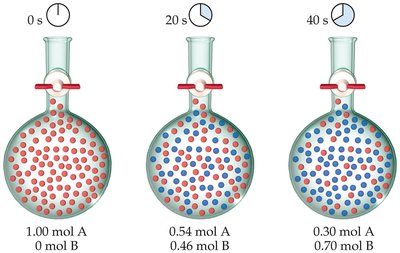
The rate of a reaction is determined by monitoring the change in concentration of reactants or products over time.
For a reaction A → B:
Rates can be measured by the appearance of products or disappearance of reactants.
Units: mol/L·s (M/s).
Instantaneous vs. Average Rate
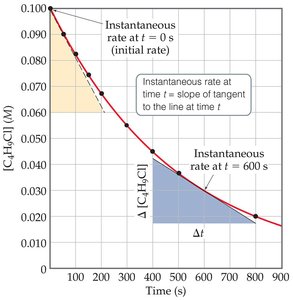
Reaction rates decrease over time as reactant concentration drops. The instantaneous rate is the slope of the tangent to the concentration vs. time curve at a specific moment.
Instantaneous rate: Rate at a specific time, usually at the start (initial rate).
Average rate: Rate over a time interval.
 9
9
Stoichiometry and Reaction Rates
Reaction rates are related to stoichiometry. For reactions with different ratios, rates are adjusted accordingly.
Example: For 2 HI → H2 + I2, rate is:
General form:
The Rate Law
Effect of Concentration
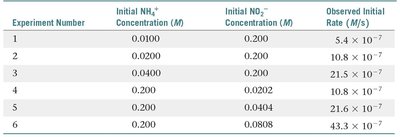
The rate law expresses the relationship between reaction rate and reactant concentrations. The exponents (orders) must be determined experimentally.
General form:
Overall order = m + n + ...
Zero order: Rate does not depend on concentration.
First order: Doubling concentration doubles rate.
Second order: Doubling concentration quadruples rate.
Determining Rate Law and Rate Constant
Initial rates are used to determine the rate law and rate constant. The units of the rate constant depend on the overall order.
Units of rate: M·s-1
Units of k: depend on reaction order
Example: For first order, units of k are s-1; for second order, M-1·s-1.
Change of Concentration with Time
First-Order Reactions
First-order reactions depend on the concentration of one reactant raised to the first power. The integrated rate law allows calculation of concentration at any time.
Differential rate law:
Integrated rate law:
Plotting ln[A] vs. t yields a straight line with slope -k.

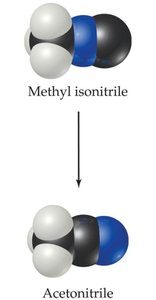
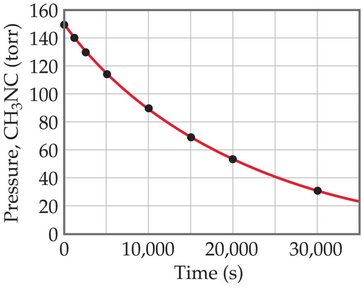
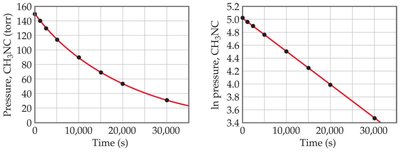
Second-Order Reactions
Second-order reactions depend on the concentration of one reactant squared or two reactants. The integrated rate law is different from first-order.
Differential rate law:
Integrated rate law:
Half-Life
Half-life is the time required for half of a reactant to be consumed. For first-order reactions, half-life is independent of initial concentration.
First-order half-life:
Second-order half-life:
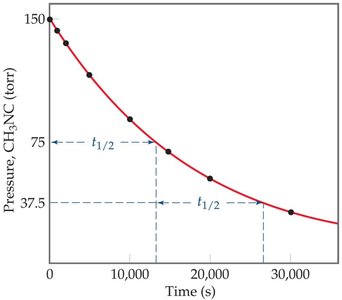
Temperature and Reaction Rate
Effect of Temperature
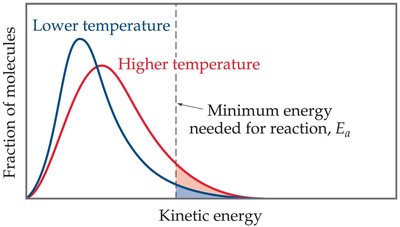
Reaction rates increase with temperature due to higher kinetic energy and more frequent collisions. The rate constant k depends on temperature.
Example: Light sticks glow brighter at higher temperatures.
As temperature increases, more molecules have energy to overcome activation energy.
The Collision Model
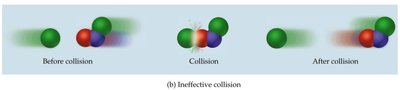
Reactions occur when molecules collide with proper orientation and sufficient energy. Not all collisions result in reaction.
Effective collisions require correct orientation and energy.
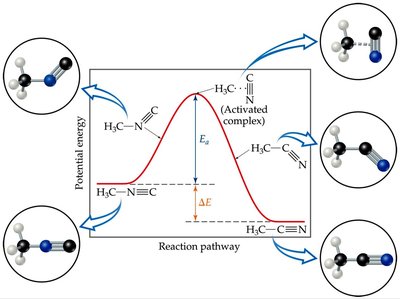
Activation energy (Ea) is the minimum energy needed for reaction.

Activation Energy and Reaction Coordinate
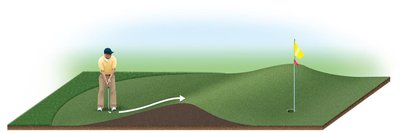
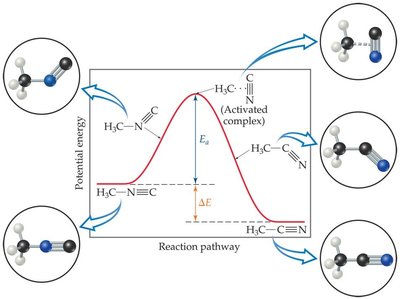
Activation energy is the energy barrier that must be overcome for a reaction to proceed. The reaction coordinate diagram illustrates energy changes during a reaction.
Activated complex (transition state) is the highest energy point.
Exothermic reactions release energy; endothermic reactions absorb energy.
Arrhenius Equation
The Arrhenius equation relates the rate constant to temperature and activation energy.
Arrhenius equation:
Linear form:
Fraction of molecules with energy ≥ Ea:
Reaction Mechanisms
Elementary Reactions and Molecularity
Reaction mechanisms describe the sequence of steps by which reactants become products. Each step is an elementary reaction with a defined molecularity.
Unimolecular: One molecule involved (first order).
Bimolecular: Two molecules involved (second order).
Termolecular: Three molecules involved (rare, third order).
Multistep Mechanisms and Intermediates
Many reactions proceed via multiple steps. Intermediates are species formed in one step and consumed in another.
Overall reaction is the sum of elementary steps.
Intermediates do not appear in the overall equation.
Rate-Determining Step
The slowest step in a multistep mechanism determines the overall reaction rate.
Rate-determining step governs the rate law for the overall reaction.
Catalysts
Homogeneous and Heterogeneous Catalysis
Catalysts lower activation energy and increase reaction rate. Homogeneous catalysts are in the same phase as reactants; heterogeneous catalysts are in a different phase.
Homogeneous example: Bromide ion catalyzes hydrogen peroxide decomposition.
Heterogeneous example: Metal catalysts (Ni, Pt, Pd) speed up hydrogenation of ethylene.
Enzymes
Enzymes are biological catalysts with highly specific active sites. Substrates fit into the active site like a key in a lock, enabling fast and specific reactions.
Enzyme inhibitors block the active site, preventing catalysis.
Turnover number: Number of reactions catalyzed per second (high for enzymes).
Summary Table: Factors Affecting Reaction Rate
Factor | Effect on Rate | Example |
|---|---|---|
Physical State | Homogeneous mixtures react faster | Powdered medicine vs. tablet |
Concentration | Higher concentration increases rate | Steel wool in pure O2 |
Temperature | Higher temperature increases rate | Food spoiling faster at room temp |
Catalyst | Lowers activation energy, increases rate | ATP synthase, metal catalysts |
Key Equations
Average rate:
Rate law:
First-order integrated rate law:
Second-order integrated rate law:
First-order half-life:
Arrhenius equation:
Conclusion
Chemical kinetics is essential for understanding and controlling reaction rates in both laboratory and real-world settings. By manipulating factors such as concentration, temperature, and catalysts, chemists can optimize reactions for desired outcomes.
