 Indietro
Chemical Reactions: Stoichiometry, Redox, Thermodynamics, Kinetics, and Equilibrium
Guida di studio - Note intelligenti
 Appunti personalizzati basati sui tuoi materiali, ampliati con definizioni chiave, esempi e contesto.
Chemical Equations and Stoichiometry
Law of Conservation of Matter
The law of conservation of matter states that atoms are neither created nor destroyed in a chemical reaction. This means the number of each type of atom must be the same on both sides of a chemical equation. Chemical equations are balanced using coefficients, not by changing subscripts.
Reactants: Substances that undergo a chemical change.
Products: Substances formed as a result of the reaction.
Example:
The Mole and Avogadro's Number
A mole (mol) is a counting unit in chemistry, representing particles (Avogadro's number). This allows chemists to relate atomic scale quantities to macroscopic amounts.
1 mole of any element or compound contains the same number of particles, but different masses.
Example: 1 mol Cu = 63.55 g, 1 mol Pb = 207.2 g, 1 mol NaCl = 58.4 g
Stoichiometry
Stoichiometry uses the coefficients in balanced chemical equations to determine the ratios in which substances react and are produced. These ratios can be used to calculate the amounts of reactants or products in moles.
Example:
Stoichiometric ratios: , , etc.
Conservation of mass is demonstrated by the fact that the total mass of reactants equals the total mass of products in a balanced equation.
Redox Reactions
Oxidation and Reduction
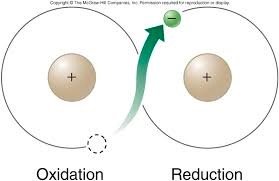
Redox reactions involve the transfer of electrons between substances. Oxidation is the loss of electrons (increase in oxidation number), while reduction is the gain of electrons (decrease in oxidation number).
Mnemonic: LEO says GER (Lose Electrons Oxidation, Gain Electrons Reduction)
Mnemonic: OIL RIG (Oxidation Is Loss, Reduction Is Gain)
Oxidation Numbers
Oxidation numbers are assigned to atoms to keep track of electron transfer in reactions. The sum of oxidation numbers in a compound equals the overall charge.
Uncombined elements: 0
Monatomic ions: equal to their charge
Group IA: +1, Group IIA: +2, H: +1, O: -2 (except peroxides)
Example: In , C = +4, O = -2
Redox Agents
Oxidizing agent (oxidant): Causes oxidation, is itself reduced.
Reducing agent (reductant): Causes reduction, is itself oxidized.
Enthalpy of Reactions
Enthalpy ()
Enthalpy is the thermal energy released or absorbed during a reaction, measured per mole. The sign of indicates whether the reaction is exothermic or endothermic.
Exothermic: Releases heat, is negative.
Endothermic: Absorbs heat, is positive.
Equation:
Energy in Food
Combustion of food molecules releases energy, measured in kilocalories (kcal). Carbohydrates and proteins provide about 4 kcal/g, fats about 9 kcal/g.
Spontaneity and Thermodynamics
Free Energy ()
Free energy determines whether a reaction is spontaneous. A negative means the reaction is spontaneous (exergonic), while a positive $\Delta G$ means it is non-spontaneous (endergonic).
Equation:
= enthalpy, = temperature (K), = entropy
Entropy ()
Entropy is a measure of disorder. Processes that increase disorder (e.g., solid to liquid to gas) have positive .
Increasing temperature increases entropy.
More molecules or simpler molecules in products increases entropy.
Coupled Reactions
Endergonic reactions can be driven by coupling them to exergonic reactions, so the overall process is exergonic.
Reaction Kinetics
Activation Energy
Activation energy (Eact) is the minimum energy required for a reaction to occur. The rate of a reaction depends on the size of the activation barrier.
Higher activation energy = slower reaction
Lower activation energy = faster reaction
Factors Affecting Reaction Rate
Temperature: Higher temperature increases rate.
Concentration: Higher concentration increases rate.
Catalyst: Lowers activation energy, increases rate, but is not consumed.
Inhibitor: Slows down reaction rate.
Chemical Equilibrium
Equilibrium and Reversible Reactions
Chemical equilibrium occurs when the rate of the forward reaction equals the rate of the reverse reaction. The concentrations of reactants and products remain constant, but are not necessarily equal.
Reversible reactions can proceed in both directions.
Equilibrium Constant ()
The equilibrium constant () is the ratio of product concentrations to reactant concentrations at equilibrium.
: Products favored ("lies to the right")
: Reactants favored ("lies to the left")
Only (g) and (aq) species are included in
Relationship to free energy: Exergonic reactions () have ; endergonic reactions () have .
Le Châtelier’s Principle
When a system at equilibrium is disturbed (by changing concentration, temperature, or pressure), the system shifts to counteract the disturbance and re-establish equilibrium.
Adding reactant or removing product shifts equilibrium to the right (forward reaction).
Adding product or removing reactant shifts equilibrium to the left (reverse reaction).
Increasing temperature shifts equilibrium away from the side with heat (exothermic vs. endothermic reactions).
Catalysts do not change the position of equilibrium; they only help the system reach equilibrium faster.
